Showing posts with label respect. Show all posts

Saturday, 22 August 2026

Essential Snobbery 101: The Slow Death of Proper Address

A Stringent Beginning

It was almost a decade ago when I underwent a stringent vetting process with all the officialdom that extracted more information from me than I would willingly have volunteered. This process was supervised by a department within the organisation to which I was contracted to offer professional services.

When the process was completed, I received a notice from a member of staff confirming that I had passed all the requirements. It began with "Hi!" Just "Hi", without a name, stripped of all formality, dignity, and function, as though we shared the familiarity born of mutual friendship going back decades, rather than mere acquaintance.

I was reeling and altogether taken aback; this could not seriously have come from within the company with which I held a formal contractual engagement.

Insult and Injury

To add insult to injury, the person who signed off the message bore names suggesting a common Nigerian heritage, where the expectation is that a modicum of formality should greet those with whom you have never interacted before. Only after you have introduced yourself and established communication through a cordial response and acknowledgement should informality be considered.

This was analogous to an ingénue who had abandoned the sophistication of speech for grunts and howls.

From that day, I wanted nothing to do with that individual, and I made a point of expressing my displeasure at such an approach to their manager. My own manager attempted to apologise on her behalf, then suggested that we might have become old-fashioned.

Manners Never Age

Maybe we were; but good manners, in my view, can never be old-fashioned. They should always be fashionable and properly taught. Comportment, decorum, respectful address, honour, regard, and etiquette make the person and exude character.

I have worked in places where informality is the culture, yet I would still address you by name, and with deference, because I was brought up that way, and what you give out comes back to you in spades.

The Order of Greetings

Whilst I have spent four decades in the corporate world, any first contact with a person would always come with a greeting for the time of day: good morning, good afternoon, or good evening. Good night is usually goodbye.

Then comes the person's name, which might be preceded by a standard, academic, religious, military, royal, or political title. Professions deployed as titles, apart from "Dr" for medical doctors, are an exercise in pompous superfluity and self-aggrandisement.

At other times, it is "Dear" and the person's name. "Hello" is for friends. Then I close my messages properly, with a variation of "regards" and my name. In speech, it is formally the greeting for the time of day; I introduce myself with purpose if required, or await a response with names and preferences.

Pronouns and Coherence

On the new trend of pronouns, especially those that challenge the natural flow of the English grammar I learnt from well-appointed schooling, I would rather use a name than defeat the ends of coherence and adherence.

Good and traditional forms of address will always establish the standard of communication and the protocols of language. If someone is too well-spoken to use expletives in any way, it is unlikely others would deploy them when speaking to you; or at least they are guarded, and moderate their language with apologies for any unfortunate slips of the tongue.

The Art of Subtlety

Maybe, indeed, I am old-fashioned. I would rather be that than uncouth and uncultured. From my youth, my mode of address has earned me consideration, respect, and a hearing. Yet if I am overly formal in beginning a message with "Dear Mr Jones", when we have always been on first-name terms, you need not read any further to know that this is an expression of great displeasure.

Subtlety and discretion; the polite turn of expression that, on first reading, seems complimentary, until some thought is put to it. It is the way of the English, an art of communication lost to many for whom a good education might have been a luxury. It is not their fault.

Friday, 3 July 2026

Thick Skin and the Colour of Pain

A Familiar Ethnicity Pain Gap

It comes as no surprise to me to read that in the UK, women from Bangladeshi, Pakistani, and black Caribbean backgrounds were less likely than white women to receive an epidural whilst having a vaginal birth. [The Guardian: “Women from minority backgrounds in UK less likely to receive epidurals, research finds”]

The ideas, conceptions, perceptions, or prejudices that feed the narrative that non-white people, especially from the aforementioned backgrounds, do not need adequate pain medication to arrest high levels of discomfort and distress have appeared in studies for decades.

This situation, termed the "ethnicity pain gap", is quite concerning, and it might persuade one to surmise that there is a seething racialised disadvantage in the public health system, one that ascribes thick skin to the Black population and precious delicateness to the Asian cohort.

My Own Experience

My experience of this in late 2009 came as a result of cancer pain in its enduring intensity. I was on multiple regimens of pain medication, with Fentanyl dispensed as a transdermal patch being the most critical palliative, yet I was in pain.

When I informed my consultant that I was still in pain, and this was in the Netherlands rather than in the United Kingdom, he did not acknowledge my distress or seek to address it. Instead, his response was that the pain medication I was on should be enough. An ill-informed perception that I should have a higher pain threshold.

I remonstrated that it was not, and he then sought to double the dose from 12.5 micrograms to 25 micrograms. This made all the difference because it tackled the pain, and I got much-needed relief. Why I was not also told that transdermal patches could fall off, and that they could be held in place on the skin with an adhesive film, escapes me.

Knowledge Withheld

Returning from church, one Sunday, a few weeks after I had the new prescription, I was in a lot more pain than usual, and then I saw that the patch had fallen off.

I laughed myself to delirium to produce endorphins as pain relief whilst the new patch took hold. It was only when I told the nurse who came to dress the lesions on my foot daily that he told me I could get an adhesive film to keep the patch in place.

The knowledge was there all along, but it was never shared. As a race, in our encounters with the medical establishment, we are constantly pathologised, and this is characterised by either not being listened to or being ignored, because the medical personnel assume they know and understand our bodies more than we do with the intimate experience of our own skins.

Asserting Our Reality

That Caucasians are immediately responded to and given palliative succour on demand speaks volumes, without suggesting something untoward. Whether it is bias, prejudice, or indifference, we need to be better equipped to ask pertinent questions and persuade our doctors of our reality, without having to jump through hoops, trapped in suffering until it becomes unbearable.

It is not just in matters of pain, but in decisions being made about diagnostic and treatment regimes without explanation or rationale, delay in action when the full knowledge of a condition is evident, the lack of respect, courtesy, and the according of dignity to your personhood and humanity, or the use of the wrong indicators based on race for decision trees towards useful outcomes.

I approach the medical establishment on the premise of “It is my body first, before it is your guinea pig.” This need never be the default, because you are then preparing for a fight instead of fully trusting someone who took the Hippocratic Oath to do you no harm. Yet you find you need to assert yourself and manage the egos to ensure that you, at the very least, leave the hospital better than when you went in.

A Google NotebookLM AI Podcast on this blog

Friday, 26 June 2026

Thought Picnic: Meeting Your Estranged Children Where They Are

Adapting to a Changing World

I am constantly told that I need to make allowances for the older generation because they are set in their ways. This might be true, but the world is always changing around us, and thriving in any community requires steady, sometimes sudden, adaptations if we are to relate to people, events, ideas, and circumstances.

Whilst reading an article on LinkedIn titled “Meeting Your Resistant Children Where They Are”, I immediately realised that it seemed to address only one part of the wider issue of relationships. The article focused more on divorced parents and their apparently adolescent children, and I appreciate that the writer's area of expertise is divorce and parenting.

If I were to extrapolate, however, the issue extends well beyond divorce, which is merely one of the elements contributing to the breakdown of relationships, just as resistance is only one facet of parent-child estrangement.

The Generational Cycle

It is interesting to observe how we all move through the generational phases of life, beginning as children with parents, grandparents, and great-grandparents, and then transitioning through these phases as those who came before us begin to drop off, in that natural cycle of life.

How we relate to those before us sometimes follows an established code of community, reverence, and respect. What rarely finds adequate scrutiny is the need to adapt for those who come after us.

For instance, when does a parent begin to see their child as an adult, one to be treated with some acknowledgement and, I dare say, respect for their autonomy, independence, initiative, and decision-making?

A Personal Reflection

Then again, this topic is probably too broad to be addressed in a blog, or from an amateur's background, even with the lived experience that might cloud one's judgement. My parents were never divorced; rather, with the palpable tension, the middle-aged theatrics, and the passage of time, they grew apart.

It might have been better had they gone their separate ways a long time ago, rather than being hemmed in by middle-class values until their cohabitation became untenable. Each kept their own record of what the other might or might not have done, and we, the children, were corralled into narratives that expected us to take sides; in the main, we tended to remain neutral.

However, to bring this conversation back on course, there is where my parents expect me to be, where they see me, and where I actually am. These are entirely different places. Whether I am a child, an adult, pliant, or recalcitrant, I can only wonder whether I am all of these at the same time. The fact that I have never been a parent might inform other perspectives.

Naming the Thing

Still, there is a name for the thing I am circling, and I only came upon it recently: relational maturity. It is not the same as being agreeable, nor the same as being patient, though it borrows freely from both. It is, rather, the capacity to meet another person where they actually stand, without insisting they first travel to where we happen to be waiting for them. I had felt its absence for a lifetime without ever knowing what to call it.

The question that follows is not a comfortable one: who is obliged to do the adjusting? Tradition has a ready answer, that the younger defers to the older and the child to the parent, and like most tidy arrangements, it survives chiefly because it serves the people who designed it.

Relational maturity refuses this one-way traffic. It accepts that adjustment must flow in both directions, that the parent who demands reverence might first ask whether they have offered acknowledgement. I say this as a sexagenarian, mind you, and not as a young firebrand with a grievance, for I am now of the very generation that is customarily granted the latitude I am here declining to claim.

There is a temptation to mistake all this for weakness, as though meeting people where they are were merely a polite word for capitulation. It is nothing of the sort. The mature party is not the one who folds; it is the one who can hold their own position firmly whilst still granting the other their dignity and their difference. Anyone can be tolerant of those who already agree with them; the test arrives with the person who does not.

And yet relational maturity is not infinite. There comes a point where meeting someone where they are reveals only that they have no intention of moving, and no interest in your moving either. At that juncture, the mature response is not to keep travelling toward a meeting that will never take place, but to disengage calmly and without rancour, which is itself a form of maturity.

Snipping the Cord

Certain interactions have rubbed me up the wrong way, and my reaction has usually been to disengage. People, and this goes beyond parents to siblings, relations, friends, and others you encounter throughout life, seem to forget that, regardless of what they assume ties you together, you can snip the cord and walk away, unbound, unfettered, and unconcerned.

The way you address and talk to people, their slight and unfortunate expressions of indifference, and the use of words that fail to give credence to the multifaceted nature of a person, or that fail to acknowledge the changes we see in ourselves and in others, can alter things so radically as to put them beyond redemption.

Tradition Versus Individuality

Tradition might dictate one thing, but personalities are individual and unique; they may not conform to any prescribed norms and may fall entirely outside our common frames of reference.

The question, then, becomes whether you are ready to shift your position, find common ground, seek resolution, and even accept that you were wrong, despite your ways being set in reinforced concrete.

The Cost of Indifference

I remember conversations and interactions that informed my decision to withdraw fellowship from certain people. You may not realise you have done something wrong, albeit inadvertently, but whoever is doing the kicking is rarely the one doing the hurting.

There might be another way to work through this, yet I am only human, and there is a dignity in that which demands the courtesy of others, regardless of the ties.

Restrict this ever-constant need to adapt our relationships, the need that keeps conversation thriving and engaged, all in the name of conserving what we think we hold dear, and the consequences will be exactly where we find ourselves, whether we are involved or not.

Honour and Provocation

Parents tend to think of estranged children as personifications of the Prodigal Son. Yet we, the children, eventually begin to see our parents with all their flaws, and for all the care and responsibility that went into their parenting, they were never in the class of God; they were simply human. Where the holy book says, “honour your father and mother”, it also says, “do not provoke your children unto wrath”.

Someone really ought to write an academic study on “Meeting Your Estranged Children Where They Are”.

A Google NotebookLM AI Podcast on this blog

Wednesday, 17 June 2026

Essential Snobbery 101: The Etiquette of Getting Caught

The Art of Discretion

If one were to court controversy, one could say that infidelity is congenital or consanguineous, but rarely learnt or taught. The debate around that is for another forum.

However, the tendency to stray must surely come with the essential common sense of, first and foremost, not rubbing your partner's nose in it. This means according those liaisons the respect of keeping them at a distance, and being as discreet as you possibly can in order to avoid getting caught.

History, as I have read it, would suggest that the Victorians and Edwardians who kept mistresses made sure their spouses were not disadvantaged in dignity, position, attention, or latitude. It was usually a case of knowing without feeling threatened.

A Cautionary Commotion

What I cannot abide are those who break the rules in wholly unforgivable ways, such as placing their matrimonial bed at the very centre of the travesty whilst hoping not to get caught. What on earth are you thinking? The follow-up question is unprintable.

I was once privy to a narrative relayed to me of a commotion that brought the police to a home, the cacophony having included the shattering of glass, and whatever else might have been flung, in both words and objects, when a hapless fool was caught in the act.

His wife had gone away and was not expected back until the weekend; she returned the previous night, however, only to find her husband canoodling with another woman. There is no need for a graphic replay, at the risk of sensationalising the matter with the aplomb of a village rag.

A Failure to Plan

There must be a reason why she did not telephone ahead to forestall what might have been her suspicions of something untoward. Some people spare themselves the possibility of such situations by making allowances, in the spirit of "out of sight is out of trouble".

He, however, in his careless and carefree manner, played the oily mouse whilst the cat was away. He should have planned his rendezvous for a motel, or somewhere far from home, yet he did not.

Stepping back to view this from an objective angle, the effrontery and audacity required to bring someone else home should always have come with the forward planning of a number of things. First, an alert system that detects proximity, so as to avoid an encounter. Then, easy sequestration, should your spouse enter the house when there is no chance of escape.

Hiding the Evidence

You cannot put the interloper on the window ledge outside if you are on the tenth floor, especially if that was not intended as a final goodbye. Slipping them under the bed, behind the curtain, or into the wardrobe are far too common as places to hide, and so to be found. Just roll a bottle under the bed; if it does not come out the other end, take a look.

Someone suggested the oven or the fridge, which left me thinking of the double-jointed contortionist who performs at the Victoria & Alfred Waterfront in Cape Town, doing such unimaginable things with his body that the spectacle is too suggestive for a polite audience, and yet impossible to look away from.

Perhaps the clothes basket could help, and what you would need next is a snake charmer to play the pungi as your quarry wriggles to the swaying hypnotism of the sound, lifting the lid of the basket and unleashing the scandal that would ensue. You may not be prepared for the confessions.

If you do not have a number of well-planned escape routes, no amount of explaining would extricate you from a complex situation that would serve as entertainment for your neighbours, and inspiration for this very piece. You got caught, pants down, and the only thing you might ever salvage is your dear life, by the skin of your teeth.

A Google NotebookLM AI Podcast on this blog

Thursday, 11 June 2026

Memento Mori in the Modern Workplace

The Two-Headed Fear

I usually say that I am only scared of a person with two heads, and thankfully, I have never met one. Yet in my working life, I have had many encounters with colleagues, juniors, seniors, and C-suite personnel.

In the main, they have been nice, respectful, considerate, and courteous. It is the workplace that brought us together; our backgrounds can be radically different, just as our outlooks on the world might never be the same. If we are human, humane, and accommodating of each other, it makes for a pleasant working environment.

Frustration Is No Excuse

There have been exceptions, people who think their positions give them room to misbehave and be discourteous. Usually, they get away with it, and the behaviour becomes compounded and accepted by many. Once, I was offering support to a caller at work when he began hurling expletives out of frustration.

We all get frustrated, but frustration is no excuse for abuse. I calmly told him that I did not get paid enough to take abuse at work, and informed him that I was going to put the phone down.

When he was ready to discuss the matter calmly, he could call me again. We ended that conversation, and a few minutes later, he called back, apologised, and I resolved the matter.

The Gracious Senior VP

On another occasion, a deployment for which I had provided statistics showing a high success rate just happened to brick the Senior VP’s device. His secretary was implacable, and other senior staff were running around like headless chickens. I was instructed to call the SVP to explain my actions.

I had never met him before, but he immediately acknowledged me, then said he had seen the statistics and understood that, on occasion, something might fail; it just happened to be his device. He closed with, “Take your time, I appreciate what you do.”

There have probably been other technical personnel elsewhere, in the very same position, marched out of the office simply because the screen on a manager’s computer flickered.

Things can be that brutal. I learnt early in my career that keeping users honestly informed reaped more dividends than leaving them ignorant of what might affect what they do or how they work. To inform is to liberate.

The Master of the Universe

Bring in the esteemed fellow, the one to whom no one says no. He has the ear of the CEO, and anything he says is gospel and unquestioned. To have attained that status is commendable; but unlike the generals of ancient times, who at their victory parades had a man whisper memento mori into the ear of the celebrant, this master of the universe, for all that they have achieved, yet so lacking in character, thinks they own the world and that everyone answers to them.

They seek exemption and exception in the demands they make. Aggression and coarseness are their raison d'ĂŞtre; nothing is ever a request. They hold Aladdin’s lamp, incessantly summoning the genie to grant any wish, and should the wish be denied, truculence becomes them.

Any resistance, even a reasonable challenge to their requirements, is met with forceful tales of woe about how they cannot get anything done because the system, the design, or the personnel are lazy, wasting time, and derelict in their duties.

The thrust of the conversation leans towards disparaging you, your work, your team, and anything else you have done professionally and diligently.

Winning the War for Peace

It is tempting to assume nothing can be done when management indulges its favoured figure. Yet such attitudes can be named and challenged, and I have done so many times, with success. The behaviour is not untouchable; it simply relies on everyone presuming that it is.

Each encounter is weighed on its own merits; sometimes you yield, and sometimes you hold firm. Where there is no point in holding the fort, and they are used to having their way, you make that allowance too, for the peace of mankind.

Yet even in those bruising encounters, you can own facts that clearly prove their position wrong, leaving them with no option but to concede the point, even if they remain unrelenting in pursuit of their self-aggrandising goals.

We do not have to win every battle when the war is for peace, for respect, for dignity, and for the recognition that in every endeavour, no matter the position, the esteem, or the remuneration, no one of us is better than another.

We are equal as human beings, deserving of the same courtesy, respect, and dignity. It is in our efforts together that we all make the organisations we work for successful.

A Google NotebookLM AI Podcast on this blog

Wednesday, 15 April 2026

Borstal Wednesdays on Teams

The Wednesday Dread

Wednesday mornings do not deliver the kind of impetus and encouragement needed to see the day through with a sense of purpose and an aim for achievement.

One is reminded of being in a secondary school morning assembly with all the trappings of a borstal; the headmaster traipsing across the platform, slapping the birch into his hand, and speaking in a booming voice of quarrelsome displeasure and pique.

Diktat Over Dialogue

For a gathering of professionals, where the distinction is more one of corporate hierarchy than any other gift or ability, the patriarchal and patronising tone of diktat over conversation rubs everyone up the wrong way.

One might want to consider that this manager is perhaps oblivious to the fact that those who report to him are indeed professionals. Besides, whilst there may be a case for certain colleagues needing some hand-holding, guidance, direction, or instruction, the broad-brush approach to generalisation over the particular and specific creates a rather toxic environment.

Morale and the Pulpit

It can be said that a majority do not leave the Wednesday powwow thinking they have been edified; it is moral-sapping, pulpit-thumping vituperation that easily slips into uncouth language, betraying both discourtesy and disrespect.

In the same vein, I appreciate that the higher-ups are under pressure to deliver results, but ruling by fear, deeming us stupid, or questioning our intelligence will get you nowhere.

We are here to do a job, not to be corralled like sheep or donkeys into some subservient role, subject to constant and unwarranted opprobrium. The borstal comparison becomes all the more telling when you wonder whether they once presided over some regimented setting and held sway over unskilled labour.

The Reckoning Ahead

In other words, in my decades-long experience of dealing with management, this one ranks, in every sense of the word, as the least commendable and capable when it comes to managing talent, and would be far better suited to commandeering a chain gang.

Heck, some of us are way past slithering up a greasy pole of obsequiousness for favours; we have had roles of greater responsibility and remuneration, and are here for nothing other than the joy of doing and giving back.

If there is room for improvement, I cannot say, because this appears to be learned behaviour from a former leader who barely earned my respect, their brusqueness unbecoming of anyone cultured. The headiness of office is becoming an aggrandisement of self, not far removed from bullying. Many will tolerate this for just long enough before the blowback makes heads roll.

A Google NotebookLM AI Podcast on this blog

Wednesday, 8 October 2025

Thought Picnic: When the truth you think it is, is not the truth at all

Dangerous Navel Gazing

We should be cautious of the sort of persecution complex that tends to give credibility solely to our own viewpoint and narrative about matters involving others.

I read a narrative at the start of the week that nearly made me snigger as I shook my head, because, although it was believed by the narrator, the truth was a considerable distance from where they were.

However, to resolve this issue, we need a proper sit-down to talk and an open mind to listen to what the other has to say, considering the facts, their perspective, and their experience.

Our prospective interlocutor lacks the emotional self-control needed for such a discussion. The level of self-absorbed self-indulgence makes that conversation almost impossible; those who have attempted it have been left utterly exasperated.

Breaking free and moving on

Amid a growing trail of unresolved conflicts, parental interference, and sibling rivalries, coupled with a tendency to seek refuge in victimhood without examining where one might have been at fault, it becomes a rather daunting task.

As it stands, everyone engages out of goodwill and good nature because that is the only fallback—apart from completely extricating oneself from the process—and that is what I resorted to, as the bond of trust had been utterly broken beyond repair.

Some might see this as making a mountain out of a molehill, and that’s fine with them, but if you lack the courage of your own convictions, then where does your conscience fit in, if you can be persuaded against your will to do things merely to satisfy others? As this line of thinking led to a conversation being aborted and not resumed, that inclination has not been compelling.

Your narrative is not the full story

To be accused of stabbing another in the back is to level a charge of treachery and betrayal, none of which was evident beyond egotistical entitlement conveyed with deft miscommunication bordering on disrespect.

The person claiming to be a victim was never genuinely one; yet, when allowed emotional blackmail, it was deployed, but I refused to be baited. The tendency for public lamentation with their version of the truth requires a wary reading.

We did not have another conversation afterwards. I gracefully excused myself to tend to my physical, emotional, and mental well-being. Other responsibilities faded into the background.

I am pleased that all proceedings went smoothly, based on the feedback I received without participating in any way. The knowledge that everyone will find their level and support, regardless of involvement, is also reassuring.

In conclusion, just because you possess a narrative does not mean you hold the full story, if viewed from all sides and exhausted through mutual discussions rooted in respect for one another. The truth is somewhere, but rarely in the loudest talker’s mouth.

Thursday, 12 June 2025

Time after time

Like a foreigner to them

It is a source of amusement when I consider those who dismiss my viewpoints as borne of Western ideals totally bereft of understanding the cultural norms of my forebears.

I appreciate that I am quite detached, if not absent, but to mistake any of that for being oblivious is to fail to understand the power of influences of place, people, and position on the character and personality of a person.

One gets dismissed as a foreigner, mostly for convenience in terms of taking guidance, one's generosity is however more welcome and accepted than when one’s Western-tainted wisdom is dispensed. People only align with you where there is some advantage they can gain.

Time is not time to them

The somewhat unfortunate and conspicuous Englishman in me is rarely gratified on the use of and the sense of time as a material of precise measurement, by others.

You could be forgiven for thinking you live in a totally different universe, their timepiece is usually lagging yours by hours, and any synchronisation takes no consideration of putting any value on your time. It is assumed; you always have the time to suit the needs of another rather than yourself.

What a foible it becomes, if you are fastidious and punctual, making every effort to be on time and on schedule. You strive on principle to ensure any inkling of not making an appointment is always communicated with respect and courtesy to the other person.

Making allowances for them

Time to them maintains and retains an elasticity totally indeterminate, that no properly functioning watch can aspire to give it any sense. Your attempt at giving time a bare modicum of precision is to be viewed as an obsession indicative of a mental health problem.

Even with the allowances made for tardiness, patience is ultimately a finite resource, and if others have no better things to do with their time, it is not universal. In the Western world of thought to which I have belonged for longer than I can remember, the abuse of your time is a clear sign of disrespect.

This is why I have adopted the flexibility of allowing the other person to decide the time and place for any meeting. I know I'll be there, on time.

It begs the question when the person who chose the time and place for our meeting is not there on time and has not bothered to communicate why. If you cannot keep to the time you set for yourself, what can you successfully do for yourself?

Friday, 16 May 2025

Dreamscape: I said hire me

Untouched by Touch

It was one of those contactless payment nightmares, and it truly was a nightmare. I was with a close family friend, and we had boarded a train within the city to travel from one location to another.

Upon arrival at my destination, my mobile phone simply refused to provide the NFC-related information and contactless payment interaction to let me through the exit barriers.

Despite my efforts, my friend easily exited and waited for me as I began to look like a fare dodger. However, I had indeed touched in where my journey began and was struggling to touch out.

A Free Pass Granted

One of the staff came to help, first directing attention away from us before moving us outside the perimeter of the checking system. Effectively, I was beyond the exit barriers and could go on my way.

However, having touched in, if I did not get a legal touch out, I could potentially be fined almost 10 times the cost of travel. I needed this resolved before I was subject to a cash grab from my account.

Finding a Solution

Upon reviewing transactions on my phone, I found that the entry contactless system had failed to register my touch-in properly, posting an Error 21, indicative of a fault with the system rather than a mistake of my own making.

I approached the staff who called in a technical architect to review the error. While acknowledging the error was not my fault, he opted to do nothing about it as he prepared to take his dogs out for a walk. As far as he was concerned, the cost was too minuscule to warrant concern.

Meanwhile, in my examination of the information related to the error, the company admitted fault and offered compensation for the inconvenience. As the architect was walking away, I inquired about the compensation, and he promptly signed off a few free tickets for daytime and nighttime travel.

Fighting My Corner

It was his attitude that was grating, inconsiderate, and failed to recognize the needs of the customer. To which I vocally stated, for all to hear, “If your company needs a technical architect with an eye for detail and solutions to help the customer, please immediately hire me.”

That was completely out of character for me; I am not typically one to express myself in that manner. However, I felt irked and disrespected; it needed to be said. All that agitation, and it was only a dream.

Sunday, 2 March 2025

Thought Picnic: The result of excusing bad behaviour

When we excuse the inexcusable

I have sometimes been concerned if not worried about the way we reward bad behaviour by excusing things because of our better nature, accepting things because they are out our control, commending things because another characteristic of the person appeals to us, or through some lack of moral fibre in us, we allow such until that behaviour becomes commonplace.

From the observation of many things as close as within my family or further afield in political leadership in places that would have been bastions of good manners, the vilest of characterisation has emerged that one is both filled with revulsion and disgust as one recoils into some sort of recluse unable to comment about each particular issue.

How broken fences cannot be fixed

That I deployed myself to specifically address one such instance, which was the culmination of a series of mistakes and mishaps we had allowed to fester and had been fostered more by filial relationship than anything else had drawn the most out of our better nature, we had to draw the line somewhere.

It is too easy to be taken advantage of because of the familiarity and the reading that we cannot follow through with the inconceivable. It only takes a little more disrespect and discourtesy to breach that thin curtain that veils what we conceal of the worst of what we can be.

For safety and self-preservation, which might be selfish and sinful, we find that essential resolve against emotional blackmail.

Witchcraft cannot be understood

Rebellion, the good book says, is as wicked as witchcraft, and in witchcraft is an unmistakable recognition of the inexplicable, because nothing reasonable or logical is understood from what you find yourself perceiving.

The thought that people might recognise and seek a space for self-reflection on their own flaws rather than regard themselves under siege is one we rarely find as the appropriate resort.

In certain relationships with friends and even leaders, elements of affection and regard will wane, in family, it creates drift and exacerbates rift. Does one have the energy for making peace?

This only depends on whether things are redeemable from an initial point of people willing to engage and listen. You cannot get far if the default at the mountain is obstinacy, and some mountains are better not climbed or scaled, there are other meadows for appreciation.

Facing down the schoolyard bully

On the leadership front, on which I would rarely want to comment because too many are entrenched or enthralled, my heart goes out to Volodymyr Zelenskyy. He has come from a comedy to exemplify Ukraine's fighting spirit.

To stand up to bullies who have become so powerful because we have always excused bad behaviour and accepted an inexcusable narrative masquerading as truth is the greatest danger we now face, but only a few can face down.

There comes a time when bad behaviour should never be excused again, I know where my red lines are and where they have been crossed, I have done the selfish and sinful, yet within the human sphere of things, it is a needful and rightful thing.

Facing down the schoolyard bully just takes one person, courageous enough to challenge the seeming potentate and call out the abuse of power, to the wherewithal to stand their ground. Of such men, few remain.

Monday, 15 July 2024

Essential Snobbery 101: Time is about you and how you respect others

Time for peace of mind

Last Thursday, I had a hospital appointment for 9:45 AM, in my planning the day before, I had determined that it was best to get the bus and at least 3 buses plied the route to the destination for a journey that would have taken 30 minutes.

Then accounting for reaching the intended department in the hospital complex, I gave about 15 minutes, especially if I could not get good directions or got lost along the way.

This meant I had to leave home at the very latest time of 9:00 AM with a 2-minute walk to the bus stop. I had a friend offer to accompany me to the hospital understanding the kind of discussion I was about to have, but their sense of timing was impaired by a personal emergency, he was not going to make it for my proposed departure time.

Time to ease the pressure

There are reasons why I keep time and many times my patience is tested by those whose concept of time suffers deficiencies of exactitude and timeliness, it is a fluid construct of happenstance dictated by quality of discipline and the aggrandizement of lassitude. Yet, for many reasons, these transgressions can be forgiven.

When it comes to hospital appointments, getting there with enough time to settle down before being called for initial observation before consultation is paramount. In circumstances where I have cut it too fine, my blood pressure has risen in consonance with the stress of not giving myself enough breathing space.

As I did not know what checks would be done, waiting for my companion was out of the question even as that presence would have been a source of support. When attending to medical matters, it is essential that you do not feel alone in that setting.

Time is respect and consideration

My attention to time is not just in this area, it pertains to appointments, schedules, travel, social events and much else. Time gives you a datum of measurement to allow disparate situations and people to align, when it is handled with levity, not only is it unfortunately a sign of disrespect, it gives little consideration to how others use their time.

To some, being fashionably late is a sign of status, I usually have 15 minutes to spare to allow for hinderances to being informed of why another is late, after which, I might well go and do something else. Heck! I have walked away from interviews because the interviewer has been badly behaved on keeping time.

My thinking, if you would waste the time of a stranger interested in working for you, what more would you do when they are contracted or employed? End the whiff of disrespect before it takes root. There might be an apology and an adjustment after, but that is not what I live for.

Time is first about you and then others, it is a paraphrase of loving your neighbour as yourself. Sometimes, I prefer others to choose the time, I’ll be there, I wonder what explanation you’ll have for not making it at the time you chose to meet.

Friday, 14 June 2024

Thought Picnic: Choose your travel companions carefully

Sharing with the caring

Choose your travel companions carefully, they are usually rarely blood-related but the bonding that grows between you gives a daring sense of adventure that you won’t wish for another to share the experience.

The journeys you venture on in life come with perils and triumphs, you must think about who would support and succour you first in the wilderness and long before you get to the city comforts that mask the true nature of your company.

Know the wolf cries

Fairweather friends are many, feigning interest, love, and engagement, sometimes our discernment and the ability to be a judge of character deserts us and in the process, we face unexpected betrayal and hurt. To know the signs early is to be blessed beyond measure.

When you are following someone, do not follow them too close so that you cannot cut yourself loose when they are determined to end up in a ditch. You do not have to be collateral out of blind loyalty. Fall because of your misstep rather than out of using another’s eyes.

Know the person indeed

If your friends are your relations, you are probably lucky, in every case. judge a person on their own character and integrity and avoid allowing the corporate trust in an environment of allegiances like a place of worship, business, or a club to vouch for your association. Many have had their fingers burnt in being taken advantage of by malevolent people covered by community settings.

Be wary of sycophancy or bias, take the compliments and test the sincerity of anything that attempts to puff you up, between friends, honesty, frankness, openness, and bluntness does crucially matter. You need to know who would pull you out of the fire. They will always stand with you yet will not let you get away with bad behaviour. We all need accountability partners, cherish them with love, honour and respect.

Choose your travel companions wisely, that can be the difference between getting to your destination or perishing along the way.

Saturday, 8 June 2024

Dispute Resolution 101: Make it a reasonable and respectful appeal to their good nature

The sweet fragrance of language

Just a few hours after someone suggested that the way I write is ornate, I had to dig into the reserves of that sometimes flowery and elegant use of the English language to dispute a penalty fine and write an appeal.

As I was about to pay for a service yesterday, I found that my bank card had been blocked, a penalty fine had been applied to my account that my bank in their probably aggressive fraud checks decided was questionable, so they held up the transaction and blocked my card.

Looking up what had happened, our local transport service provider had applied a penalty charge on my card for my journey back home from the hospital, I got a bit emotional.

Banking on prudent checks

My bank sent a text message early in the morning to ask if I recognised the transaction, I knew the vendor, but I did not recognise the one-handed cash grab, something inadvertent had happened, and this was grounds for appeal.

I disputed the charge, called the bank and at the third time of asking the obsequious and unintelligent bot, it handed me over to a human being. It eventually realised, “Can I speak to a human being?” meant just that.

The bank with their layers of security and protocols lifted the pending charge but said I must contact the vendor and be ready to prove that I had done that as part of the dispute resolution process. My card was unblocked, and then I logged on to the vendor site to address the matter of penalty fares.

Circumstances are part of the story

My visit to the hospital left me a bit troubled but I also wanted to stop along the way back home to do some shopping. Using my phone, I tapped the contactless reader at the beginning of my journey and disembarked at the next stop. 

That was where I had forgotten to tap out for that journey. 30 minutes later, after doing my shopping, I was back at the same stop where I tapped in again and remembering my earlier mistake, I tried to tap again, but the system indicated I was tapping in twice.

I boarded the tram and at the following stop ticket inspectors got on and checked passengers for evidence of valid travel tickets for their journeys, my phone bleeped their device and I thought that was the situation resolved. I then tapped out at my destination and walked home. The penalty charge of £60 came 2 days later.

The scaffolding of an appeal

Thankfully, my phone records the exact times of tapping the contactless reader, with all the series of taps documented. After filling in the mandatory fields on the vendor website, these were the characteristics of my appeal and dispute.

  • I shared the circumstances and my state of mind after my hospital visit.
  • I logged every instance of using the contactless reader and agreed that I might have forgotten to tap out at the first stop out of the distraction indicative of my hospital visit.
  • I then detailed all the other encounters before appealing that these were extenuating circumstances to rescind both the penalty fine and any further proceedings related to the journeys of the said day.
  • I closed my appeal by thanking them for their understanding.

Appeal by appealing to their good nature

Now, I have seen appeals and disputes written by some rather more erudite and learned people than me, everything suggested their appeal would not be successful for many reasons. They were angry, ranting and raving about the system, projecting their superiority and emotions into their arguments, and making demands and threats.

The whole reason for an appeal is to appeal to the good nature of whoever might read your disputation. You do this respectfully knowing they have a job to do, you invite them to walk in your shoes, so they are persuaded to see things from your perspective and engage others if there is an escalation, to agree with your viewpoint.

You appreciate what they do and ask for their consideration of what you desire, a refund without dragging out the dispute, then close the appeal with thanks.

Do what works not what rankles

The art of effective communication is in the use of language and the appreciation and respect of the reader. It has worked for me in many places, at work, in business, and in my general writing, especially for formal communication. Deploy the skill deftly.

When I need to be fierce, ranting, debunking, condemning, and excoriating, that only applies to other issues where I am not seeking a dispute resolution in an appeal process.

Yes, my appeal was successful, I will be refunded the penalty charge, that is what I wanted to achieve and nothing more. The lesson is that the tap-in tap-out system works best when there are barrier gates at the entry and exit points, else, if you forget, the system is not as forgiving as you might expect.

The person who reviewed my appeal did say, “As it appears you intended to touch in for this journey, we have upheld your appeal on this occasion. We will shortly be refunding £60 to your account and recalculate your charges for the day to what you would have paid had the correct touches been made.” They came onside and were amenable to my wishes. That is what matters.

Saturday, 6 April 2024

A play for time

Playing with time

Time is one of those things that seems immaterial to many, that the need to keep time is rarely important. While I am not obsessed with time, I like to have time, keep time, know time, take time, and use time. It matters in a lot of things, time is precious.

Yet, when it comes to setting appointments, I prefer to defer to others, and this might seem like ceding control to setting the agenda. We should not confuse agenda with schedule, the agenda is a series of points to discuss, and the schedule is when you have chosen to have that discussion.

I accept there might have to be adjustments for time, manner, location, and some other variables. However, when I concede the setting of the time to others, I already know I will be on time.

Playing on time

If you have then set the time and for whatever reason you have failed to keep to time, one element of irresponsibility has inadvertently been displayed, especially if parties to that arrangement have not been duly updated and informed you will be late.

Communication is key, but what I find amazing is for someone given all the opportunity to dictate the time not meeting conditions they had set for themselves and others.

I consider keeping people apprised as both a duty and a sign of respect. It is valuing their time, the idea of being fashionably late is pomposity passing for self-importance and insouciance.

Playing to time

Maybe punctuality is not a virtue, being punctilious saves you from avoidable stress in travel, appointments, and decisions.

There's not much to anyone who abuses or misuses time, wasting the time of others. Don't call me impatient if you are late, and if you are doing me a favour, please, do not take liberties too.

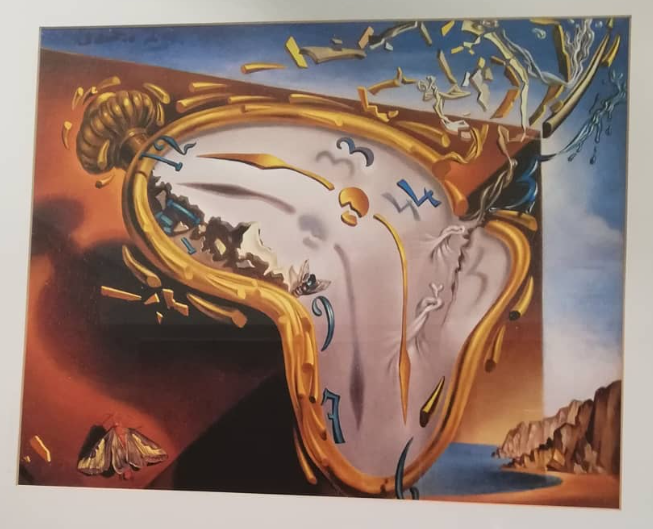
This brings me to African time and the picture I found in a restaurant convenience in Franschhoek, South Africa, my observation then was it was a bespoke watch, not for the purposes of keeping time.

African Time, Franschhoek, South Africa