Showing posts with label homosexuality. Show all posts

Wednesday, 13 May 2026

The Family We Inherit, the Family We Choose

The Family We Inherit

When I was a child, family was a map already drawn. There were parents at the centre, solid and unquestioned. Grandparents orbited with stories and memory; I even had a great-grandmother into my twenties. Siblings came later, not quite close enough to grow up alongside, as it was to fight with and lean on in the same afternoon.

As I grew, the map widened to include aunts, uncles, cousins, and distant relations whose names carried branches of a tree I had not planted, but to which I undeniably belonged. Nowadays, a name from that stock carries some resonance but no clear recognition.

Family, in those years, was inheritance. You were someone’s son, someone’s brother, someone’s nephew, someone’s grandson. You did not choose your place; you occupied it.

An Unspoken Expectation

The expectation, though rarely spoken aloud, was that one day you would recreate the pattern. The heteronormative construct was laid out as tradition, without any consideration that you might be differently inclined. You did not create yourself; you became yourself, but you were still required to represent them as part of that genealogical framework.

You would find a wife. You would have children. You would extend the line. The structure felt inevitable, almost architectural: generation building upon generation, each layer confirming the last. The scaffolding stood there as a template, but what sort of building would emerge once it was removed?

The Expected Script

In adulthood, society tends to follow a predictable rhythm of questions:

“Are you married?”
“What does your wife do?”
“Do you have children?”

Closer to the traditions with which I have some affinity, the question is inevitably:

“How are your wife and kids?”

These questions are not malicious; they are rituals. They affirm that you are participating in the established arc, that you have stepped into the role once held by your parents.

Marriage, in that script, is not just about love. It is about continuation, about replication, about becoming what raised you. In fact, the word used is “responsible”, and you are apparently not responsible if your image of adulthood is not framed as husband and wife, home and children, the next branch growing from the familiar tree.

My Reality

My name is Akin, and the centre of my adult life is Brian. Brian is not my wife. He is my husband.

He lives in Bulawayo, Zimbabwe. I live in Manchester, England. And regularly, as often as we can, we both travel to Cape Town, South Africa. We met in South Africa and meet there because it was the first country to recognise and legalise same-sex unions.

Cape Town is not just a city for us. It is a promise, a rehearsal for the life we are building. It is where time feels concentrated, intentional, and fiercely protected.

Measuring Life in Countdowns

Everything we do is designed to maximise the hours we have together. Flights are booked with military precision. Calendars are negotiated. Work is arranged around reunions. We measure life in countdowns: how many days until Cape Town.

We have been together for over seven years. Seven years of distance. Seven years of choosing each other. Seven years of making geography bend as much as it possibly can to commitment.

The Conversations of a Marriage

When people speak casually about spouses, they often describe the ordinary:

Morning coffee conversations.
“Darling, what shall we have for dinner?”
“Love, how was your meeting?”
“Babes, did you sleep well?”
“I mean, how are you in yourself?” [I smile at this question.]

Brian and I have those conversations.

I speak to him first thing in the morning and last thing at night. That is not symbolic; it is simply how life works. He is the first voice in my day and the final presence before sleep.

The Fabric of Our Bond

We talk about finances, health, frustrations, politics, and our families. We argue occasionally. We reassure constantly. We plan relentlessly. We discuss where furniture will go in the Cape Town home, we have not yet secured. We imagine neighbourhoods. We calculate costs. We picture morning light in rooms that exist for us only in hope.

These are the conversations of spouses. They are not lesser because they occur across time zones. They are not diluted because they travel through screens. They are not temporary because they are stretched by distance. They are the fabric of a marriage, the centre of what tugs at our hearts.

Recognition and Silence

Yet the world does something subtle.

A man mentions his wife and is met with easy follow-up: “What does she do?” “How did you meet?” “Do you have kids?” The questions flow naturally, as though the script has already been agreed.

But when I speak about Brian, there is sometimes a pause, a recalibration. Not hostility, not necessarily rejection, just a slight disruption of expectation. And often, no further questions come.

While I appreciate that some people need time to get used to that construct, in other cases it is those who give no consideration to that reality who make this conversation necessary.

This relationship will not fade into insignificance or irrelevance; the indifference of the original setting I was born into will not obviate the consequential position of Brian to me and in my life.

The Unfitting Template

It is as though the conversation does not quite know where to place us. We do not fit into the inherited template of husband-wife-children-grandchildren. There is no automatic branch extending from us into the next generation.

We have no children. Our relationship does not replicate the structure we were born into. But it is no less central, no less serious, no less real.

We as individuals might have deigned to conform, satisfying the cultural expectations of tradition whilst complicating the lives of those who, in my view, would have fallen victim to a lavender marriage, one in which our intimate desires were met elsewhere, where a wife could not compete.

We chose instead to be who we are, without scandalising others through the revelations that might have emerged from the liaisons we had proclivities for.

The Myth of Continuation

Much of how society recognises marriage is tied to reproduction. Parenthood acts as proof of adulthood, of stability, of contribution to the future. Children become the visible extension of a couple's bond. Yet even people within those constructs may not have children, for all sorts of reasons.

Without children, a relationship can seem, to some, self-contained. But what if continuation is not only biological?

Brian and I are building continuity of another kind: continuity of devotion, continuity of shared planning, continuity of showing up, again and again, despite visas and airfare and the blunt inconvenience of geography. Our lineage may not be genetic, but our commitment stretches forward just the same.

Cape Town: The Dream

Cape Town is the convergence point. I fly from Manchester. He flies from Bulawayo. Two separate lives narrowing toward the same coastline.

We walk the same streets each time as though tracing the outline of a future. We talk about where we will finally set up home, not as a fantasy, but as an inevitability we are patiently engineering.

The Sacred Mundane

That is our dream: to close the distance permanently. To wake up in the same space without calculating time zones. To make breakfast without screens. To argue about which cupboard the mugs belong in, or the clocks on the oven, for which I have been accused of having OCD.

Domesticity is not mundane to us. It is sacred.

The Centre, Not the Periphery

Whether others like it or not, Brian matters. He is not an aside in my story. He is not an interesting footnote. He is not an exception to a rule.

He is my husband, my partner, my integral and significant companion. The person I consult first. The person whose opinion steadies me. The person who knows the texture of my thoughts before I fully articulate them.

The absence of children does not shrink that reality. The absence of a wife does not make it incomplete. He is my full responsibility, before all others.

The Family I Choose

As a child, I belonged to a family I inherited. As a man, I have formed a family I chose.

It may not look like the one that raised me. It may not produce grandchildren. It may not trigger the standard conversational questions. But it is no less a family.

Brian and I are building something deliberate, intentional, and resilient. Every mile travelled, every reunion planned, every late-night call is a brick in that foundation.

Family is not only about bloodline. It is also about allegiance, about persistence, about saying, across continents and years: “You are my person.”

And that, however quietly the world acknowledges it, is marriage. That is just the way things are.

A Google NotebookLM AI Podcast on this blog

Monday, 12 January 2026

Held in Tension: Sexuality and Spirituality

Navigating Sexuality and Faith in Religious Spaces

There's a conversation I had recently that keeps replaying in my mind. It started with a Facebook post about the conflicts between sexuality and spirituality in Christian communities, and before I knew it, I was in a deep exchange with someone facing what they called a "horrifying" internal conflict. They were an aspiring Anglican priest in Nigeria, caught between their calling to ministry and their authentic self.

This isn't just their story. It's the story of countless individuals sitting in pews, leading worship, teaching Sunday school, or aspiring to ministry, whilst carrying a weight that feels unbearable. The conflict between sexuality and spirituality in religious settings is real, raw, and deeply personal.

The Weight of Worthiness

What struck me most in our conversation was how quickly we default to the language of worthiness and condemnation. My response to them came from years of wrestling with these same questions: Jesus died for us regardless. Grace teaches us godliness. These aren't just theological platitudes; they're lifelines for those drowning in guilt.

The fundamental question isn't whether God loves us despite who we are, but whether we can accept that God loves us because of who we are: fully, authentically, completely. When we understand that the Father sees us through what Christ did for us, not through what we do ourselves, it changes everything. Or at least, it should.

The Complexity of Conflict

As our conversation deepened, I found myself laying out the layers of conflict that many face. It's never just one thing. There's the matter of attraction itself: acknowledging it, understanding it, accepting it.

Then there's the question of what to do with that attraction. Do you seek companionship? Commit to celibacy? Try to change? Each path comes with its own set of challenges and consequences.

For those called to ministry, like my conversation partner, the stakes feel even higher. In conservative religious environments, particularly in places like Nigeria where the Anglican Church takes strongly traditional stances, the choice can feel impossible: your calling or your truth, your ministry or your authenticity.

The Geography of Grace

I mentioned Reverend Jide Macaulay to them: a gay Anglo-Nigerian Anglican priest who founded The House of Rainbow and now ministers in the UK. His story illustrates something crucial. Sometimes finding peace means finding new spaces. Not everyone can or should leave their religious community, but knowing that affirming spaces exist can be lifesaving.

The geographic and denominational differences in how churches handle these issues are stark. What's considered grounds for exclusion in one congregation might be celebrated in another. This isn't about church shopping for convenience; it's about finding communities where you can worship authentically and serve fully.

Compartmentalisation versus Integration

Near the end of our exchange, I suggested something that might sound counterintuitive: sometimes we need to compartmentalise to gain liberty from our conflicts. This isn't about living a double life or hiding parts of yourself. It's about recognising that different aspects of our identity might need different kinds of attention and space to develop.

You can be deeply spiritual and sexually aware. You can be called to ministry and attracted to the same sex. You can love God and struggle with church doctrine. These aren't contradictions to be resolved but tensions to be held with grace.

Moving Forward

What I've learnt from conversations like these is that there's no one-size-fits-all solution to navigating sexuality and faith. For some, the answer is finding affirming religious communities. For others, it's reinterpreting scripture through a more inclusive lens. Still others find peace in celibacy or in stepping away from organised religion whilst maintaining their spirituality.

The key is this: the conflict doesn't have to be horrifying. It can be transformative. It can lead to a deeper, more authentic faith, one that doesn't require you to leave parts of yourself at the church door.

To those facing these struggles, know that you're not alone. There are communities, resources, and people who have walked this path before you. The journey towards integrating your sexuality and spirituality might be challenging, but it doesn't have to be a journey of condemnation. It can be a journey towards wholeness, towards a faith that embraces all of who you are.

Because at the end of the day, any God worth worshipping is big enough to handle our complexity, our questions, and our authentic selves. The real question isn't whether God accepts us. It's whether we're brave enough to accept ourselves.

A Google NotebookLM AI Podcast on this blog

Monday, 7 March 2022

Beyond queer theory to the experience of living

Exploring our humanity and expression

Reading of the death of Professor Leo Bersani which occurred a few weeks ago at the age of 90, got me thinking of an area of study defined as queer theory that I have not before explored, yet on perusal suggests many of us of a homosexual persuasion might have lived. To codify the lives of homosexuals and sexuality in academic terms definitely makes for an essential area of research. [Advocate: Leo Bersani, Author on Gay Identity, Dies at Age 90]

Only recently, I was reading up on Anti-LGBT rhetoric which to many extents has been to those of the LGBT persuasion lived rather than rhetorical, in discrimination, in ostracism, in queer bashing, sometimes resulting in death, in legislation that delegitimises and dehumanises our person in the pursuit of some nebulous family or culturally based ideal that seeks to set us apart for repudiation and castigation.

The corruption of conformity

Obviously, at once in our suffering and then in our understanding, we are caught in a situation where our difference from heteronormative structures set us up in conflict with family and relations, in community and society as we seek to have a human voice to exist in a humanity is more diverse than the conformity that is expected of us.

For instance, sex to me has always been utilitarian for the simple reason that my first experience of it was from the age of 7, the innocence I lost has had consequences and it would not have mattered whether I grew up for be heterosexual, bisexual, or homosexual, once that childhood naivety was given the fruit of the knowledge of good and evil, my eyes, as much as anyone else exposed to child sexual abuse were opened.

What at first seemed coercive became immersive and the pleasure it provided was natural and untainted by philosophy, religion, or morality. Sadly, the criminality of such was rarely prosecuted, rather, it was hushed up in shame and embarrassment with the hope that the child would outgrow the memory of it. They never do.

Understanding how different we are

Then within the conflicts of appreciating, understanding, and accepting one’s sexuality against the requirements to present as ‘normal’, in that one should subsume sexuality for the heteronormative and fulfil all the necessities of such.

This morning, on my walking exercise, I thought about the many males from adolescence with whom sexual relations have been explored who now deploy their heterosexuality in marriage, procreation, and the profession of faith and creed that supports that existence in their collective amnesia of the past. Grandfathers they are today even as some preach the gospel in various forms.

Yet, as Leo Barsani wrote in his 1987 essay, titled, Is the Rectum a Grave? he lambasted as quoted in the Advocate article referenced above, “the tendency among some gay activists to respond to AIDS by downplaying their sexuality and emphasizing the need to replicate bourgeois heterosexuality.” The point, we are not heterosexual, we have never been, we have to define ourselves as who we are, not in the context of others who have no idea of our lives. [Amazon: Is the Rectum a Grave?: and Other Essays] Ordered today.

Having sex without angst

In that is the tendency to rail against the apparent promiscuity of homosexuals, but fundamentally, once we begin to understand that homosexuals are not governed by heterosexual constructs and norms, we can also deconstruct the viewpoint of seeing homosexuals only through the lens of sex, lifestyle, and inclination, for we are just as valid an expression of our humanity that has existed from the beginning of humankind.

What seems to dog the homosexual is the tendency to want to ape the heteronormative, and so we read personals that include straight-acting, moralising the concept of monogamy, even though polygamy has defined many human relationship until it was morally and legally constrained by recent Judeo-Christian hegemonies seeking to decide the use and utility of sex, whilst removing from public knowledge the pleasure and enjoyment of sex.

We are schooled to think sex as nothing to derive any stimulation or pleasure from except for the sake of procreation, yet, in our private places, we all know that sex is considerably more pleasurable than we are told it is not.

A remembrance and celebration of lives

Amongst us homosexuals, the enjoyment of sex cut a swathe of death in our population with AIDS for almost 20 years when we lost men in their prime at never nearly 40 into the mid-1990s and the AIDS Memorial Instagram page speaks of lives of men who we have refused to forget, for What Is Remembered Lives. We stopped enjoying sex, seized by fear and loathing, exacerbated by bad faith actors depicting a human disaster as divine wrath. Yet, it is human progress and advancements in medicine has contained this epidemic.

I lost a partner and many friends, I mourn some still, though for the society I lived in, I mourned alone, because until 1995 we had no effective long-term treatment and therapies for HIV. I also was touched by the scourge of AIDS, I survived, and I am grateful for the gift of life.

My AIDS encounter has however not diminished my appetite for sex, for it is essentially part of human nature and it is only those in denial that would suggest we do not have that need. Our world presents us with exploration along with some caution and care, but to become puritanical about sex is to censure human expression.

We were never the same in outlook

When for the heterosexual, it might define uniquely lifelong bonds, it would for the homosexual be once of tryst to which you do not need to attach any emotion. It is very possible to separate the act which is practically animal expression from the higher human state of intelligence. That ability to compartmentalise the functions of the physical, the body, the mind, and the heart, devoting the right attention to the fleeting from the significant is something that probably takes the mimicry of the heterosexuality out of homosexuality.

It does not mean we do not understand commitment, it is just not predicated on sex, either through objectification or deification, its utilitarian function is just that, and where intimacy between partners is involved, there is a totally different dynamic at play than when there are liaisons with strangers.

Through generations, we have been on the margins of society, the only thing we have ever asked for is not to be persecuted or prosecuted, to be able to live our lives equally as part of our diverse humanity, contributing to the advancement of our civilisation all around the world.

For that, we can be grateful for the likes of Leo Barsani, Paul-Michel Foucault, James Baldwin, and many more helping the discourse about sexuality and its full expression.

Blog - Thought Picnic: A child has memories that last a lifetime

Blog - Thought Picnic: How do you lose your virginity?

Blog - Thought Picnic: We Never Knew What a Healthy Sexual Relationship Was Because ...

Tuesday, 30 March 2021

Lil Nas X - MONTERO - The Pied Piper is here

Setting it up

There is something about Montero Lamar Hill, also known as Lil Nas X that is enthralling, engaging, and arresting. Now, I am not a fan of rap music or any music where the apparent absence of enunciation leaves you having to attune your ear to patterns, rhythms, cadences, and much else to understand what is being said. I guess I will always need subtitles.

A story in antiquity tells of the town of Hamelin in Germany where an infestation of rats might well have introduced a plaque. Then came a stranger who promised to rid the town of the rats for a payment, he did do so playing his pipe and attracting the rats out of the town into the River Weser where the rats drowned.

On returning to the town to collect payment, he was refused. The Pied Piper then returned one day, playing a magical tune, had all the children follow him out of town into oblivion as certain legends have it, never to be seen again. The evil of not keeping promises and treating a person with courtesy, respect, and dignity was visited back on the town of Hamelin by the loss of their children. [Wikipedia: Pied Piper of Hamelin]

The piper in his element

I just watched the video of Lil Nas X’s new release, Montero (Call Me by Your Name), it is filled with a lot of mystical symbolism, and the lyrics have much hedonistic context for suggestion, eroticism, homosexual sex, drugs, and drink. Whilst a lot of this is Computer-generated Imagery (CGI), he descends the longest pole into the belly of the earth where he apparently lap dances the devil before strangling him and wearing his crown, thereby sprouting wings like the angelic being that Lucifer once was.

You can imagine the outrage, hot flushes, disgust, recriminations, and agitation from people who think they are good parents, the conservatives and the religious at all this with their confected rage about protecting children and all that. Let’s hear what Lil Nas X has to say.

Your responsibility, not mine

To the parents: “I am an adult. I am not gonna spend my entire career trying to cater to your children. that is your job.” [Tweet] In another tweet, he writes, “I literally sing about lean & adultery in Old Town Road. U decided to let your child listen. Blame yourself.”

About the depictions in the video with a mind on the ultra-religious that have preached about homosexuals going to hell, he says, “I spent my entire teenage years hating myself because of the shit y’all preached would happen to me because I was gay. So, I hope u are mad, stay mad, feel the same anger you teach us to have towards ourselves.” [Tweet]

So, there you have it, you tell someone that he is going to hell because of who he is, he uses his creative talent to give you a vision of your words and you are angry about him, about it, fearful for your kids and much else?

Love your rats or pay up

Therein is the advent of a modern-day Pied Piper, the parents who loved the music but failed to listen to the lyrics and gave their children full rein to enjoy the song and the video that won even a Grammy are like the people of Hamelin who were happy to see the rats piped out of town.

Now, as Lil Nas X has continued to showcase his talent with a full expression of his sexuality and giving life to the stereotypes thrown at many of us who just happen to be gay, everyone is pulling their children away, but they are hooked and joyfully following the Pied Piper.

The morale in every case is, pay up, pay your dues, pay what you agreed, be nice, reckon that difference does not make others less human, if you cannot show love, it is unnecessary to express vitriol and hate.

An appeal to our better selves

Be careful what you wish for, whatever nasty thing you say to another might well become a picture of your worst reality, at which point, you have nothing left to fight with, the battle for hearts, minds, and souls, was lost when you dehumanised a fellow human being because of their sexuality amongst other things.

Like always, from time immemorial, just because you pick a fight with someone does not mean they will fight you back if there is someone or something else that pertains to you where they can get an advantage. Love heals all things, hate destroys many things, including our faith in humanity.

Lil Nas X, thank you for being your true self, for that alone, you might well be in front of the queue to heaven leaving your earthly detractors in the other place.

References

Montero (Call me by your name) – Lyrics from Genius

Old Town Road (Remix) – Lyrics from Genius

The video; not for the faint-hearted, watch with caution and prepare to be shocked. (Parent & Grandparent advisory.)

Friday, 19 February 2021

Seyi Omooba: A princess refuses to play her role

The acting of Celie

I have been following the case of Seyi Omooba, the actress or rather the actor as I have noticed the gender-specificity appears to have been taken out of the noun for the acting profession. She was to have taken the lead role of Celie in a stage production of The Colour Purple until it was found that sometime in the past written view on Facebook that called into question her ability to take on the role.

Apparently, the role of Celie does have some same-sex attraction and it is left to the director to decide how that is interpreted and the actor to give that the best expression possible that the audience will suspend belief and be absorbed in the depiction and quality of the performance. That is what actors do, it does not make actors the roles they play in real life.

The mind of Seyi

Ms Omooba, however, wears her religion on her sleeve and that appears to come before her vocation for which she was by all terms fully qualified to do, for that is why she auditioned and was selected to play Celie. She was not minded to play the part as she had said on a Facebook post that, “I do not believe you can be born gay, and I do not believe homosexuality is right, though the law of this land has made it legal doesn't mean its [sic] right.” [BBC News: Seyi Omooba: Actress sacked over anti-gay post loses legal fight]

Now, Ms Omooba is entitled to her views and beliefs, we live in a free country, what she believes to be right is her prerogative and that is fine by me, even if those views question the essence of my being and that of the broader LGBTI+ community, or that of any other person. Prejudices abound, what matters is the ability despite our persuasion, that difference exists and that is the way the world is. We can all live our lives happily respecting that.

The princess throws a strop

Having expressed those views way back in 2014, they had not changed when she took on the role of Celia and Ms Omooba was going to depict the role within the constraints of her worldview making no allowances for either directorial discretion or that of the author of The Colour Purple. At which point it was decided she was incompatible with the role and the theatre seeking an amicable settlement offered her unconditionally full salary to walk away, but she was not going quietly.

She took the case to tribunal seeking substantial redress and compensation, supported by a fundamentalist religious organisation founded by her father and has lost.

It has not escaped my notice that the name Ọmọọba is Yoruba for the child of a king, suggesting prince or princess, we still have gender roles in royal titles. Her father is both a religious and community leader who has been honoured with an MBE for his community work whilst being strident homophobic, but we can separate the issues, it does not make him any less worthy of honour.

The choices she made

His princess, fully imbued with the teachings of her father needed to work in a rather different environment that offers equality of opportunity and the acceptance of diversity, but chose to use her inability to adapt to a different environment to play the victim of discrimination, thankfully, she could not play the race card because it is very likely the role that once went to Whoopi Goldberg in the 1985 film directed by Steven Spielberg and had Quincy Jones as one of the producers would most definitely have gone to another African American.

This is what Ms Omooba had to say on the website of Christian Concern, “When I received the email that I was going to be dropped from the cast, I was heartbroken. The agency told me that I would receive financial compensation, but I am not in this for the money. For me it’s not about the money or my face – it was about telling and expressing Celie’s story, as I interpret it as a performer, because that is what I love to do.”

“Yet the theatre and the agency gave me the choice of either losing my career or renouncing my faith. I could not do this, not even to save the career that I love.” [Christian Concern: Seyi Omooba]

No, sweet child, you cannot unilaterally interpret a role divergent from what the director requires the role to be. Celie’s story was written in 1982, was depicted on film in 1985 and there is a musical remake to be released in 2023, society and norms have so moved on. [Wikipedia: The Colour Purple (Film)]

The choices they made

Yet, much as this might have been a career-boosting opportunity, no one was asking you to choose between your faith or your career, you made that choice. Your career was not ending, you created the circumstances for questioning if you were suitable for the role and whether you could be represented by your management agency. As the lawyer for the agency stated at tribunal, “Her comments had so adversely affected her future employability that her contract with Global was ‘an empty vessel.’” [The Telegraph: Actress Seyi Omooba loses tribunal claim over her dismissal from The Color Purple]

It would appear rather than for the common good, you took the selfish and unchristianly stance to jeopardise the fortunes of the theatre ready to compensate you and the management agency about to lose clients because of what you chose to represent; prejudice, bigotry, entitlement, and intransigence.

The opportunity she did not embrace

Her troubles began when in 2019, after she was announced as the lead for The Colour Purple, a member of the cast of Hamilton, Aaron Lee Lambert asked on Twitter, with a caption of her Facebook post, “Do you still stand by this post? Or are you happy to remain a hypocrite? Seeing as you’ve now been announced to be playing an LGBTQ character, I think you owe your LGBTQ peers an explanation. Immediately.”

Ms Omooba did not answer to the issue for months and the theatre seeing the public relations disaster brewing had to take measures to both save the production and their enterprise when it became apparent that she was not ready to temper her views. In the comments that followed the tweet, it was revealed she had recently refused to appear in a pride video along with members of the cast of another production she featured in. Besides, she had before appeared in a concert version of The Colour Purple.

She had no case, just trouble

Laid out in those terms, it was unlikely Ms Omooba had any intention of playing or depicting any of the LGBTQ aspects of the Celie character, one cannot suggest what presumably chaste component she would have brought to give the role a meaningful interpretation in consonance with the original writing.

The tribunal ruling against her demands for compensation for loss of earnings, future losses and reputational damage concluded, “If there is damage to her reputation, it was not caused by being dropped from the production but by an unconnected person's tweeting... of her Facebook post and the outcry resulting from that.” [BBC News: Seyi Omooba: Actress sacked over anti-gay post loses legal fight]

We all have to live with others

My takeaway from this case is simple, you are free to have whatever views you espouse, but the moment you publish them, they are on the record for a public and global audience that extends well beyond the community that would fully agree with our opinions that it is necessary that the expression of such views do not become a future impediment to progress.

Bigotry, prejudice, hypocrisy, lies, unkindness, hate, inhumanity no matter how reasoned our positions are do not win laurels, they eventually become burdens unintended and consequential.

Religious intransigence in a liberal and secular environment is the harbinger of notoriety and personal grief. Your beliefs exist within constructs, never in a vacuum. Ms Omooba accepted the construct that homosexuality is legal, and much as she could comment on the rightness or the wrongness of the law, she chose a moralistic dimension that set her apart from the profession and broader society that had made accommodations for living and let live, it became her undoing.

Within fundamental Christian circles, Ms Omooba might be lauded and celebrated for her courage and integrity, that is probably where she can ply her trade, in the cohort of those who believe the same way as she does. However, if she needs an audience to her art and talent beyond that setting, the change will have to happen to her, though she might well think it is the society that needs to bend to her will. That is her hill if she chooses to die on it.

Friday, 22 January 2021

Understandably some fathers will not get to acceptance

Hard truths of sons

From a personal perspective I can understand how difficult it must be for a Nigerian father to countenance the idea that their child is not heteronormative. If it were a matter of choice or lifestyles, it is likely they might have been different, but the world we live in is diverse with expressions of individuality and uniqueness that may not follow the orthodoxy.

When I father challenged the public acknowledgement of my sexuality as a gay man years ago, I was directly instructed to come out of the gay world. I had no other alternative than to tell him without mincing words some truths about my life he might have been suspicious of or never knew. Until then, I was hiding my reality from him in the misconception that I was saving him the shock of my person and my personality. [For Akin – Funmi Iyanda]

From aberration to acceptance

In the 1960s, I appreciate the cultural aversion to homosexuality in the UK even as acceptance of the fact that homosexuals exist and are neither mentally incapacitated nor deviants. In 1967, homosexuality was decriminalised in the UK, though it took decades for acceptance to gain traction towards non-discrimination based in sexual orientation. [Wikipedia: Sexual Offences Act – 1967.]

When I returned to the UK in 1990, I did not shy away from who I was, considering I was being blackmailed in Nigeria. The way I dealt with the blackmailer was to say he would have to explain how he found out, why were involved for an extended period and whether he would not be just as exposed and unlikely me with an exit plan, he had to exist within a homophobic environment.

My son

When my father responded, he said, “You are my son, I cannot reject you.” Whilst I did not read that as a wholesale acceptance of who I am, it was conciliatory enough an acknowledgement that there was nothing he could do about it if we were to retain any form of relationship. We have developed that filial relationship despite occasional hiccups.

Dr Doyin Okupe, a former presidential spokesman for the President of Nigeria today from the papers finds himself in the same situation of first acknowledging against every gain in his religious and patriarchal body that his son, Bolu Okupe is gay. The most important and significant statement he could make was, “He (Bolu) is my son.” [The Nation: Doyin Okupe, son in a row over ‘gay status’]

Beyond that, any discussion by anyone else is an exertion in conjecture and vain jangling. It is no doubt a trying period for heterosexual fathers, but their homosexual sons do have their lives to live. I have a partner to whom I hope to get married. I affections have never had any inclination apart from a homonormative existence, I accepted myself long before I needed to tell anyone about who I am, even at work from the 1990s.

A deluge of ignorance

What I find utterly irksome is the crass and ignorant reportage that masquerades as journalism in Nigeria. With the abundance of knowledge, expertise, academic material and legal precedent in many countries not only acknowledging homosexuality but conferring rights and freedom with the criminalisation of discrimination on the basis of sexual orientation, we have people who offer stupefying opinions, bias and bigotry as fact, that I read, “He resides in France where the law allows him to experiment with his sexuality.” Experiment?

You do not experiment with sexuality, it is embodied in the person, their expression and their identity, it is their life and they live it in or out of the closet, depending on the agency and autonomy they have. We need to banish the concept of lifestyle or choice from the canon of sexual orientation or we risk being refused access to societies where the debate about sexual orientation has long passed from a wedge issue of societal and cultural exclusion.

Sunday, 18 October 2020

Richard Quest does not need your permission to be happy

A marriage is a marriage

I did not read of this development until I saw the Facebook posting on a “Friend’s” page that castigated and excoriated it, the comments that followed maintained the same theme. Yes, Richard Quest of CNN had tied the knot in a same-sex marriage ceremony with his long-time partner.

Apart from the Instagram message Richard posted, I do not think it made the news anywhere else except in a sensationalist stance on African newswires in Ghana, Nigeria and Kenya. What is surprising is how little people know about Richard Quest, not that it matters, but he is a gay man, he has spoken about his sexuality a few times, and he has made no secret of his, as it were, proclivities. [Instagram: Questinny]

That is a wrong choice of word, proclivities, but it is a sop to the ne’er-do-wells who cannot countenance the idea of difference in the lives of others. For whilst many may not understand sexualities different from heterosexuality, homosexuality, bisexuality and transsexuality has always been in humanity since long before history was recordable.

It never hindered him

However, this is not the space to argue that, despite and in spite of his sexuality Richard Quest has a high global profile as a news anchor and presenter, his quirks and expression is uniquely individual, entertaining and enlightening, what is not to like about Richard Quest as a professional?

In the aid of full disclosure, I am also a gay man, I have always been a gay man, I did not change from one thing to another and never have I had any interest in the opposite sex, that is just my nature and I make no apology for it. I am engaged to be married to my partner Brian, and once the cloud of this pandemic is lifted, that will be done.

As if you matter

Back to the issue itself, Richard Quest does not need the permission of anyone to be happy, he finds his happiness and fulfilment in the companion he has chosen to spend his life with, who just happens to be male, as much as the person could have been female. It is neither here nor there.

Richard Quest has lived a rich eventful and highly achieving life that he would be proud of and many would aspire to and I celebrate him for having found the kind of exemplary balance in life as in his profession and gone ahead with living his full life.

His gain, your loss

If out of this, some now decide they will no more entertain the views of Richard Quest as he enters our homes on CNN screens globally, that would be your loss because there is no one else that does what he does in such an engaging and interesting way that has brought his global following. What we must agree to disagree on is this, his sexuality is more your problem than it is his.

I wish Richard Quest and Chris Pepesterny a very happy married life, may they grow old together and be beacons of light and hope to many who find it still too difficult to live their best lives. It reminds me of William Haines who forsook a burgeoning acting career in Hollywood in the 1920s for his gay relationship that Joan Crawford was reputed to say, they were “the happiest married couple in Hollywood.”

Now, if you cannot be happy for a happy event in another life because of your prejudices, that, my friend, is entirely your problem, your burden, your whatever it is, but definitely, it is not good.

Blog - Opinion: When William Haines decided against a sham marriage

Wednesday, 30 September 2020

Normalising HIV Challenge against stigma

A challenge worth entering

One thing I have learnt about Social Media as I am just an amateur is that you never know what you post that might catch fire and go viral.

Just over two days ago, I joined the Normalising HIV Challenge with the hashtag #NormalizingHIVChallenge, the American spelling notwithstanding. What it involved was a short profile of oneself, one’s HIV status and what one is doing about it. Then, you can add a tagline.

This was all in aid of banishing HIV stigma, for there are many who are HIV-positive and living normal productive happy lives, going about regular and exciting activities the pills helping a long way.

I posted my tweet with the tagline, “I'm not dirty and clean is when you've had a shower.” This comes from what I have seen on certain profiles or in conversation where you are asked if you are clean. By implication, anyone who is HIV-positive is not clean or consequently dirty.


Courtesy of The Stigma Project

Blog - Dealing with sexuality and HIV stigma

Blog - Experience is not enough to teach you to understand things

Clean after a shower

This is after well-published and peer-reviewed studies that show HIV-positive people on antiretroviral drugs and by consequence with undetectable viral loads cannot pass the virus on to sexual partners. We can live healthy and passionate sex lives under the right medical supervision.

It does not mean we should be reckless with our sexual health, regular check-ups are necessary and it is unlikely that anyone who is HIV-positive is not completely clued in about this. Yet, ignorance persists in communities that should know better and the wider public who are usually deluded into thinking they are safe without any awareness of their real status.

Owning my experience

Literally, all the responses to my tweet have been supportive apart from one where the person in his cynicism thought I was being paid to demonstrate a false status in my search for clout and to trend. It was a shame that after he apologised, he deleted his tweets and then blocked me, out of embarrassment or shame or the inability to face up to his calumny, I would not know.

However, this much I know, a long time ago, I decided to own my situation, understand my condition and share my experience, if, in any little way, it might help others.

I know there are aspects of life I went through that others might well relate to and seek prompt medical attention rather than delay it. As I alluded to in the blog below.

Blog - When I had the murderous cancer of denial

Even this is normal

For the commendations of bravery or daring, I am thinking of neither, rather it is a simple case of acceptance, I am already a miracle of medical prowess that has come of the body of knowledge acquired through the medical interventions in other lives affected by HIV and related medical conditions. Forthrightly, I have to live with what I have, if I can't, what is the point of living and where is the joy of living?

We will continue to challenge HIV stigma, not so much to normalise being HIV-positive, but to aver that regardless of your HIV status it should not define you and you can live normal and amazingly productive lives. That is the goal of #NormalizingHIVChallenge from my perspective.

Monday, 28 September 2020

Thought Picnic: Leaving them to grudging and numbing

Refusing the obvious

Denial is probably the desire to live a different reality. Presented with the obvious, we find a delusionary diversion in thought and in deed to create an existence of the utmost deception in the hope that circumstances might just align.

There is the occasion where one exhibits reluctance with grudging acceptance, then another is engaged in persistence with numbing insistence, either way, none can alter the course of events as life and its decisions are primarily that of the principal regardless of expectations or prayers.

Defusing the devious

That one was offered the option of a village girl was quite amusing even as it was deftly declined, there is a city boy to whom one is betrothed, many traditions sacrificed to realities that have more relevance for heart and mind.

It is with warmth though that when in conversation with the dean after the Eucharist yesterday, the mention of marriage was embraced with easy accommodation of all genders not presupposing anything and welcoming of the response given. He is marrying him and whoever is in denial cannot be helped beyond facing the truth of what life really is.


Friday, 4 September 2020

Barclays Bank has severed its relationship with Core Issues Trust, that's fair

A petition I could not support
I was invited earlier today to register a protest in favour of a British Christian organisation called the Core Issues Trust that according to them works to help people with homosexual inclinations reform and realigning towards what might be pertaining to a norm.
Now, Core Issues Trust has a lot to say about themselves and that is a valid issue, I also want to know what others say about them because they are and the premise of their petition which I do not support is to have the Barclays Bank reinstate the backing services they have allegedly withdrawn from their putative customer at the behest of the agitations of certain forceful LGBTI groups.
Core Issues Trust avers that they are “a non-profit Christian ministry supporting men and women with homosexual issues who voluntarily seek change in sexual preference and expression.” Then reinforces the point by saying, ‘It respects the rights of individuals who identify as 'gay' who do not seek change, and supports dignity for LGBT persons. It does not support gay "marriage" - usually considered an "equality" issue, premised on the belief that being gay is "biological" and is therefore unchangeable.’ [Core Issues Trust]
It is Conversion Therapy
Yet, when I view the Wikipedia entry for the same organisation, I see another face of the organisation, “The Trust claims it is possible to change sexuality and offers "psycho-therapeutic" conversion therapy for homosexual behaviour and feelings. Core Issues Trust states it believes human sexuality in both men and women is a choice; and that sexual preference can and should be changed. The Trust says it does not consider homosexuality a native human behavior, but rather a relational or sexual "damage" that causes "deviancy" that it may be "cured".” [Wikipedia: Core Issues Trust]
My reading of this is unequivocal, this organisation is engaged in Conversion Therapy in everything but name, it is well understood that Conversion Therapy is not only harmful, there are laws being promulgated around the world with outlaw it. “There is no reliable evidence that sexual orientation can be changed and medical institutions warn that conversion therapy practices are ineffective and potentially harmful.” [Wikipedia: Conversion Therapy]
However, I respect the right of Core Issues Trust to render whatever services they deem necessary as their somewhat wholesome contribution to society whilst bearing in mind that many organisations involved in sexuality realignment have folded in comprehension of the reality of what core sexuality pertains.
Freedom to harm others
Core Issues Trust remonstrates that this matter is one of religious freedom and from their perspective, it might be, but I take exception to people and organisations who project their freedoms as the licence to act according to their beliefs that would inadvertently or demonstrably harm others.
I see no difference between their situation and that of hoteliers who provide services to the public but select their customers in line with their prejudices against the broad spirit and letter of trade descriptions laws. It is illegal and they get sanctioned when it comes to the notice of the authorities.
As I have written before, if you want to limit the scope of your services or influence to a particular cohort, you have to be in a confined ghettoised community of that homogenous cohort, the moment your doorway is in the public space, your prejudices would have to be lost to a liberal clientele.
Find a Christian bank
Whilst I do sympathise with the loss of banking services to the Core Issues Trust, it is a matter of reputational consideration that they have also lost the services of PayPal and MailChimp, they have courted controversy for a while that it probably does not need much activism to render them a negative customer to consider a business relationship with. [BBC News: High Court hears 'ex-gay' ad ban 'a political issue']
On the point that Barclays Bank unilaterally without notice or consideration withdrew their banking services, I would quite reticent to think a global organisation like Barclays Bank did not have extensive and involved processes that put this matter before panels of intensive debate and analysis before reaching that conclusion.
It made amusing reading when in their petition they attempted to join issues with Barclays – Qatari deal of 2008 when the Qataris came to the aid of the bank during the financial crisis. It was neither germane nor necessary, yet, interesting.
My advice to the Core Issues Trust who have such high Christian principles is to find a bank that supports their value system, maybe a Christian bank. Barclays Bank is not the only bank in the world, and it is not that Barclays Bank has seized their funds if they do find another bank to provide those services. Petition all you want, the decision has been made, contest it in court, if you’re so aggrieved.

Sunday, 16 August 2020

Prejudice has no place in Christianity

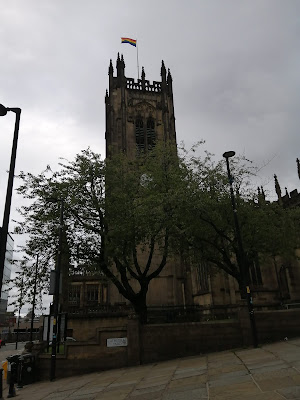
The Rainbow flag fluttering on the Tower of the Manchester Cathedral today 
The Rainbow flag - Manchester Cathedral
The tenderness that prevails

The fact that I could even be religious at this time of my life is a product of divine tenderness and mercifulness that fills me with both awe and gratitude. This is because my personal experience with many strands of Christianity in the church, the customs and traditions that became rituals of strict observation replacing Scripture with the seeming helplessness of adherents whilst they were taken advantage of by those in authority creating personality cults is enough to be bruised for a lifetime.
Yet, within this morass of faith and spirituality, the conflicts of thought, truth, and humanity, I have found something that gives me a sense of belonging along with experiencing wonder in spirituality and belief. I have written many times about the fact that I have returned to my Church of England Anglican roots, it works exceedingly well for me.
Outsiders everyone
The readings in church today along with the sermon delivered by the Dean of Manchester was a ministry in diversity. The first part was in Apostle Paul’s epistle to the Romans, the first verse and part of the second, then the verses 29 to 32. This was one that jumped out at me that I did not appear to notice that well before.
The Message translation says it best for all the versions I have reviewed. I start with, “God’s gifts and God’s call are under full warranty—never cancelled, never rescinded.” Yes, I still speak in tongues and I got introduced to that in the Pentecostal phase of my Christian growth, I get much comfort and sustenance from doing so.
However, it is this that was amazing to me, “In one way or another, God makes sure that we all experience what it means to be outside so that he can personally open the door and welcome us back in.” God has made us all the same, wanting and unqualified that we all can recognise His mercy. [Bible Gateway: Romans 11: 29 – 32 (MSG)]
The crumbs are enough
The gospel reading came from the book of Matthew 15:21-28, where a Syrophoenician Canaanite woman came to Jesus to ask for the healing of her daughter who was demon-possessed. At first, Jesus ignored her, but she was unrelenting. Jesus asserted He was only sent to the lost sheep of Israel, but she approached more closely and worshipped Him.
At that point, Jesus said, “It is not good to take the children’s bread and throw it to the little dogs.” This is a statement I have never fully understood because it reads as both an insult and deep prejudice. Somewhere else Jesus had said, and I paraphrase, “Shouldn’t this daughter of Abraham who had been bound by Satan for 18 years be set free on the Sabbath?” Yet, here, it appeared he was not ready to help.
The woman however challenged his prejudice with a retort, “Yes, Lord, yet even the little dogs eat the crumbs which fall from their masters’ table.” As far as she was concerned, the crumbs falling off the table would feed the dogs, and the crumbs of a miracle she wanted for her daughter would be enough to heal her. [Bible Gateway: Matthew 15: 21 – 28 (NKJV)}
The great faith of outsiders
To which Jesus commended her great faith and at that instant, her daughter was healed. It is notable to realise that Jesus always marvelled about little faith amongst his disciples and his people, but commended great faith non-Jews, like the Roman centurion who just needed Jesus to speak the word to heal his servant, of the Canaanite woman who believed crumbs falling off the table to dogs would heal her daughter. [Bible Gateway: Matthew 8: 5 – 13 (NKJV)]
More pertinently, it was about addressing prejudice, discrimination, inequality, difference, racism and anything divisional factor that diminishes our humanity. Our Dean was born in South Africa, here, he would be identified as black, in South Africa, he would be distinguished as Coloured. He experienced Apartheid at the beginning of his ministry in Durban and saw the Christian charity of people who refused to have prejudice remove him from the parish to which he was posted.
An inclusive church
During the last week, he supervised the hoisting of the Rainbow flag on the tower of the church, it was his clear message of inclusiveness of the church at which he has been the Dean since 2006. I was quite moved by his message; I was close to tears. The New Testament, Gospel and Christian underpinnings of the readings, his sermon and philosophy were clear, the church will not exclude anyone.
There is a bigger message here, but I reflect on how I have been able to come to terms with my sexuality and spirituality. A difficult journey in many respects and very personal too. I remember telling my pastor in my Evangelical church about my struggle with homosexuality, he asked questions, sought understanding, never judged nor condemned me. He always saw me first as a person and asked how he could be of help.
Further on, he wanted to appoint me to a leadership position even as the head of the global movement cleared said that was not something he personally would do. The fact is, we would not all be hot-blooded heterosexuals on the unwavering trajectory to marriage and procreation.
Knowing ourselves to know others
I cannot answer the question why, but God has a mission for everyone. I, in myself, whilst engaged in the church in other activities declined the offers to lead because I felt inadequate by reason of my situation even as my pastor saw more in me than I saw in myself.
The Rainbow flag flying proudly on the tower of the Manchester Cathedral was significant in that someone did write to the Archbishop of Canterbury to complain and the response of Archbishop was what the Dean decides to do at his church and chapter is his business.
Down in Cape Town where we attend the St. George’s Cathedral which was once the seat of Archbishop Desmond Tutu from during the Apartheid era, Brian and I find a welcoming church, an inclusive community, diverse in persons and walks of life, yet acknowledging of the fact that prejudice of any kind would not feature in the community.
People who have known prejudice should not themselves be purveyors of prejudice when prejudice of any sort is challenged, a way is opened to the embrace of our extraordinary humanity. Then in the first reading, we see that “God makes sure that we all experience what it means to be outside so that he can personally open the door and welcome us back in.”
You’re left asking one question, how can you be merciless if you have once received mercy? That is the basis and crux of Christianity, it cannot be escaped, it needs to be faced up to.