Showing posts with label nigerian. Show all posts

Friday, 20 March 2026

Heritage Without Nostalgia

Observing Heritage from a Distance

Two events this month should have created a kind of nostalgia in me, but I seriously failed to be excited about either. I had become an observer of sorts of elements that have formed part of my identity.

Whilst in Cape Town, there was the Commonwealth Day Service at Westminster Abbey on the 9th of March, and then yesterday came the conclusion of the first UK state visit in 37 years by a West African head of state, the Nigerian one. [The Royal Family: State Visit by The President and First Lady of Nigeria]

The first event gained significance through someone I follow on Twitter/X who had been invited to a reception at St James's Palace, though he could not attend because he was indisposed. As an activist for Nigerian immigrant causes, he had become prominent enough to be noticed and recognised as an important Nigerian diaspora figure.

For the state banquet at Windsor Castle, several people of Nigerian heritage were invited to represent the Nigerian community, many of whom have stronger roots in the United Kingdom than in Nigeria.

An English Identity

My living parents are Nigerian, but I was born in England, and though I have strong influences of Nigeria in my identity framework, I do not identify as such. To any question about where I am from, I respond that I am an Englishman, and I am originally from England.

This is reinforced by the fact that two-thirds of my life has been spent in Europe. Even for ethnic purposes, I would describe myself as Black English rather than the typical Black British or Black African.

This distinction matters to me because Black British functions as an umbrella term that groups together vastly different backgrounds and experiences, often implying a hyphenated identity or connection to a diaspora narrative.

Black English, by contrast, centres my English identity as primary. It asserts that I am English who happens to be Black, rather than suggesting divided loyalties or perpetual newcomer status.

The choice is deliberate: it reflects where I was born, where I belong, and how I understand myself. It challenges the assumption that Blackness and Englishness are somehow contradictory, and it refuses to accept that “English” is synonymous with “white.” For someone like me, whose connection to Nigeria exists more in memory than in meaningful attachment, this specificity matters.

The Outsider's Accent

I can reminisce about aspects of childhood and development that have served me well from having lived in Nigeria, yet for the simple reason that I had an accent, I was always an outsider.

That accent was no affectation; it was the sound of my formative years, the linguistic imprint of the England where I first learned to speak, to think, to understand the world. By the time we moved to Nigeria, my identity architecture was already established.

The English pronunciation I arrived with immediately identified me as different. In the playground, in the classroom, even within extended family gatherings, the way I spoke became a constant reminder that I did not belong in the same way others did.

Children would mimic my speech, adults would comment on how I sounded “British” or call me “Òyìnbó,” and I became known as “Ọmọ ìlú Òyìnbó,” the boy born abroad, or more literally, the child born in white-man’s land.

The accent was an audible barrier that no amount of time or adaptation could fully erase, a daily declaration of otherness that shaped my understanding of where I truly belonged.

The irony, of course, is that this very accent that made me perpetually foreign in Nigeria was simply part of the spectrum of English voices from the West Midlands. In Nigeria, I was told daily through reactions to my speech that I was foreign; in England, I simply was.

My parents, who moved from Nigeria to England and back, could navigate both worlds with the fluency of belonging. They spoke the languages without pronounced accents, understood the unspoken rules, carried the cultural memory in their bones. I had none of these inheritances.

Where they were returning home, I was simply living abroad. This distinction, between inherited belonging and biographical accident, crystallised my understanding that identity is not a matter of bloodline but of lived experience and genuine connection.

The experience taught me something fundamental: identity is not about where others place you, but where you place yourself, and where you are recognised as belonging without constant explanation.

Detachment and Memory

In terms of identity, whilst I am interested in what goes on in Nigeria, I am more detached than ever. The closest association nowadays depends on whether my flight between France or the Netherlands and Cape Town flies over the Nigerian landmass, where place names trigger some memory or recognition from more than 50 years ago.

In general, I have determined there is no reason to visit Nigeria since I left over 35 years ago. I have the name, I have the influences, I have the memories, but the nostalgia has fully settled into obsolescence and insignificance.

Gratitude Without Nostalgia

Yet I love that Nigeria was part of my upbringing because it strengthened elements of self-identity, self-esteem, and self-respect. For that alone, I am grateful for the Nigerian experience, as it reinforces the context and sense of who I am.

God bless Nigeria, for when things are going well in Nigeria, there is less anxiety for all of us associated, even in the remotest sense, with Nigeria.

A Google NotebookLM AI Audio Overview Discussion of this blog

Thursday, 2 October 2025

Nigeria, some hail thee

Nigeria, off my mind

On the first of October, Nigeria celebrated its 65th year of independence; however, in my mind, I let the day slip away with a sense of the uneventful.

As the thought crossed my mind, I realised that, despite the heritage, childhood experiences, memories, and influences, these are all vital parts of my being, though my affinity for Nigeria has diminished to the phrase, ‘my parents are Nigerian’.

Thirty-five years after I left Nigeria for the final time, I have no desire to visit or revisit any part of the seemingly privileged, idyllic childhood I once experienced there.

Even so, I am as estranged as anyone can be from any of the relations and relationships that once contributed to what might be called a sense of identity. It was a place; it was never home.

Relating to Nigeria

The independence days of yore, when Nigeria was still a young nation, were celebrated under a series of murderous military juntas, whose many names and roles I still recall. How we endured the sweltering heat on parade grounds, ready to march before military governors taking the salute on a dais.

One cannot forget how the Nigerian anthem of that era, written in 1959 but replaced by socialist-themed lyrics in 1978, remained etched in the mind as more representative of Nigeria’s story, until it was readopted in 2024. Although I have not personally sung it again, it felt like a Nigeria I could relate to.

Belonging elsewhere

My sense of belonging today is to the land of my birth and a land of my dreams, along with a land of desire from where I found a love beyond compare, England, South Africa, and Zimbabwe.

Nigeria is a place I view from 10,000 metres when travelling at a land speed of 960 kilometres per hour. The moving map on the aeroplane shows cities as we traverse from the middle of the north through to the southeast into Cameroon.

As I get less encumbered by detachment, I appreciate Nigeria’s contribution without acceding to any concept of being possessed by it. It was a place I was taken to, a place where I never truly belonged.

Saturday, 2 August 2025

Is Kemi Badenoch suffering a midlife identity crisis?

Kemi’s Nigerian baggage

Once again, Kemi Badenoch, the Leader of His Majesty's Most Loyal Opposition, is in the news, not for policy ideas on how she intends to lead His Majesty’s government, if she becomes the Prime Minister of the United Kingdom of Great Britain and Northern Ireland, but by defining herself against her Nigerian ancestry.

Her new tirade is about how she no longer sees herself as Nigerian, while how you identify is quite left to the individual. One can only wonder if our principal is suffering an identity crisis in trying to situate herself comfortably in the minds of the electorate she desperately needs to appeal to. [The Guardian: Kemi Badenoch says she no longer sees herself as Nigerian despite upbringing]

Gosh! A baby girl

The difference between her and me? I did have a childhood I vividly remember in the UK, born of parents who were students and residents rather than of a mother gaming the system for pecuniary advantage, the likes of whom forced the government of Margaret Thatcher to change the rules of birthright citizenship.

Kemi might protest until she is blue in the face that her mother was not engaged in birth tourism and consequently she herself was not an accidental anchor baby, but let us speculate on how having a medical doctor father in Nigeria, it was expedient for her mother to travel to the UK for medical treatment, and then she pops out in a maternity hospital, how convenient.

On the other hand, my mother was heavily pregnant with my sister, as anyone would have noticed in the last picture we took before boarding the plane on our departure from the UK. How things might have been different if someone had counselled my mother about the need to anticipate the opportunities Kemi now has for her then-unborn daughter.

Embracing all influences

I identify with Nigeria by heritage and influence through some of my formative years, but now, I have spent about 40 years living in Europe, and I do not define myself through the denigration of Nigeria as she does. When I was in primary school, most of us Black kids had foreign accents, and our schoolmate children of immigrants or expatriates in Nigeria mostly had Nigerian accents.

I am broadly European, even though I have a mastery of Yoruba and an understanding of Hausa. I do not pretend to know Nigeria that well, and I spent more time than Kemi in Nigeria, but left 35 years ago.

I'm affected daily by Nigeria because I have family and relations there, and a thriving and prosperous Nigeria is a comfort for all of us of Nigerian heritage in the diaspora. Yes, there are bad memories as there are fond memories, but it is in the UK that I have experienced muggings, racism, prejudice, and all sorts of attacks on the person.

I didn't live in the Netherlands for 13 years, trying to please the Dutch by putting down England or Nigeria, I embraced all influences that make up my third culture kid identity.

She needs a better narrative

In Kemi’s case, it is both political and personal, the need to constantly redefine herself in the context of Nigeria. If we set aside the circumstances of her birth through her mother for some unforeseen benefit as the story gets told, her pronouncements framed in a negative mindset about Nigeria are becoming unfortunate.

Eventually, someone is going to ask her what she intends to do in government and whether she can drop the Nigerian baggage she lugs around as a chip on her shoulder and see herself as just a black English girl who happens to have Nigerian parents.

I have no problems saying I am an Englishman with a Nigerian heritage and European influences, accent and all. More importantly, I am comfortable in my own skin; I dare say, she exhibits a form of self-loathing with an eagerness to belong and please.

Nigerians getting agitated by each outburst by Kemi are missing the point. The issue is not Nigeria; Kemi is still struggling with who she thinks she is, and well into midlife, she has not found a clearly positive narrative to embrace all the influences that make up her multifaceted identity.

Wednesday, 24 May 2023

Essential Snobbery 101: The waning art of discretion

In view of the setting

It is interesting to review a day in which some settings within which I found myself brought a mix of behaviours, attitudes, prejudices, and indiscretions which, on reflection, just indicated how much we need to be self-aware of how what and how we do things can affect others.

In the first instance, the engagement, which had moved from the necessities and essentials of effective communication last week, was initially an exercise in how the same instructions given to a group can present different results in comprehension and action. Though the core element for the day was the broader subject of diversity, equality, and inclusion.

An undress in address

In a multicultural grouping of diverse and variant abilities, this would bristle against the learned long before the acquired suits you to the environment. My first encounter came with an enthusiastic fashion aficionado who, in my view, probably knows what goes with what for what time of the day but forgot to recognise we were not being groomed for either the catwalk or the red carpet.

As I asked to sit with them, my acknowledgement of compliments on my apparel seemed to open the door to a level of intrusion that should have been invited rather than imposed. However, she took it upon herself to instruct me on what colours and styles should match what I was wearing. I could have brusquely rebuffed her and asked her to mind her own business, but I made the allowances in observation of an intriguing display of the use of discretion.

Absent filters of sharing

As the day progressed, there was something about just giving out too much information, where even as you begin to cultivate familiarity in a grouping, you let down your guard too easily to reveal what probably should be kept to yourself in some eagerness to share something that might yet not be known about you.

Even though I can be quite expressive, I still filter the products I share and consider what a no-need-to-know in consideration of how what one dares to share might affect others. Discretion is an art in and of itself.

Once some secrets of others were shared, there were a few instances where I could have interjected with ‘Me Too’, but I was not so inclined. I learned much and revealed little else, but in the observation of character, you appreciate who to keep in your confidences.

Of prejudice in scowls

Then came the apologies, this was in the aftermath of both discrimination and prejudice that some would have observed as redolent of a stereotype belonging to a certain demographic that, for a matter of discretion again one would think but never voice.

The need not to voice everything that comes to mind, even when there is irresistible prompting, is a discipline in awareness and sometimes necessary not to upset others.

That I found myself in the middle of the exchange whilst offering an example to buttress a point was incidental, but I was only ready to reveal so much about myself without laying myself out to avoidable vulnerability and exposure in sharing information that was not germane to the discussion. It was rattling and eventually resolved; uncomfortable would not fully describe what happened.

Platform pearls before swine

Back at home, I happened upon a tweet that included a clip of a BBC interview with an unctuous ingenue, a Nigerian male YouTuber who, with little urging, seemed to spill the beans on the immigration inclinations of his fellow countryfolk, just at a time the UK government has been looking for a means to reduce net immigration and dependants joining students during their sojourn in the UK.

He, apparently a dependant himself, in his excitement, ingratiated himself with a forwardness lacking self-reflection that could implicate him in immigration fraud when he inferred that he had helped some falsify documentation, apart from painting Nigeria and Nigerians in a very bad light. His quest for notoriety and clout presented more than an opportunity for indiscretion and lascivious boast of questionable ability or prowess. If ever the pearls of a large platform were cast before swine.

We remain, good ambassadors

He no doubt irked many a Nigerian at home and abroad, but I, being a 25-year resident of the UK and another 12 in the Netherlands, and we Nigerians, by birth, heritage, or allyship, are unwittingly ambassadors in the communities wherein we are, and no upstart, regardless of the platform they gain, can rubbish the good and useful contributions we make in our communities.

Honest Nigerians need not fear a backlash in their quest to emigrate; this would blow over, as we have always faced hurdles from as far back as memory would allow and have still made the moves and progress we have desired. Our YouTuber, who would not be granted even basic recognition, would fade into obscurity at just the same speed at which he came to our notice. An irrelevance in the scheme of things.

In the sidebar, I joined a Twitter space to assure Nigerians of continuing our good work, and for all I had to say, one was too distracted to listen, for he had read my profile and all he could glean from it was to ask why I am gay. I could have been exasperated, but when you realise that some can never learn to mind their own business, you make a cursory note and ignore it.

Thursday, 23 March 2023

The UK: What can he do? How justice was served the Ekweremadus in this organ harvesting case

They are not entirely helpless

It was hardly 6 years ago that I wrote of a case of human trafficking involving Nigerian professionals fundamentally unable to check their privilege in the use and abuse of others for their benefit. The refrain of “What can she do?” was a word-for-word translation from Yoruba, “Kí ló lè e?”

I dare say that there are many with much power, influence, and money in the upper stratum of society from Nigeria who exercise and demonstrate this mindset in exploitation with regard to others without means, opportunity, status, or autonomy.

Blog - The UK: What can she do? How justice was served in this Human Trafficking case

Nigeria presents a theatre for criminality wherein it might be impossible to find redress or justice. However, that sense of untrammelled impunity sometimes bedevils Nigerians who orchestrate that behaviour abroad, as different systems exist for the unlettered and underprivileged to the law not only taking their side but acting with the utmost fiery vehemence to ensure justice is done.

All emotions awry

This morning, I read of the court finding of guilt against Dr Ike Ekweremadu, a 3-time deputy senate president in Nigeria, his wife Dr Beatrice Ekweremadu, an accountant, and a Dr Obinna Obeta who had successfully procured an illegal kidney transplant under false pretences for himself, a few years ago. [BBC News: Ike Ekweremadu: Organ-trafficking plot politician and wife guilty] [The Guardian: Nigerian politician, wife, and a doctor guilty of organ trafficking to UK]

I am both conflicted and incensed by this whole charade; conflicted by the situation of having lost two close relations to chronic kidney disease where a kidney transplant might well have given them hope and life along with the enjoyment of their participation in our lives for amazing stories.

The Ekweremadus were in a desperate situation for their 25-year-old daughter who had fallen ill in 2019 and needed the kindness of a donor to rescue her from the constant trauma of dialysis and incapability due to chronic and debilitating disease.

On that score, any parent would go to the ends of the earth with all the resources they can muster to find everything possible to help their child to health. It is the means by which this is procured that begs the question and has led to the indictment and conviction of the aforementioned parties.

They marshalled people and money

Within the confines of Nigeria, a donor might well have been acquired for exploitation, their organs harvested and the person discarded as a spare part to fend for themselves, after what was a cold heartless transaction. More is demanded of donors in the UK, it has to be altruistic, with coercion or inducement and never a transaction in monetary or other terms.

Through their privileged network of family and friends of considerable clout and influence, they procured a hapless street trader whom they promised a life of opportunity without acquaintance with why they brought him to the UK to have his kidney harvested for their daughter.

It was upon enquiry about his relationship to them and the consequences of his being a donor that the medical establishment decided against proceeding with a transplant.

How they failed themselves

Rather than mollify and commit to some humane endearment of their prospect, he was left in the care of procurer-middleman Dr Obinna Obeta, who for the grace of the kidney of a donor seemed not to have the capacity of self-reflection and gratitude for the gift of life, once possessed, for which he must have felt entitled than to be grateful to anyone from donor or surgeon.

The prospective donor was mistreated that he ran away and lived rough on the streets of London before handing himself in, to the police where his plight unravelled to the detriment of the so-called privileged, powerful, and moneyed Nigerians.

Meanwhile, the Ekweremadus were already shopping for another person to exploit, from whom to harvest a kidney for their daughter in Turkey, at the time the police pounced on them.

Careless with the caring part

It is my view and hence where my anger stems from, that had the apparent donor been treated with a modicum of respect, dignity, honour, and sense of gratitude, he might well have bought into this kidney transplant transaction, himself convinced the medical personnel, gone through with the exchange, had opportunities along with long-term care and consideration from the Ekweremadus apart from the personal sense of gratitude from their daughter that would have engendered a friendship borne of the gift of life shared.

It speaks to the earlier blog that I wrote in 2017 where a doctor and a nurse could have brought someone over from Nigeria to care for their own children and still maltreat that child carer with no sense of reflection or possible consequence on their children. Sometimes, I am just left baffled at the thinking that a carer for your children would be so hopelessly indebted to you that it becomes a licence to abuse them.

Having disregard is costly

What the Ekweremadus facilitated even under desperation and duress for their daughter was both criminal and illegal, they will be consequences and hopefully, lessons for others seeking the help of strangers to learn. From the onset of their arrest through how the case was building up, I personally could not see how they could walk away unscathed as it all seemed underhand, malicious, and seedy.

The words of the Chief Crown Prosecutor present the full indictment of how class, privilege, power, influence, means, and opportunity deludes people into thinking they can get away with it and that there can be no consequences for whatever they do because the people they have brought into their enterprise have nothing but just breath in their nostrils, good enough health, and they are spare parts put on earth for the harvesting to the health and pleasure of their lives and those of their children.

She said, “The convicted defendants showed utter disregard for the victim's welfare, health and well-being and used their considerable influence to a high degree of control throughout, with the victim having limited understanding of what was really going on here.

The disregard for another human being, no matter their status in life can bring you to utter ruin. The Ekweremadus and Dr Obeta would have that to think about as they languish in the restricted confines of His Majesty’s secure accommodations. The irony is that Dr Ike Ekweremadu helped draw up Nigeria’s laws against human trafficking – the mind boggles.

Thursday, 17 March 2022

Thought Picnic: The potential ransom of dual-citizenship

The potential ransom of citizenship

The return of British-Iranians Nazanin Zaghari-Ratcliffe, 43, and Anoosheh Ashoori, 67, to British soil this morning that is so very welcome and heart-warming rings a cautionary tale of familial attachment and affinity that can put people with multinational citizenship in peril and jeopardy. [BBC News: Nazanin Zaghari-Ratcliffe and Anoosheh Ashoori back with families]

It was a sad development that Mrs Zaghari-Ratcliffe and Mr Ashoori became pawns of international diplomacy where Iran was ready to persecute people of other nationalities who returned home to see family with trumped-up charges of espionage or insurrection in order to gain leverage in negotiations that in no way concerned the victims.

In the end, the release of these two people was obtained for the UK ensuring moneys to the tune of over £400 million owed Iran from the 1970s was paid back. I would not think of the interest, but that is a princely sum.

In things outside our control

Mrs Zaghari-Ratcliffe’s situation was not made any easier by the gormless idiocy of the then Foreign Secretary, Boris Johnson, who at a House of Commons hearing suggested her activities in Iran were not altogether altruistic and that was used in another trial to turn the screws and incarcerate her for more time.

Then I think of many of us with dual or more citizenships who have close families in lands where freedoms, liberties, and expression are monitored, curtailed, or prosecuted. The apparent bounty that seems to hang on our heads when the malevolent either of state or private agency determine that they exact a price out of denying us our freedom by any means.

Much as I have family in Nigeria and many contemporaries do visit with ease, I do not have some rosy view of bliss, security, or safety, if I ever ventured there, despite the many assurances I have received from too many to mention.

I know how I feel

I left the country over 31 years ago, somewhat imperilled and I am not convinced that some of that past as well as the very present including the intervening years where my being abroad keeps out of the ambit of unguarded retribution does not present a clear and present danger to my wellbeing if I visit under any guise.

Besides, those who could almost pride themselves on being quite conversant with the Nigerian ways have quite spectacularly fallen for the wiles and scams that certain desperate can wreak on us and our resources. I have taken the stance that I am not comfortable with visiting Nigeria, and it is unnecessary to burden myself with the angst of attempting to override my deepest premonitions.

It might well be that there is nothing to my feelings than irrationality, I can live with that and the only reason Nigeria features in my purview is more at the behest of others than of any particular wish or desire of mine. When I consider it took almost 25 years for me to set foot on African soil with an official visit to South Africa in May 2015, I think I have a good idea of where my home is, and where next I am thinking of setting up home. It is not in Nigeria and that is a settled matter. Thank you.

Saturday, 16 October 2021

Do not mistake me for a Nigerian

I am not your Nigerian

Sometimes, I am left frustrated by assumptions others have of me, the way elements of my expressed heritage seem to suggest I am wholly one thing to the exclusion of other aspects of my mixed identity.

In July last year, I ordered some food that was to be delivered at a certain time from a Nigerian food caterer, we conversed in Yoruba most of the time and it must have given her the impression that I had the stereotypical predilection for poor timekeeping. Nothing could be further from that presumption.

Timekeeping is a virtue

In one of our exchanges, I had to tell her, our familiar repartee should not be mistaken for me being a core Nigeria, I am nothing of the sort, I am an Englishman who just happens to be able to code-switch into Nigerian parlance with ease, but I am completely unreconstructed for the Nigerian way of doing things. On that issue of time alone, much as her food was exceedingly good, we would not be doing business ever again. Please, do not waste my time.

Then again, I find myself quite irked by another situation. This is a person not particularly enamoured of familial ties to be blackmailed into doing anything. I do what I need to do according to my own convenience and abilities dictated by my own worldview. Some might consider that harsh, but I am not here to please or pleasure anyone about the things I do, I just work to make the best of my expression of humanity.

Warming to growers

I have an acquaintance who I met when I was a superstar-technical-guru parachuted in to create a solution and move on. That stint for just over 4 weeks worked because the technical bud I was working with was knowledgeable enough to pick up what I was doing and run with it.

Obviously, it was nice to see a Nigerian trying to find his feet in the technical team, and so we kept in touch. This young man has now landed a role he is totally incapable of handling, he is out of his depth and apparently winging it with keeping things going but without the wherewithal to do anything new to implement or improve the service that is desperately in need of both the expertise and audacity to introduce change.

Disappointing engagements sour interest

Months ago, I was invited to have a look at the environment and in the process, it became and has become more evident that not only does he not know what to do, he cannot even follow detailed instructions to achieve what he needs done.

How am I supposed to be able to help this situation without going back to the fundamentals even as the prospect shows no agility, ability, aptitude, or capability of the growth necessary to give him control of his brief?

I do not work weekends, not if I can help it, in all my contracting life of over 25 years, I doubt I have done 20 weekend days of any work, and this is considering the rates are double or triple my usual rates. You need to set aside your weekend from work except where no other time can be found to do what needs doing. I have a life. Please, you have no hold on my time.

It’s my time, not yours, man

Altogether, I have probably spent 14 hours of my weekends doing stuff with this chap, the last time, I planned on just 90 minutes but on recognising what we had to do, we were still at it 6 hours on, until he had to break off to attend to some volunteer activity, priorities, I thought.

Since then, he has sought my time first to continue from where we left off and then suggesting he has progressed, which is fine, but I have had other plans and it has not been convenient for me to engage. I guess what is more annoying is the premise that he can choose the time I am to be available to help him, it is a kind of unwitting sense of unconscious entitlement that demands without consideration for the other. Please, do not abuse my time.

Things that move me

Now, I like to help, but I want to recognise that I am helpful in that the person being helped is growing and developing in the area where the help is being sought. I appreciate I have a wealth of knowledge that I also like to share with people that show the aptitude to learn, I guess that is the first part of my discomfiture.

Then, if you are asking for help, you have to tailor your request around how convenient it is for the ones you need help from, do not assume you have a call on their time as if they are waiting on your beck and call. We all have things to do and have to eke out our time for these things, even if I decide to spend the whole weekend sleeping, that is my prerogative fully dictated by me.

It is still my time

In this case, he does not ask when I can do stuff, he immediately thinks my Sunday is available, I have just decided to ignore him, and I am close to getting pissed off enough send him to Block-land. How do you teach that my apparent affinity to things Nigerian does not mean I acquiesce to the varied forms of passive-aggressive entitlement that allows the sense of kindred to expect anyone to just give in. Please, you cannot usurp my time.

I am hamstrung by my Englishness, for even finding a polite way to suggest I am unimpressed almost seems rude whichever way I might want to deliver it. He is best sent to Coventry, maybe some moderating effect can play out in the end.

Tuesday, 20 April 2021

The selfless and vicarious LGBT activism of Uche Maduagwu

Act 1 Seen Enough

It was not a few months ago that Uche Maduagwu who I do not know from Adam came out as ‘proudly gay’. He is apparently a Nigerian actor and so probably well known in Nigeria. Now, I am completely unconcerned about Uche Maduagwu’s sexuality, but when viewed in the context of Nigeria, the fact that an ordinary but albeit influential person, who is just ordinary first and whatever else and then happens to be gay, can be interesting, yet should be insignificant. [Gay Times: Nigerian actor Uche Maduagwu comes out as “proudly gay”]

In a recent Instagram post, Mr. Maduagwu now claims he is not gay, he was just fighting for LGBT rights that appear to have cost him movie roles, endorsements, and his relationship with his girlfriend. I sympathise. Now, Mr. Maduagwu may choose to be gay or not at any time of his convenience like he is assuming a movie role; many LGBT+ Nigerians do not have that luxury, it is not a fad, it is their lives.

Instagram post of Uche Maduagwu
This is our lives

LGBT+ Nigerians are also not fair-weather activists of causes that look expedient until they are at risk of losing jobs, status, relationships, or even their lives. We all have to live with our reality, the dangers and experiences, too numerous to relate, and for all the treasures in the world, we do not deny ourselves but live our truth.

Mr. Maduagwu, God bless him, can be a chameleon or an impostor, by providence or talent, he is an actor and maybe we should thank him for his selfless activism and as if we do not have enough occupying our minds for our safety and survival in Nigeria and elsewhere, his plight is an unnecessary distraction.

We wish him well, but whether he will be forgiven for earning notoriety at our expense, time will tell. Sometime in the future, he might have an epiphany that he is a proud person, and not soon after denying his personhood to be something yet undefined but even more interesting that we cannot ignore his method, his acting and the genius we will never believe he was.

Thursday, 15 April 2021

The malign state of cultural programming

The random in Uber rides

I was not going to walk back home with my shopping after visiting the hospital yesterday, so, I called Uber cab to take me home. The name of the driver appeared to be a Christian forename and a Muslim surname; it would have been an interesting conversation point.

When he arrived, the phonetical sounds I heard as he was conversing with someone on his mobile phone was unmistakably Yoruba, so, I engaged him with greetings and a sense of familiarity almost to my regret. The first I have had of a Yoruba person, probably the last I would want if this situation is repeated.

Patriarchy is the default

We seem to have this cultural programming to be first intrusive and probably judgemental. His first inquiry was whether my wife was too busy to do the shopping. There is no accounting for how long our people have lived in the west, some patriarchal views die hard. Even if I were married, nothing regardless of my status stops me from shopping.

So, I answered, I was just returning from the hospital nearby and that presented an opportunity to do some shopping. However, he would not let go, he wanted to know about my wife and my kids. An apparently essential demonstration of my whatever it might be. Wisely, this was not the time to introduce a radically implausible issue as sexuality, but some matters needed addressing all the same.

Moving on to other things

No, I do not have my own children, I cannot have children by reason of many issues including the consequences of chemotherapy. Then indeed I do have children in my nieces and nephews. Knowing I cannot have children I am pragmatic enough not to involve a woman in my complicated situation leaving her attached and yet bereft of issue.

Then, the matter of issue is one of contentment in terms of whether you do require them or not and whether you have made peace with your circumstances. Whether with issue or not, someone would take up that responsibility for interment when you are gone, the more important thing is to have impacted lives enough to be relevant in life and the hereafter.

That being said, we got to the matter of how frequently I visit home. Home to him is different from home to me, but I humoured him, I have not been to Nigeria in over 30 years. There began another inquisition. I volunteered I am English, though it did not tweak that my grasp of the Yoruba language and completed sentences without interspersing with English was probably commendable. I had committed infractions I should be answerable for.

Coming up for air

Obviously, whereupon that kind of situation within the Yoruba construct might well be considered unfortunate, on wife, on children, and on visits, the fact is to be consumed by circumstances over which you have little control or are not persuaded of will distract you from fulfilling other aspects of life and purpose. I reckon my message was clear from our interaction, I neither castigated nor excoriated him, I just provided another perspective to things.

That he was taking me into the centre of town elicited another comment about me being quite wealthy, to which I responded in Yoruba, the blessing is there to be shared to all. Yet, that cultural programming impervious to review does grate. I bet he has never done any domestic shopping before, but that is none of my business, I just want to get home.

Tuesday, 21 April 2020

Finding my safety in a cultural chasm


Invisible until I speak
One subject of personality development that probably needs study and research is one of cultural invisibility and this is a somewhat complex topic that is coming out in stories of third culture kids. I first broached this subject when a friend highlighted her cultural identity issues being mixed race Nigeria.
In a comment to her article then, I talked about looking like everyone else until I began to speak, my natural accent had become an amalgam of being born in the West Midlands, though without a strong Brummie accent and the influences of spending a later childhood in Nigeria, first in the north and then the south. This to the Nigerian ear was a British accent, yet, to the British ear, it was not clearly English, yet to a degree well-spoken in grammar and diction.
Cannot find a longing to belong
This set us apart, the moment we spoke, we were different, separate, excused, or exploited. There was no sense of belonging for that which set you apart and inadvertently it came with labels that identified you as the one born abroad. Caught between these conflicts of identity, when my father said I always thought like a Westerner, and then my brother said, “You’re not one of us.” I realised my quest for identity would be defined by what I am comfortable with rather than my progeny or ancestry.
In a conversation with my mother some time ago, she relayed a time when I returned home from foster parents and I was stealing food from the fridge. She could not understand why I had taken to thievery until she learnt that I was being starved. These were people entrusted with my care and paid for the service who abused that trust without scruples.
The scars of cultural schisms
From what I was told, my mother travelled the length and breadth of the country looking for suitable nanny parents and I still ended up in the hands of reprehensible and nasty people. I do not think they realised I carried the emotional scars long after the situation.
For when we moved to Jos in the early 1970s and I was attending Corona School, Shamrock House, the pupils left their lunch packs on the floor outside their classrooms, it was open season just before school started for some of us to raid the food packs. I did not need to, I was well fed at home, yet, it happened.
There are many more aspects of being caught in the middle of cultural divides and finding a way to exist in that complex. I think my agreement with my identity is set in the context of being an Englishman of Nigerian heritage, whilst also a European. The story of understanding and refining identity along with the stories is in progress.

Tuesday, 6 November 2018

Ikoyi London - Bring a full wallet to an amazing experience

Decisions in flux
We had planned to meet on Monday evening without any clear plans as I decided to spend stay over in London. We have been friends on Twitter for years and she was coming to Europe for a number of necessary #MeToo events.
I was unsure of what we would do, but when she said we should meet to have more than a drink but to get to know each other, this, I thought, could only be done over a meal. As I do not live in London, I could not suggest a favourite place, but Pitanga was on my mind, however, they open at inconvenient hours closing at 5:00 PM every day except for Friday and Saturday when they are open until 11:00 PM. They are closed on Mondays.
I floated a few other alternatives whilst seeking ideas, Ikoyi London, by interest and by reputation came to the fore and we decided on that.
Impressing impressions
I was greeted at Ikoyi London by a waiter ready to take my coat and my hat, I was then given a check-in ticket, a card, the 8 of clubs. Any restaurant that without prompting defrocks you and knows what to do with your hat has had staff see the four walls of a finishing school.
Making my way to our table by the window where my friend was already seated, embraced with kisses on the cheeks before contemplating what was to come before us. Starting with drinks, we took the non-alcoholic cocktail of Ikoyi Chapman – a concoction of hibiscus, guava and sour passionfruit, it was a tasty shade of pink that lasted through the seating.
Ikoyi London only serves a fixed tasting menu of 7 courses for dinner, which made it difficult to decide on the wine, so, we took on the wine pairing that came in from the third course. Ikoyi London does not follow the good rule of the skirt that any seamstress has learnt from the very first day, that it should be long enough to cover the detail and short enough to keep the interest. The courses were small enough to keep the interest but hardly big enough to sate the hunger – that is for another conversation.
You don’t say
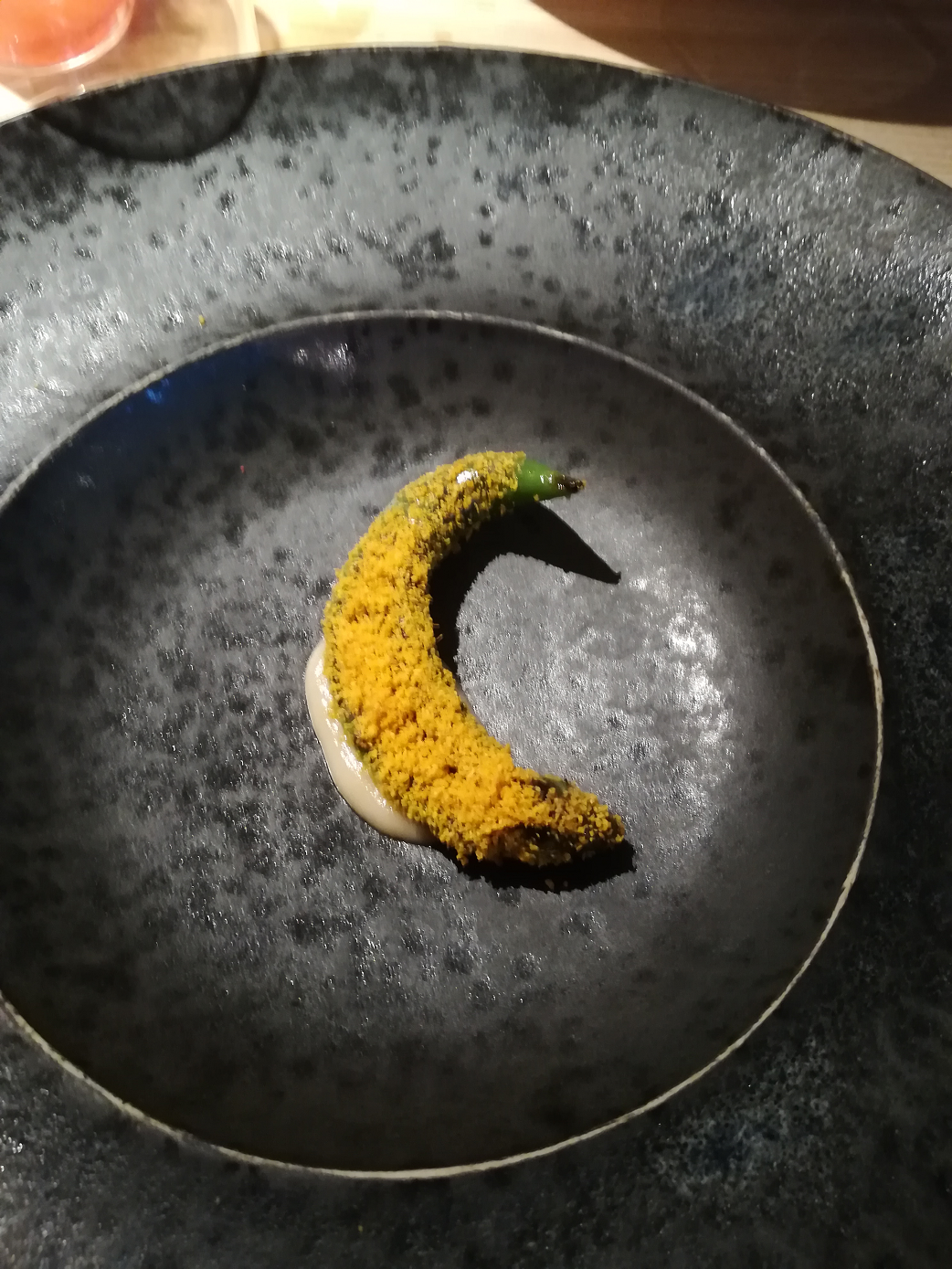
The first course arrived which in terms was a new look on plantain and stew, my two Nigerian grandmothers of blessed memory would have been spinning in their states of repose, but this is an exercise in open-mindedness, where familiarity is dispensed for the whimsical. Authenticity gives way to the uniquely original and surprise. It went down a treat.
[Plantain and a scotch bonnet dip]
Little did I know that I had entered a West African version of Willy Wonka & the Chocolate Factory, I was living the lines of Ikoyi London saying to me, “Come with me and you'll be in a world of pure imagination.” The course had more plate like a tree trying to be a forest, a burnt pepper and a sprinkling of dust with something related to cassava in the narrative. This was a long way from Eba and stew, the ship of our common reality had sailed.
Within 4 visits from crockery to buccal cavity, we were done.
[Burnt pepper and cassava]
Exciting the taste buds
Mackerel is not necessarily fish you will find on the plate of the bourgeoisie, but we were told the next serving was caught today, strips of seemingly poached mackerel on a bed of banga fish paste with vegetables. It was savoury and comfortingly feeling like home cooking. The paired wine only seemed to assume any character in taste after we had tasted the dish. Though I would be honest, all the pairings were lifeless at first taste and not entirely exciting afterwards.
[Mackerel and a banga sauce]
By the fourth course, we had pumpkin and that was a revelation. I had to ask, could you really do this to pumpkin? By now, we were sold on this visit, it was one to write home about.
[Pumpkin]
Jollof the duck
The fifth course was, in fact, two courses, the duck arrived first and then a steaming bowl of smoked jollof rice, both of which were a titillation of a different kind, filling with excitement and a screaming desire for more. Oliver Twist would have died for the lust of the more that cried for.
[Duck and malt bread]
[Smoked Jollof Rice]
You can wish for death
By then, we have the table next to us occupied, in that group of four of probably Europeans or North Africans, the light or my eyes were dim was one Nigerian who was unaware he was being brought to Ikoyi London. The look of amazement, despair and incredulity at what was presented to him could easily have had someone of a different disposition toss the tables and walk out in disgust.
As soon as I ascertained he was Yoruba, I began in a language that would communicate the experience was to be cherished as the difference for which there would be stories to tell about a place called Ikoyi London. It was not about pretensions but innovation, the challenge to open one’s mind and consider that what we once knew does not have to be sacred and impervious to design, artistry and review. That is what Ikoyi London is about.
It’s a lot more wonderful
He asked if the restaurant was one to visit regularly, I could not say that would be wise, but for the whimsy and the occasion, a conversation and gastronomic banter, Ikoyi London would come ahead of many a restaurant. It is the deconstruction of the mundane and typical to create a new essence. This is bold and hardly experimental, it works.
The dessert was a rice ice cream with a biscuit I cannot remember the name of, paired with a cider. One sip had me reaching for my old cocktail. I do not have a palate for lager, beer, ale or cider. It was a miss for me.
[Rice Ice Cream]
It is easy to forget that dinner is a tasting menu and not a meal, which suggests the portions are for tasting as opposed to filling. We had a wonderful time before walking down Jermyn Street and taking a picture with the statue of Beau Brummell.
Ikoyi London is a variation, an exploration, an interpretation and an experience, you will lose more weight in your wallet than you’ll probably gain in ingested food, that is the nature of the location, the standard of service and daring proposition the proprietors have decided to unleash on its adventurous clientele.
There is a discretionary charge and I suppose we rarely exercise the discretion to refuse the charge. The service was top class, the waiters gorgeous and interesting. The restaurant was full by the time we left. Ikoyi London is what is possible if we decide that excellence matters above all else.


Sunday, 25 June 2017

The UK: What can she do? How justice was served in this Human Trafficking case

Empty promises to exploit
The matter I write about today should be a salutary lesson to anyone who has power, influence, authority, means or privilege and is tempted to use that as a means to exploit those over whom they can wield it.
Iyabo Olatunji was a 29-year-old secretary working for a local government authority in Nigeria when she was persuaded by the Adewakuns to leave her job in Nigeria for the UK to serve as a nanny to their two young children.
Iyabo, as a young teenager, was a housegirl servant to an earlier generation of the Adewakun family in Nigeria. This would indicate she was already known to them, and there was some trust already established to persuade her to seek a new fortune in the UK.
Doctor a contract to nurse abuse
Mr Abimbola Adewakun is a nurse, and his wife, Ayodeji Adewakun, is a medical doctor. Through a contract of employment, they engaged Iyabo Olatunji for a salary of £450 a month, working for 6 days a week. She came to replace a Hungarian au pair who left a week after Iyabo Olatunji arrived in the UK.
Whilst the impression of bettering the life of Iyabo Olatunji was what persuaded her to leave Nigeria, the reality of her life in the UK from February 2007 to June 2009 was anything but. [Court News UK]
By May 2009, Iyabo Olatunji had only received four payments totalling £350, and when she asked for proper remuneration, she was physically abused. She worked 18-hour days, was not allowed to use the modern conveniences, including the washing machine, but had to wash clothes by hand. The Adewakuns were cruel, terrible, nasty and horrible employers. [Daily Mail]
With the help of a family friend, with nothing to go to, Iyabo Olatunji escaped the intolerable employ of the Adewakuns in June 2009.
Slow but sure justice
Sadly, it took ages for the wheels of justice to start turning, during which time Iyabo Olatunji’s status in the UK would have been under threat, apart from other issues that might have resulted from her escaping from slavery.
Her case was then referred to the Modern Slavery and Kidnap Unit of the Metropolitan Police by the Migrant Legal Action, and in January 2015, both Abimbola and Ayodeji Adewakun were interviewed by the police. They were charged with trafficking for the purpose of exploitation in November 2015 and appeared in court in May 2017, where they were both found guilty of the charges.
Abimbola and Ayodeji were sentenced to 9 months and 6 months imprisonment respectively, and they are to pay £10,000 in compensation to Iyabo Olatunji as well as £2,520 in court costs. [Metropolitan Police]
She is a person
The Adewakuns were people of privilege and means who thought they were untouchable and unreproachable by virtue of Ayodeji’s professional standing as a doctor and Abimbola’s secured status in the UK. In their minds, Iyabo Olatunji was a nonentity, an insignificant person, a house-girl servant from a Nigerian backwater whose questionable status in the UK left her open to the exploitation they fully took advantage of.
It would never have occurred to them that Iyabo Olatunji was first a person, and every person deserves to be treated with respect, with dignity, and with fairness, regardless of their status in the UK.
They had allowed their sense of entitlement to their own money, which was being wasted on a Hungarian au pair with rights to be clouded by the possibility of exploiting a house-girl servant from Nigeria without any rights in the UK, living in fear of deportation if she dared seek help from the authorities.
Don’t look away
How they must have miscalculated in their atrociously evil scheme. They are now being made to pay up and pay a very high price in reputation, status, and freedom. If they are anything but natural-born citizens of the United Kingdom, they risk being deported back to Nigeria in ignominy.
They belittled and contemned Iyabo Olatunji, treated her as dirt, and this has now washed up on their faces.
However, there are lessons to be learnt from this unfortunate situation, and they must be well learnt.
  • Anyone residing in the UK has the right to be treated as a person, a human being, with respect and dignity – regardless of their status in the UK.
  • If you bring a person over from the sub-continent to work for you, if you are not paying them a fair wage, you’re exploiting that person, and the law frowns on every kind of exploitation.
  • If you know anyone who has employed someone through trafficking for the purpose of exploitation, you have a duty to inform the authorities about what is going on. Failing that, let the employer know it is wrong, and they should immediately make amends; failing that, help the employee escape to seek help from the authorities.
  • Do not let any abuse go unnoticed, unreported or unpunished.

They ruined their own lives
I take no joy in writing about Abimbola and Ayodeji Adewakun, but this kind of abuse happens a lot in Nigeria; that it has been imported into the UK is utterly reprehensible and must be excoriated in the strongest terms. Nowhere should people be exploited in this way, and if it takes going to jail in the UK to make that a lesson for everyone in the UK and abroad, that is a good thing.
I put this situation down to greed and entitlement; it need not have happened. The seriousness of the matter is indicative of the fact that Ayodeji Adewakun has been suspended from practising as a medical doctor, as has her husband, Abimbola Adewakun, from practising as a nurse in the UK. As the attached graphic indicates.
Related Links
Take Action
Modern Slavery Human Trafficking Unit (MSHTU) [National Crime Agency]
Modern Slavery Helpline 08000 121 700
Modern slavery and human trafficking [National Crime Agency]
Migrant Legal Action [The Law Society]
53 Addington Square
London
SE5 7LB
020 3150 1470
Courtesy of the General Medical Council, searched on 25/07/2017

Courtesy of the Nursing & Midwifery Council, searched on 25/07/2017