Showing posts with label architecture. Show all posts

Thursday, 4 June 2026

When the Backstop Becomes the Plan

From Doldrums to Hope

The days carry varying degrees of emotional toll, from the palpable to the expectant; the feeling that you may not be pulling your weight gives way to the exhilaration of success, because what was once intractable became resolvable.

We have moved from a week that seemed to present diminishing returns to one that appears to offer appreciating results. While we are not totally out of the doldrums, there is hope on the horizon, and things have been better than expected.

Governance Left Behind

Yet we get embroiled in administrative issues that should have had governance born from contractual obligation, including the clear requirement specifications that would apply to an architectural design, with guidelines for solutions to be crafted on agreed policy.

A backstop activity, meant only to tide us over until automation could take hold, has evolved into the core solution. This is because resources will not be committed first and, evidently, the architectural element is missing altogether.

Shortcuts Over Policy

The project manager, under pressure to deliver, has short-circuited the process, favouring the concept of ease over the policy guidelines that should govern it. The ideas are lifted off a contract statement and put into play, leaving the implementation resting on broad assumptions.

What we hear is that it must be done because the contract demands it; what we do not have is any documentation describing what is actually to be done. The best element of guidance to materialise today came in an email. However, can governance be run from an email, you wonder?

That is why this is being escalated. I am not convinced a proper resolution will be forthcoming before the pressure to act overwhelms the tendency to err on the side of caution; not out of any impossibility to perform, but because of the absence of governance that informs the processes required.

A Google NotebookLM AI Podcast on this blog

Thursday, 26 June 2025

I've got everything left to achieve

Building for Life

Baron Foster of Thames Bank turned 90 on June 1st. He has left his mark on the architectural landscape of the world, collaborating with fellow architects and many designers. One cannot help but be in awe of how imagination on paper becomes the realisation you can behold.

In one of his iconic buildings, where I used to have lunch in the 1990s, the Willis Building in Ipswich, with black curtain walls contrasting with a yellow and green interior, went on to become the youngest Grade I listed building in the UK.

I remember visiting Berlin and observing how a Foster and Rogers project in that city seemed like you hire Norman Foster to transform a monument into a modern masterpiece, as he did with the Reichstag building, and Richard Rogers to create a monument by building a modern masterpiece, as he did with the Daimler complex.

Everything left to achieve

Architecture has always interested me, but that is not the primary focus of this blog. Interviewed for the Architects’ Journal in May, this last exchange—question and answer—offered an insightful perspective on the man himself.

Gino Spocchia: You’re about to turn 90, an achievement in its own right. As an architect, do you feel there is anything left for you to achieve?

Norman Foster: I've got everything left to achieve. That’s an impossible question. [Architects’ Journal: Norman Foster at 90: ‘I have everything left to achieve’]

My journey to this interview was influenced by listening to Richard Rogers on Desert Island Discs yesterday; he was interviewed in March 1990, and he spoke about his early partnership with Norman Foster, then winning the Pompidou Centre competition with Renzo Piano, and Su Rogers. [BBC Sounds: Desert Island Discs – Richard Rogers]

Propinquity to serendipity

In the 20 years I have visited Paris and sat for brunch on the first floor of Café Beaubourg that overlooks the space in front of the Pompidou Centre, I have only observed people and never entered the centre itself. Richard Rogers passed away at 88 in 2021.

I suppose one first considers the blessing and fortune of good health at such an age, to continue to have zest for life and a purposefulness that suggests you believe you still have much to do and give.

Thinking of continuing potential

For Norman Foster, advanced age is not an end; he embraces a philosophy of ongoing potential, rejecting the cultural narrative that achievement belongs primarily to youth. Meaningful accomplishment remains possible at any stage of life. Retirement is not a part of this man’s vocabulary.

For someone turning 90, this perspective embodies:

  • A refusal to be defined solely by past accomplishments
  • An understanding that wisdom and experience create unique opportunities
  • A rejection of artificial timelines for meaningful contribution
  • An embracing of new goals suited to current capabilities
  • Finding purpose in mentorship, creative expression, or personal growth

I am deeply inspired by this mindset, as I contemplate returning to university to learn from and engage with youthful insights and young minds. I am convinced of the importance of lifelong learning and continuous engagement with a world of possibilities.

Norman Foster exemplifies this life-affirming stance beautifully; if we have consciousness, will, health, and resources, we retain the capacity for meaningful achievement. It is clear he enjoys what he does and will continue for as long as he can. Belated happy birthday, Norman Foster, Baron Foster of Thames Bank.

References

20th Century Architecture: Norman Foster

20th Century Architecture: Richard Rogers

Saturday, 27 June 2020

Just another walkabout

Just by the way of

I begin to write with no idea of what I am writing about, I begin, nonetheless. The thoughts in my mind percolating like coffee being made for a morning pick-me-up.
Maybe I should write about the chance encounter made possible by my taking a detour to take a look at the statue of Abraham Lincoln. Unfortunately, it is in the midst of a construction site and boarded up out of view. I suspect it might have temporarily been moved elsewhere. [Manchester History: Abraham Lincoln]
Then I came upon a bigger restoration site of our city town hall, a Grade I listed building completed in 1877 by the architect Alfred Waterhouse renowned for over 600 architectural works around the UK, including Strangeways Prison in Manchester and the Natural History Museum in London. The town hall is undergoing a 7-year restoration until 2024. [Wikipedia: Manchester Town Hall]
Policing our curiosity
As I read the notices on the hoardings around the site, two policemen walking towards me were sharing information about what changes were being implemented. I was reading a list of the rulers, the rich, the famous and accomplished that had visited the town hall when I suggested to them to have their names on the list.
That began a conversation about the names on the list, the history of the town hall, my discoveries during my walk around Manchester, the joy of travel and so on. We concluded travel broadens the mind out of sheer curiosity and curiosity inspires the need to travel. In something like 20 or so minutes, we had such a meeting of minds that at another time, we would have shaken hands, we didn’t.

Tuesday, 10 December 2019

Unanimous points scoring for my TOGAF® 9 Combined bout


Catching up with the times
It would be easy to write a motivational post, but that is not really my way of doing things, rather, I will just tell my story.
As I related in my previous blog on passing my PRINCE2 Practitioner certification last Thursday morning, I was suddenly furloughed a month ago and rather than sit at home twiddling my thumbs, I considered going on a PRINCE2 course and when I was booking the course, I was offered a bundled deal to do both PRINCE2 and TOGAF certification which just happened for fall on consecutive weeks.
Like project management, I was first introduced to TOGAF just a few months after recovered from cancer by an ex-colleague. I went as far as buying the study guides and registering on The Open Group website, that was just 9 years ago, but nothing really came of it. I even explored doing the course in South Africa then, I eventually went to India instead to attend courses for Microsoft and Cisco certifications.
Keeping the faith
I suppose what made TOGAF a bit of a chore was the volume of theoretical processes that I thought only a classroom training environment could help ameliorate. The Knowledge Academy for all its poor customer service record does appear to have some really good trainers. Mustafa Ahmed took our TOGAF course and from the first day, I began to have confidence, it could be done.
This was my second week of courses and something seemed to have triggered an immune response in me that by the third day of the course, I was coughing, spluttering and running a fever that I had to return home early without acquiring anything. The trainer sent me an update of what was covered for the day and I was able to return for the fourth and last day of the course.
His advice was to take the test within two weeks of the course, or we’ll begin to forget what we had learnt. I first had to get PRINCE2 done from before I could begin to think of scheduling the TOGAF test.
Brought to the edge
It was an exasperating ordeal to get the Exam Bookings department of The Knowledge Academy to forward me the test voucher, it took 3 emails and 4 phone calls over 8 days to get that resolved. The service is an atrocity that makes an appalling review appear too generous for words.
You’re tested to the point of losing your cool and in my view, the staff care not a jot about the frustrations of their customers. It is a test of patience that one has to pass.
When the voucher arrived, I found I could not get a test window at any of the Prometric Vue test centres up north in Manchester, Liverpool, Leeds or Birmingham. Only one test centre London had availability and so I chose to travel to London to take the test today. The test centre could do with bigger monitor screens.
Tested to the limit
I was caught in a quandary of my preparedness, having acquired the official study guides, the full standard documentation and a pocket guide. Something seemed to be missing until I found a YouTube video TOGAF® Level 2 Exam Questions – Tackling Those Effectively! This in addition to the tips I got on the course meant I could be boxing clever to win this match.
The TOGAF® 9 Combined Part 1 and Part 2 Exam is 40 questions for Part 1 in 60 minutes, immediately followed without results for 8 scenario questions for Part 2 in 90 minutes. I raced through Part 1 reviewing a few thorny questions and was done in just under 33 minutes. Part 2 was harder, the recommended approach is 10 minutes per question, I spent 18 on the first and had squandered 30 minutes without a satisfactory answer for the second. Open book tests don’t mean easy results. You will in some instances be told where to go in the TOGAF standard document, it doesn’t make it any easier.
I tried some and skipped some that I returned to for review, by the end, I had just 3 minutes to spare and passed both Parts. Part 1 presents a bit more difficulty as it relies upon memory and specifics from the TOGAF documentation, Part 2 is about the application of the TOGA methodology and I did much better on that by far.
They helped me do it
On reflection, I marvel at the determination and daring that saw me decide to take two highly process-driven courses with much documentation, standard and theory, just 4 weeks ago and in that time clear both tests that give me certifications in project management and enterprise architecture.
Yet, without the amazing support of Brian my partner and my friends Funmilola and Kola, I probably would not have had either the courage or determination to see this through. They are my cheerleaders, constantly telling me I can do it and do it well. It gave me such great pleasure to share my successes with them.
Now to new challenges and rewarding prospects. There is the minor issue of a holiday in South Africa to plan now. Phew! It’s done.

Monday, 4 January 2016

Barcelona is the pickpocket

Back to life
Finally, my year has begun being flung straight into work and emails flying out in typical Akin fashion, long, detailed, particular and quite particular indeed.
I cannot fail to note that I have only spent five nights at home since the 17th of November that has had me in South Africa, in London and I have just returned from Barcelona.
I had considered going much further afield after my birthday, the choices, at first, were the Thailand (Bangkok or Phuket), Canada (Toronto) and the United States (Miami), all places I had never been before, but with so little time to plan for these I defaulted to either Berlin or Barcelona. The latter won for slightly warmer weather.
Of Barcelona again
Now, the last time I was in Barcelona was in November 2008 when I attended the now defunct Microsoft TechEd Europe conference, before that it was December 2006 and my first time in some 18 years ago.
Then, whilst Barcelona was an exciting place to visit, the tourism elements had not been overly commercialised as they are now. I note that Palau Güell and Casa Batlló were not accessible to the public.
This time, I availed myself of the opportunity to visit these masterpieces of Antoni Gaudi’s genius, which if you know anything about Barcelona are a draw for tourists from the world over. The fact that Barcelona has beauty, treasure, culture, architecture, history and nationalism cannot be debated, there are lots to see and do.
It’s all about money
However, for all the tourist things I did, from the bus tours to all the buildings, things I did and the souvenirs purchased, no one can fail to notice how pricey all these places and things are, it is a case of over-exploiting the World Heritage status for outrageous price gouging and profit advantage. The whole idea that what we pay maintains and supports these sites should not excuse the atrocious profit motive of the custodians of these places.
Even the taxi drivers in Barcelona agree that this is the only motive, profiteering. We tourists pay top prices for accommodation, eat in the restaurants, shop in the fancy stores, visit all the places of significance paying full whack and to add insult to injury, as we leave we are charged as city tax. Then for what I paid from city centre to the airport, the thievery continued to the end of my visit.
You gotta pick a pocket or two
They say Barcelona is full of pickpockets, that might be true, but the real pickpocket is Barcelona and all the great beauty of this place is in the process of being marred by the inordinate quest for filthy lucre. I loved visiting Barcelona, but this is not the kind of Barcelona I would like to return to, already, in an honest survey at the hotel where I spent 11 nights, I categorically said I will not return to stay there.
If you are spending more than 5 nights in a hotel and they cannot attempt to make it feel as a home away from home, they neither deserve my custom again nor a recommendation to others. Barcelona can do better, but this time, it was a shame.

Thursday, 31 December 2015

Barcelona: On the trail of Gaudi's genius

Overcoming the fear of flying
I first visited Barcelona some 18 years ago, it was with my partner and it was an amazing experience. My partner then, a design engineering major had things he wanted to see, for me, it was one of discovery.
This was a time when I was trying to overcome my fear of flying, a strange development that took hold over a couple of years, for no particular reason I could explain. I was used to flying from childhood and at many times travelled alone even before I was in my teens.
However, this flight was quite a pleasurable one, I was sat between a father and son who had come over from Australia. The father had emigrated to Australia about 40 years before and now, he had brought his son who was born in Australia to Europe for the very first time and they were doing a modern sort of grand tour.
Gaudi’s Barcelona I learnt
I guess it was the engagement and conversation that took my mind off the fact that we were in the air and in the process, I somewhat defeated my irrational fear of flying.
In Barcelona, for the first night, we walked up a major street and passed an interesting building that seemed to have an eerie living quality about it, little did I know that it was a landmark building, I later learnt it was Casa Batlló and with that I was introduced to the architectural genius of Antoni Gaudí I Cornet.
From a knowledgeable perspective, Antoni Gaudi as he is commonly known was an early proponent of the Art Nouveau movement and particularly what is referred to as the Catalan Modermisme movement. However, to the untrained eye, meaning those who are essentially not architects, we have a different appreciation of these works, the aesthetics, the design and the appearance of buildings and other forms just show an exceptional quality of inspiration and workmanship unmatched.
A madman genius
When Antoni Gaudi received his diploma, the supervisor who granted his the title of architect wrote, “Who knows if we have given this diploma to a nut or to a genius. Time will tell.” Suffice it to say that seven of Antoni Gaudi’s buildings all in Barcelona have been listed as World Heritage Sites.
Then we were only able to access Casa Milà, Sagrada Familia and Park Güell, at that time, Palau Güell and Casa Batlló were not accessible to the public. Now, literally all the Gaudi properties have a form of access for the public to appreciate the work and genius of Antoni Gaudi.
Sagrada Familia, I have visited twice and both times before it was consecrated into a basilica in 2010. Work commenced on this church in 1882 and work is still in progress sponsored by anonymous donations made towards the building and the upkeep. The first time, I went up the bell towers, the building was fascinating but not such a tourist pull as it is now.
No hurry
Of the time it will take to complete the project, Antoni Gaudi said, “My client is not in a hurry, God has all the time in the world for this to be completed.” It is likely, it will take more generations before the work is finally completely.
Yet, on this my fourth visit to Barcelona, I find myself on the Gaudi trail again, with a better appreciation of the uniqueness of this amazing genius, gifted beyond measure and whose life tragically ended as a result of being run over by a tram.
There is much to Antoni Gaudi’s work and legacy, the fact that he defied convention and boldly took strides that were somewhat unpopular, then there was Eusebi Guell, an industrialist who was a patron and sponsor of his work. He championed some of Gaudi’s listed works being respectful of the talent and a very good friend of the man.
The Gaudi trail cannot be done in a hurry, beyond seeing, there is much to observe. You cannot have done Barcelona without seeing what its most famous citizen did in the city. Here is to more Barcelonas.


Tuesday, 7 April 2015

Bucharest: Other impressions

Fashioned for victims
For the wrap on my visit to Bucharest. A few of the things I observed or noticed that might not mean anything significant.
The first few shop windows I passed by on my walks did not have price tags on the wares displayed, it got me wondering if there was a haggling activity in these shops. Again, in such seemingly nice shops, the by word might be, you can't afford if you have to ask the price.
Then as I strolled down the avenue with non-operational fountains from the Palace of the Parliament on Bulevardul Unirii, to the right was a shop called Fashion Victim.
A strange name to call a high-fashion shop, until I noticed the price tags and realised, if you paid that much for this fashion, you probably will feel a victim as you stepped out of the shop. I later saw shops with reasonable price tags.
The novelty of plastic currency notes, with transparent windows shaped in the form of instruments of vocation or of professions of people depicted on the notes. No women, but musical instruments, paintbrushes, birds for ornithology and nature and books featured on the Romanian Leu or Lei in the plural (RON).
The cross they bore
Much as I never really expected an old communist state to have very religious people, the many churches on Calea Victoriei gave another impression besides the fact that I did see people going in as worshippers.
However, what struck me was the number of people who crossed themselves as they passed by the front of the church and were not going in. At least from my Anglican traditions, I thought you only crossed yourself in church and usually facing the altar.
Sitting alone
At Cismigiu Gardens, it was the park benches that caught my eye. Usually the bench could sit four, though on a fine day, people could easily take up the whole bench, however, single-seater park benches were a new one on me.
It was like introducing a sense of private space in a public recreation area, the deck chair mentality applied to the park bench. Whether this is the case in the many parks around Bucharest, I cannot say.
For an audience apart
Most of the historic buildings, monuments or parks have signs with English translations. In fact, I could not help but notice that a building was put on sale with just an English sign, as if it was intended for non-Romanian prospectors – one can only wonder.
However, these signs always attracted my curiosity and I took pictures of some of them that described the history, the architecture and some other fine detail. There are quite a few modern-day buildings on the sites of what used to be monasteries, I wonder why.
Architecture of compulsion
However, at Piața Unirii (Union Square), I thought they had gone too far, whilst now it is the centre of town with gardens and fountains that will work in the summertime, this place used to be the site of a hospital. Yet, sometimes, it is not clear what is in the mind of town planners, especially in the Nicolae Ceaușescu years. This was first conceived in 1986.
Suffice it to say, according to the Wikipedia piece about Anca Petrescu, the chief architect of the Palace of the Parliament - She was involved in many of the 1970s and 1980s so-called era of "systematization" redevelopment projects for Bucharest, which included the relocation of residents for the demolishing of old and poor neighbourhoods, and replacing them with modern buildings with all the necessities under one roof. [Museum of Conflict]
Now, did I not see an aspect of what we might call Totalitarian Architecture somewhere else? Yes, Welthauptstadt Germania. Anca Petrescu was the Albert Speer of Romania.
I guess that is it.


Sunday, 5 April 2015

Bucharest: Bearing left

To the left for what’s left
On my last evening in Bucharest, I stepped out of the hotel and walked up the road to the left on Calea Victoriei.
Hardly 100 metres from the hotel was the Tourist Office, but it was closed. This in my view was information the hotel concierge could have given me to make my visit more eventful. I was quite irked to discover this.
After passing one of the many Orthodox Christian churches on this street I got to a square of significant historical importance.
There are many divides between Western European Christianity and Eastern European Christianity. Our churches are churches are built to different designs and our feasts are on different days. Their celebration of Easter is a week later than ours.
I will not go into church split along doctrinal, theological, linguistic, political, andgeographical lines that caused what is called the East-West Schism in the 11th Century. Romania in the summer time is three hours ahead too.
Respect and revolution
The Revolution Square named for the December 1989 revolution that toppled the Ceaușescu regime where thousands were slaughtered for rising against the dictatorship, the monument could well have been desecrated today.
I got chatting to another tourist from Denmark as I lamented the fact the skateboarders had taken over the place with no sense of history or occasion that warranted the memorial.
The revolution probably predates their births, it was then that one of their number came to compliment my dressing, and then asked to be photographed with me holding a skateboard. I obliged and returning to our conversation wondered if they could ever appreciate the need to view memorials with some respect.
Another mile down of walking and I past the old royal palace, now the National Museum of Art of Romania, a few more orthodox churches, and probably the finest piece of architecture in Budapest, I am told. The Romanian Athenaeum houses the "George Enescu" Philharmonic.


Bucharest: Bearing right

Decision Time
This Easter, my holiday would already have been planned for me if the young man who so pressed me towards the end of last year to be the uncle of the day at his nuptials had kept in contact after he got another job.
I would have jetted over the Atlantic to Toronto, Canada and that will have been some adventure.
Much as I am a creature of habit, some good, others unmentionable, I felt more like going somewhere new and the choices were Krakow in Poland, Bucharest in Romania or Sofia in Bulgaria.
The limitations of flight connections within my SkyTeam Alliance partners’ preference of KLM and Air France online meant Bucharest won out.
Flights and hotels were easy to book and I determined the hotel had an airport shuttle service which I availed myself of.
Bearing right out of the hotel
I did not get to do as much as I would have liked on a first visit, but my hotel could not have been more central than it was. Calea Victoriei is an artery for a tourist's walk rather than for vehicular traffic than you walked from monument to museum to church to whatever else that seemed to have a road branching off leading to it.
On my way to the Old Town, I walked past the bust of Kemal Ataturk, the founder of modern day Turkey, at a time in its history, Romania was part of the Ottoman Empire. In the Old Town, Old Court Museum with active excavation work ongoing was at one time the site of the court of Vlad the Impaler, his patronymic name was Dracula.
One legend I read, which I will not care to verify, because it makes such horrific reading was he arranged a banquet in his own honour and invited beggars, peasants and the destitute to it. Once they sat at the table, he had them surrounded and set fire to the building. This was his way of ridding his city of 'undesirables'.
In the evening, I went to Cismigiu Gardens, which had a lake, a grand house and for all the talk and the menace of stray dogs, now reduced to a tenth of the some 40,000 high had Bark Park, just like a children's play area, you could take your dog there to bark its vocal cords raw.
Grandiose beyond belief
Without much of a guide and the apparent unhelpfulness of the hotel concierge, I could not appreciate the sights as well as one should. The tour buses I was informed do not operate in the low season which extends to the end of April and I was not keen on a private taxicab tour.
Surveying the map at dinner I realised the Palace of the Parliament was a 15-minute walk away. It was one of Nicolae Ceaușescu’s grandest projects. It is second only to the Pentagon in size as the largest single building.
The chief architect, Anca Petrescu, was only 28 when she led the team of architects who designed this monstrosity that you can visit if you come along with you passport for a fee. However, this weekend there was a motorbike event in the grounds and I didn't really think it was worth the bother asking if I could go inside.
Another great Romanian lady
That will be the quest of another visit if and when I return to Bucharest. However, there was a lady, Ana Pauker, who was de-facto leader of Romania long before Ceaușescu, she was for while the Foreign Minister from 1947 to 1952 and she made the cover of the Times magazine as the most powerful woman in the world.
Sadly as the Politburo system of socialist and Communist governments work, keeping in favour is an inscrutable craft of power plays and Machiavellian politics, rivals got her labelled and discredited, having once survived breast cancer she was just allowed to become a translator at the end of her career. A relapse a few years on killed her.


Sunday, 1 January 2012

Incredible India: Bahá'í, the faith and the Lotus Temple

Intrepid and foolish
My first day after the torture of lecture I thought I’ll be the intrepid tourist seeking out the tourist attractions of New Delhi rather than hiring a cab to take me around for the day.
Sometimes I forget that I get disorientated quite easily that my sense of bearing might be lost when I think I am charting a course somewhere.
On agenda was the Bahá’í Lotus Temple and the India Gate, they were as far apart as you could have them in the large expanse of New Delhi but I was confident I will make it.
After 2 changes of the metro I was just about 8 stops from where to get off on the Violet Line; I wondered about that choice of colour but having used Red, Yellow, Blue, Blue, Green maybe Brown would have been an option and Black was out of the question. I had been advised to get off at Nehru Place but the Lonely Planet guide suggested Kalkaji Mandir – I stayed on the metro to Kalkaji Mandir and caught my first glimpse of the temple before I got there, it looked close enough.
Going everywhere but there
However, getting out of the station was a maze that by the time I was out, I had made it into the compound of a Hindu temple before I realised I was off course. I risked the ire of a religious mob too because I could not count the number of leather items I had on my person – belt, phone case, camera pouch, wallet, shoes, bag – everything short of a leather thong.
Turning around, I made for the main road and saw my first pedestrian bridge in New Delhi, built in such a way as to discourage usage; the riser was looking from the side a zig-zag of close to 500m probably to aid wheelchair users and there was a staircase opposite the riser but getting there meant jostling with busy traffic.
On crossing, I came upon serious a National Geographic type enclave or slum as I risk political incorrectness, but I had already realised that the road to great monuments was not paved with finesse at least that much I saw in Agra.
Another Hindu temple but no Bahá’í temple, I was at the point of giving up having walked up and down the road to no avail and really decided on returning to the station.
No gate in sight
As I approached the station, I caught a glimpse of the temple and a smile crossed my face, wiping away the despair that had clouded my countenance as I chided myself for being too adventurous for my own good.
The temple was imposing but there were no directions to the entrance, not from the station where they had put up an advertisement and synopsis of the Lotus Temple or from the roads around the temple.
From the fence, it appeared you could gain entry from a field behind the temple, that ended up in a perimeter walk of the fence around the temple grounds through places the wiser would have done well to retreat from, I did not retreat until I got round to where the gate was.
Learning and viewing
I have gotten used to the security rigmarole; we all have to walk through metal detectors, be frisked and have our bags X-rayed and checked, even at the temple of universal peace.
Not knowing much about the Bahá’í faith, I made for the information centre, walked through the exhibition and sat to watch the 21-minute introduction to Bahá’í which was quite enlightening.
I could not help but think that the premise of Bahá’í was ambitious in that it from my own thinking had found the superfluity of sophistry to suggest that it is the culmination of every revelatory religion allowing for difference by assimilation.
The teachings appear humanist though the monotheistic theme directs the sense of devotion, I could relate to the core elements of the recognition of humankind and the service of religion to humanity which many of the established religions are losing in the quest to fulfil creed and tenet at the expense of the people.
Not my opiate
However, I could not connect with the supposed spirituality of the message, in all, within the supposed difference most religions still to the same narrative – leaders rising out of obscurity with a message for the day, gathering a following, upsetting the political order, earning persecution and either being martyred or dying.
Each person is persuaded of their convictions and as Karl Marx once said, in German, “Religion is the opium of the people.” Opium is a drug – a painkiller, a sedative, a narcotic, a stiller, a dream-inducer that can separate people from reality into fantasy, it offers the succour of numbness in the presence of pain and suffering – Religion does in many cases opiate, on my way to the Lotus Temple, there was a queue almost a kilometre long of people mostly unshod and certainly well-dressed trying at access a Hindu temple – Go figure!
Not another burning bush
After the exhibition, I walked towards the Lotus Temple and there realised we had to bag our shoes to walk the hallowed confines of this amazing architectural edifice that they say draws more visitors than the Taj Mahal.
I thought the Taj Mahal was awesome even though it is a mausoleum, but I was not ready for another “burning-bush” experience of walking unshod when my own religion does not make that a requirement of others. There might be a conservation concept behind this but it has not been suggested.
The deification of humongous premises as the incumbency of the holiest interactions in my view belongs to centuries past, the matter of devotion is purposefully of the heart, if it still beats to some rhythm; that we are gathered together for the purpose of worship does not change the building into the throne of deity but that is just an opinion – I passed on the opportunity and clicked away with my camera from afar.
Not!
Now that the Bahá’í have ensconced themselves in sprawling landscapes in Israel and have erected amazing architectural beauties on all continents, they probably have a claim to some legitimacy but they did not come close to when King Agrippa said to Apostle Paul, “Almost thou persuadest me ...” I am neither convinced nor persuaded but impressed, yes, impressed, indeed.
Then I was off to the India Gate.

Monday, 26 December 2011

Incredible India: The Majesty of the Taj Mahal


A story told again and again
It has taken me a week to really be able to write about my visit to the Taj Mahal, the other blogs I have written were about arrangements, the journey and other experiences.
I was always of the impression that the Taj Mahal deserved a separate blog though I recognise that I might fail to give the experience the narration worthy of the place, it is one of those places that will never convey fully without a personal physical presence to breathe the air and savour the atmosphere of that amazing wonder of the world.
Having our own cab meant we had more control over our journey to Agra with opportunities to stop at the great temples of Mathura, the birthplace of Lord Krishna to take pictures of the great statue of goddess Durga, see manure farms, visit the site of Akbar’s tomb, do the Taj Mahal and the Agra Fort.
Tourist benefits
On my first visit, in a tour group of 10 with a tour guide that had literally annoyed everyone with his antics, we got a few pointers as to the layout and some minor detail, then we were left to our own devices.
The benefit of being a high value ticket holder was soon evident; locals just paid INR 20 to see this amazing wonder of the world in their backyard but with that came interminable queues and some jostling. We however could jump all the queues from security checks through access to all the different places.
The toilet facilities are free whilst Indians are levied and if you do visit other Agra Development Authority sites as Fatehpur Sikri, Agra Fort or Sikandra, no taxes will be levied on production of your Taj Mahal ticket for a same day visit.
The majesty
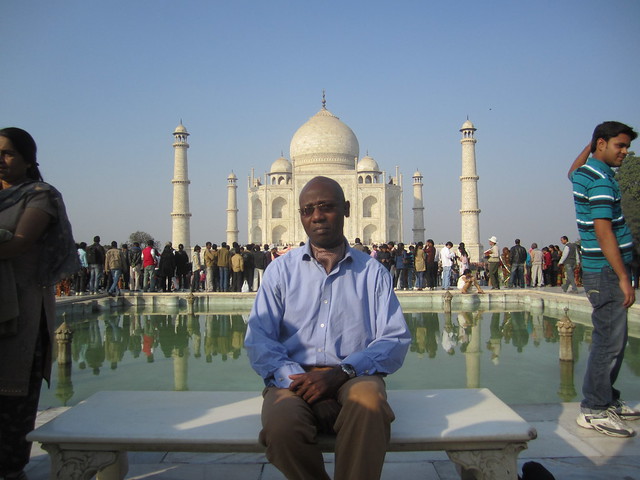
Coming through the main gate, the majesty of the Taj Mahal was evident and amazing, nothing I have seen before could describe that view regardless of all the other pictures and depictions I have seen before, it was an imposing indescribable beauty, attractively enduring, preserved for centuries; a historic monument, a tomb, a mausoleum and an edifice to the loss of love to death.
Yes, the Taj Mahal is a tomb, built upon the grave of Mumtaz Mahal, the 3rd wife of Shah Jahan; a union of marriage borne of love rather than political allegiances, but she died giving birth to her 14th child.
One can only behold the magnificence of Islamic architecture, the undeniable symmetry, the excellent workmanship, the exquisiteness, the fact that no cost seemed to be spared in erecting these edifices that have inspired awe and wonder across the globe to be admired by those who have travelled from far and near to gape, gawp and gasp.
In and around
My trainers were too big for the shoe covers that I received along with a bottle of water that I had to leave them in the shoe rack. There are so many prohibited items you cannot take within the grounds of the Taj Mahal that I had on both occasions put my bag into storage, first for having a tiny MP3 player and then for having my netbook.
Considering what we could do with phones and cameras, the logic of barring the other things escapes me, but those are the rules. Shah Jahan was buried beside his beloved wife having first been deposed by his son and banged up in a cell facing in the Agra Fort facing the Taj Mahal.
His grave being the only asymmetrical thing in the whole place. I enjoyed the company of many drawn to me for all sorts of reasons who wanted to have their pictures taken with me. We all had fascinating stories to tell and in all I probably shook over a hundred hands.
Besides the Taj Mahal, there is the mosque, the guest house, the museum and other out buildings, all cannot be done in two visits, maybe not even in five.
Just once, if able
For my second visit, I had my personal tour guide whose knowledge was invaluable and activities were very helpful especially in taking the most important pictures around the Taj Mahal.
Even so, it was all the more amazing; looking at the Taj Mahal from any angle still is awesome. However, within all this there are dangers from either those looking for a quick buck through to the fingers trying hard to prise my mobile phone from my belt holster when I was trying to retrieve my shoes from the shoe rack.
The tight fit saved the day as I whipped the hand away from my mobile phone – but let that not take away from the day that I even had the opportunity to take a seat where Lady Diana once sat. You must if you can, visit the Taj Mahal, if just once in your life.
My Taj Mahal Slideshows
Some Pictures of Delhi and my 1st Visit
Pictures of our journey to Agra, the manure farms, stopover at the temple in Mathura, the birthplace of Lord Krishna, the great statue of goddess Durga, the site of Akbar’s tomb in Sikandra, the Taj Mahal and the Agra Fort.


Sunday, 21 November 2010

Maison Tropicale - Grand Projects

The context of grand projects

The most recent grand project in Africa was the 2010 FIFA World Cup and that had its detractors. Many who thought the billions spent on hosting the jamboree could have been better spent on development and poverty alleviation projects.

In some ways, there is feeling that grand projects should be sited anywhere else but Africa until it develops to a certain standard of living before it gratifies itself with something big.

Apart from a major art commission in Senegal, the issue of the Basilica of Our Lady of Peace of Yamoussoukro [1] in Cote d’Ivoire was discussed, this was at one time in the Guinness World Records the world’s largest church.

In context, the Catholics of Cote d’Ivoire are quite proud of this church as theirs in Africa and it was consecrated by Pope John Paul II in 1990.

For the masses and for excellence

As we discussed this, it reminded me of Oprah Winfrey Lady’s Academy for Girls [2] (OWLAG) in South Africa where the American media mogul had sunk $40 million of her own money to create an institution of educational excellence.

Many thought it would have been better for her to create 40 $1m schools instead but I offered the argument that it the job of governments to build schools for the populace and if Ms Winfrey were to spread resources thin in this manner, she would who have to rely on already failing governments to manage and run those schools.

OWLAG as a beacon of educational excellence can serve as a standard of what is achievable just as grand projects that foster pockets of development and create aspirations to raising the standards of living and quality all around Africa.

The springboard of grand projects

Whilst sadly the Maison Tropicale prototypes did not get rolled out to the 10,000 units originally planned they could have provided an upward review of traditional architectural practices and the ease of dismantling the structures could have made for easier provision of housing.

Unfortunately, those were lessons we failed to learn but 33 years after the event in the Nigeria, the villages built [3] for the 2nd Black Festival of Arts and Culture (FESTAC ‘77) represent one of the largest housing projects ever embarked upon in Africa.

Sources

[1] Basilica of Our Lady of Peace of Yamoussoukro - Wikipedia, the free encyclopedia

[2] Oprah Winfrey Leadership Academy for Girls [akin.blog-city.com]

[3] Festac Town - Wikipedia, the free encyclopedia

La Maison Tropicale Series

Maison Tropicale film in Amsterdam

Deconstructing Maison Tropicale - Introduction

Maison Tropicale - Ownership

Maison Tropicale - Heritage

Maison Tropicale - Corrupt enterprise

Maison Tropicale - Grand Projects

Maison Tropicale - Corrupt enterprise

Corrupt enterprise

The audience might have worn a wry smile when the camera focused on an interview with one of the top government officials in Congo Brazzaville.

He completely denied knowledge of the removal of the Maison Tropicale prototypes and offered that he only really learnt of their disappearance and the circumstance around the situation at the interview.

It was not convincing, silver had definitely crossed palms for the removal of that structure beyond the payment that was made to the landlady who used the paltry sum she made compared to current market value of the prototype to become a powerful slum landlord developing all the land surrounding the original prototype foundations.

In Niamey, the people seemed to have a lesser claim to the prototype and simply felt powerless in preventing their monument from being dismantled and carried away.

Powerless people

In the words of that neighbor, she said, “Poor people have no power”. This again represents the helplessness of the ordinary African in exacting their rights and getting justice.

In age-old colonial-speak, they gave us the Bible and took our land; in this case, they offered a few bronze coins for the prototypes and sold them for truckloads of gold.

The money they paid would have smoothed the bureaucratic hurdles that would have impeded the opportunities to take the prototypes out of the countries with the blessing of government officials who were supposed to hold African treasures in trust for the people and ensure they are not pilfered for personal profit of as it were art thieves.

The need for reeducation

However, without a strong sense of ownership and an appreciation of heritage very little can be done to generate the activism that would militate against African treasures being stolen out of African for the business enterprise of thieves.

There is a reeducation context to this which should include embracing our colonialist past and what came with it with the greater prospects of proud African history open to tourism and the recognition of our culture in situ.

La Maison Tropicale Series

Maison Tropicale film in Amsterdam

Deconstructing Maison Tropicale - Introduction

Maison Tropicale - Ownership

Maison Tropicale - Heritage

Maison Tropicale - Corrupt enterprise

Maison Tropicale - Grand Projects

Maison Tropicale - Heritage

A lack of appreciation

Moving on from the ownership context of Maison Tropicale, when these prototypes were somewhat rediscovered for the world that would better appreciate them, they were literally derelict.

The building in Congo Brazzaville was like a castle with a moat of overgrown weeds and shrubs, occupied by a lady who returned home after the death of her father to an inheritance that had been usurped by his relations leaving her this structure that no one thought had value.

In Niamey, the building was not occupied but one of the neighbours reminisced saying the building was like a big sister and very good shelter from the rain. This was what she missed the most about the prototype.

What is heritage?

The appreciation of heritage grows from a sense of ownership and it was a revelation when one of the important interviewees said that heritage was an un-African thing bordering on taboo.

One can almost agree entirely with this assertion, there are many historical places in Africa that have failed to realise the level of conservation that exudes national pride at first before leading to tourist interest apart from the Egyptian world treasures.

If much care and attention had been paid to these structures in Africa, it would have been impossible or quite difficult to remove them from their locations in Africa to Europe and other parts of the world.

It is arguable that if the Egyptian pyramids could be transported they might well have found homes elsewhere, the Maison Tropicale prototypes were modular and easy to dismantle [1]; it just needed someone with the means and wherewithal to cart them away.

The pillage continues

Africa has consistently suffered the pillage of her treasures and the removal of these very large structures in broad daylight as late as the year 2000 is more an indictment of our sense of ownership and heritage than of the corrupt enterprise that allowed the action to take place.

It was interesting to see the activism that seemed to follow the removal of the buildings depicted in the film but given the appreciation and value these prototypes have now gained in Paris and New York, I doubt if those prototypes would ever return to Africa

We are left to view the foundations of the prototypes where domesticated livestock graze with the regret of what could have been.

Sources

[1] YouTube - Jean Prouvé – 3D Animation construction of La Maison Tropicale

La Maison Tropicale Series

Maison Tropicale film in Amsterdam

Deconstructing Maison Tropicale - Introduction

Maison Tropicale - Ownership

Maison Tropicale - Heritage

Maison Tropicale - Corrupt enterprise

Maison Tropicale - Grand Projects