Showing posts with label park. Show all posts

Thursday, 29 April 2021

Almost a stranger seeing some danger

A man in a park

How the familiar can easily rob you of the peculiar is sometimes the spectacle of living in Manchester and watching the interplay of people, property, and services. My local Sainsbury had closed when I got up from my nap and I needed to get some essentials leaving the shop at the Manchester Piccadilly Station the closest that is open until midnight.

Donning my walking gear as I was just a two-score steps short of my daily 10,000 step threshold, having aborted my walk, earlier because it had begun to rain and I was not wearing suitable apparel. Out by the Vimto monument in Vimto Park, a police car was parked on the kerb and I spotted two policemen apparently chatting to a man sitting on the bench.

A man on a limb

Maybe to eliminate the strange and wary, one of the policemen called out a greeting to be me as I passed, and he waved as I acknowledged him. Minding my own business I trotted down the rather quietly deserted road that has a few student hostel blocks until I got to the main road and crossed it into the station.

Up the escalator and via the one-way system in a station that was for years familiar and now remote as to be changed into the unknown. I have not boarded a train there since the first week of December 2019, I got to Sainsbury’s and picked up a shopping basket. A couple of bananas and then an altercation between a member of staff and a customer, whether it was a power trip or something else, the customer was being thrown out and the guards were ready to manhandle him. Some things he said were borderline unprintable.

A man to be cuffed

I continued with my shopping, some milk, tea, and sparkling water, using the self-service till I walked out seeing a man grab about 10 shopping bags that go for 10 pence each, that would be stealing or shoplifting, to put it mildly. I must have missed where he went because as I reached the bottom of the first escalator, I could have sworn those bags were a pile of litter caught in the teeth of the moving steps of the escalator.

On to the main road and back on the route I plied on my way out not expecting to see the policemen I saw earlier, there was a police van parked in front of the police car and 4 men in uniform apparently trying to get a hold of someone lying on that same bench, like he did not want to be taken away. 

I doubt the person had a medical issue, else the van should have been an ambulance. As to why the policemen were there in the first place, considering the road is private with a lifting bar gate, one can only surmise someone alerted them to the presence of a strange man in Vimto Park.

Wednesday, 31 March 2021

Coronavirus streets in Manchester - XXVI

People are outside

Out on my walk this evening, as I approached a bus stop, a lady with her mask on was frantically waving down the double-decker bus to stop, I am sure the driver saw her, but he did not stop, the driver had forgotten to change a sign on the destination indicator on the front of the bus, ‘Bus Full’, or something to that effect, it should have said.

Down at the park as dusk turned to dark that without lights or a reflection, you will not notice anything a few metres ahead of you, the sounds of revelling from all directions met my ears. People in groups of sometimes more than six, sitting on the grass chatting or chuntering away, oblivious of others and the pandemic that kept us sequestered for months.

Signs of change

The rubbish bins stacked and overflowing, empty bottles of all kinds of drinks standing on and around the bin. Bags of rubbish that did not fit in the bins strew around for others to clean up after the many who cannot keep their litter until they get home. I guess that is what our council tax goes towards.

The theatre down the road that has been closed since early March last year has become a beehive of activity, not that there are patrons or theatregoers about. The signs for The Phantom of the Opera that was to be playing this time last year have remained up, you wonder if things would take off from where they left off. Two long caboose trailers without their cabs are parked outside, I think they are preparing for an opening.

Some hotels that have been closed for months now have their lights on, someone or people should be there, for in these observations, you can feel that things are coming back to life, we might not return to normal, but we are setting ourselves up for a new normal and hopefully a better normal.

Tuesday, 7 April 2015

Bucharest: Other impressions

Fashioned for victims
For the wrap on my visit to Bucharest. A few of the things I observed or noticed that might not mean anything significant.
The first few shop windows I passed by on my walks did not have price tags on the wares displayed, it got me wondering if there was a haggling activity in these shops. Again, in such seemingly nice shops, the by word might be, you can't afford if you have to ask the price.
Then as I strolled down the avenue with non-operational fountains from the Palace of the Parliament on Bulevardul Unirii, to the right was a shop called Fashion Victim.
A strange name to call a high-fashion shop, until I noticed the price tags and realised, if you paid that much for this fashion, you probably will feel a victim as you stepped out of the shop. I later saw shops with reasonable price tags.
The novelty of plastic currency notes, with transparent windows shaped in the form of instruments of vocation or of professions of people depicted on the notes. No women, but musical instruments, paintbrushes, birds for ornithology and nature and books featured on the Romanian Leu or Lei in the plural (RON).
The cross they bore
Much as I never really expected an old communist state to have very religious people, the many churches on Calea Victoriei gave another impression besides the fact that I did see people going in as worshippers.
However, what struck me was the number of people who crossed themselves as they passed by the front of the church and were not going in. At least from my Anglican traditions, I thought you only crossed yourself in church and usually facing the altar.
Sitting alone
At Cismigiu Gardens, it was the park benches that caught my eye. Usually the bench could sit four, though on a fine day, people could easily take up the whole bench, however, single-seater park benches were a new one on me.
It was like introducing a sense of private space in a public recreation area, the deck chair mentality applied to the park bench. Whether this is the case in the many parks around Bucharest, I cannot say.
For an audience apart
Most of the historic buildings, monuments or parks have signs with English translations. In fact, I could not help but notice that a building was put on sale with just an English sign, as if it was intended for non-Romanian prospectors – one can only wonder.
However, these signs always attracted my curiosity and I took pictures of some of them that described the history, the architecture and some other fine detail. There are quite a few modern-day buildings on the sites of what used to be monasteries, I wonder why.
Architecture of compulsion
However, at Piața Unirii (Union Square), I thought they had gone too far, whilst now it is the centre of town with gardens and fountains that will work in the summertime, this place used to be the site of a hospital. Yet, sometimes, it is not clear what is in the mind of town planners, especially in the Nicolae Ceaușescu years. This was first conceived in 1986.
Suffice it to say, according to the Wikipedia piece about Anca Petrescu, the chief architect of the Palace of the Parliament - She was involved in many of the 1970s and 1980s so-called era of "systematization" redevelopment projects for Bucharest, which included the relocation of residents for the demolishing of old and poor neighbourhoods, and replacing them with modern buildings with all the necessities under one roof. [Museum of Conflict]
Now, did I not see an aspect of what we might call Totalitarian Architecture somewhere else? Yes, Welthauptstadt Germania. Anca Petrescu was the Albert Speer of Romania.
I guess that is it.


Monday, 25 August 2014

Walks through the cycle of life

 
Manchester walks
Continuing on the subject of my walking, I chose to walk towards the east of Manchester, the temple of Manchester City Football Club, Etihad Stadium and the SportCity area where the 2002 Commonwealth Games was hosted.
Having lived in Manchester for almost 6 months, I have only just begun to explore its environs. In fact, I have never been this far before and I only once walked in this direction when I was looking for an apartment, the adventurous self in me preferring not to return the way I went out.
Fuzzy mapping in the brain
My bearings are a mess though, because there times I have assumed roads or paths would lead to places I know, but almost never get there, a bit or perambulating and gallivanting, minutes almost counting the hour, I find that slither of salvation, a place I know and I am thankful I have not had to tell anyone that I am lost.
My walk took me down the Ashton Canal towpath where I saw a lady at the helm of canal boat wending its way upstream with her partner and a friend operating the water locks.
El Capitán
I saluted her with the greeting, el Capitán as we struck up a conversation about her boat, where they were going, how the water locks work and some other small talk. They had had the boat for two years and they were going up river to have it serviced. Meanwhile, they were in their third day of this journey from home wharf for dry dock, fascinating stuff.
I then helped in swinging the gates open and shut before I continued my walk.
Walking along
Soon I was at grand walkway to Etihad Stadium, I had one quick take before I returned to the steps from the canal scaling the double-steps up and running down the single steps, creating a bit of a pant and a workout before continuing on to Philips Park.
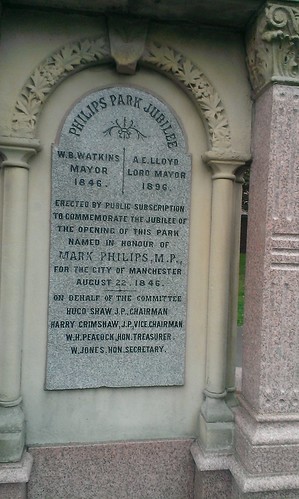
Philips Park, named for Mark Philips, the local Member of Parliament was open in 1846 after he committed himself to obtaining an open and free public space for the common man.
The River Medlock runs as brick-lined culvert through the park, so done because of the floods in 1872 that disinterred bodies and washed them downstream. The river could easily be mistaken for drainage, well, it is not.
There are serpentine paths all around the park with sections for children, cycling, rugby and other sports. It has memorial gardens and beyond the main park is the Philips Park Cemetery which opened in 1866.
People and things
As I walked through the park, I saw a boy of probably not yet 13 years of age sat on a bench smoking, he had ridden into the park on his bicycle and found a secluded spot to engage in this vice.
Soon, I walked into the cemetery where he definitely was not following his mother's advice by choosing to talk to strangers. Precociously, as he asked for how to get to the nearest tram station and I averred that I was new to this place, he wondered if I knew where I was, I had to use Google maps to point him in the right direction.
The grounding of cemeteries
In the cemetery, I observed many things; the quiet and stillness, a stillness in spirit, in mind and in body that is rest.
Yet, rest must not be an end, it must become part of the cycle of life and living, the opportunity we seize to get away from it all, the rat race and the hustle and bustle of chaotic living.
I recognise that in Africa we rarely visit cemeteries apart from when we put the dead to earth, I discovered that in England, cemeteries are so well kept, a job managed by the Friends of Philips Park Cemetery and they do provide quiet places for contemplation away from any disturbance. I eventually connected with this mind-set.
Beliefs for eternity
The cemetery had sections for the burial of Church of England, Roman Catholic, Jewish, non-Conformist (English Dissenters) - whatever that means and so on. It was like our beliefs usually handed down from our ancestry follow us through life whether we adhere to them or not and those beliefs decide where we are laid to rest. I would probably return to my Church of England roots than look for anything else.
One thing you could not miss in the cemetery with the power and the presence of love, many tombstones with the phrases, “In loving memory of”, "The dearly beloved", "The loving husband, wife, son, daughter of" with the day they died and at what age.
There was one tombstone that thanked the lady for being a wife of 53 years, in love and more, I was moved. The fact is in death, whether we mean it or not, love appears to conquer all.
Death is where resignation and acceptance meat at the ritual of ashes-to-ashes and dust-to-dust, when the dead are gone, they are gone, we bury or cremate them and keep the fond memories of them in our hearts and minds.
Other things
Leaving the burial ground, I returned to Philips Park to find out more about the park, and found a Peace Memorial that had a prayer written by Marianne Williamson but often attributed to Nelson Mandela, wrongly spelt with a double l.
The picture I took had a family who would have no idea what memorials are about clambering over it and it was clear that this activity by many other Philistines as these had damaged parts of the beautiful artwork, I was saddened and close to being angered.
This time, I walked back the way I came, quite refreshed and enlightened. I wonder where next my footsteps would take me. The other pictures.

Friday, 9 September 2011

Thought Picnic: Signposts for bicycles bearing West

The life of blogs

What I began in my last blog basically ended up in a narrative about visiting the graveside of a dear friend. That is one thing I have learnt about my blogs, I start to write and they can suddenly take on a life of their own and I just let it continue to the point where it appears to close off to the conclusion.

The main thought that inspired the blog then ends up in another blog and so here goes – I had planned to cycle out to Zandvoort which is at the coast and for once dispel that notion I have always had of beaches needing to be at certain latitude to be allowed the encomium of beach status.

Everywhere bearings awry

The implication being, you need sun along with your sea and sand to have a decent beach, but I was in for a surprise. It was a bit dull and at times the sun came out though there was the threat of rain, a few droplets were not going to dissuade me.

After viewing Google Maps for a basic idea of the distance, I decided I was going to use my bearings and rely on the signposts all along the way from Amsterdam to Haarlem and then to Zandvoort.

I ended up in the strangest places, deserted, desolate and sometimes dangerous, I knew there had to be a better way but I did not deviate from the advice of the bicycle path signposts.

The vista of amazing nature

By the time I got to Haarlem having ridden for the best part of 2 hours, it was comforting to know I still had another 17 kilometres to go, it was not tiring, the determination just kept me on.

Then I got the unusual landscape, the grassy dunes with the signs pointing in all directions that I put on my most English deference and asked a lady who had just blown her dog whistle to summon her dog how to get to the beach.

Another 4 kilometres straight down the path that was far from straight or direct but my bearings were towards the sea, a few double-takes later, the North Sea lay in front of me as I appreciated the wonder of the sea.

The Zuid-Kennemerland National Park

I rode up the promenade towards Bloomendaal aan Zee and then turned into a National Park which seemed to have interminable lengths of bicycle paths and ran for kilometres and kilometres.

The landscape was amazing; I never expected to see forests and the kind of natural features of land and water that I saw in this park especially not in the Netherlands and definitely not in the province of North Holland.

I was in awe and I probably did about 20 kilometres within Zuid-Kennemerland National Park and that hardly covered much of the large expanse of this jewel of nature.

A route so different

When I got back to the entrance some 3 hours later, I saw another signpost on the bicycle path back to Amsterdam, it literally was parallel to the main road back to Amsterdam and this time the 22 kilometre journey back to the outskirts of Amsterdam was without much adventure – a straight road and knowledge gained as to how to get to Zandvoort without getting marooned like the Israelites in the wilderness.

It goes to show once again that the journey of discovery can be quite complicated driven by determination but the return is always a lesson in knowing that there are probably better ways of doing what you tried out earlier.

It has taken me over 11 years to come to the realisation that I do live in quite a beautiful country, however, that depends on the willingness to travel, ride and walk.