Showing posts with label cemetery. Show all posts

Monday, 17 August 2026

The Ghosts We Author Ourselves

A Late-Night Encounter

A while ago, on a walk late at night, I unwittingly wandered past a disused cemetery. It occurred to me that I was looking at tombstones left unkempt in grounds untended, ensconced between a road junction and a cluster of residences.

I was immediately in a heightened state of anxiety, expecting, through the power of mental suggestion, to see something, and yet dreading whatever it might be. My rational mind insisted there was no reason to run; and on reflection, I determined there was none to be afraid either.

An Impressionable Mind

Even so, I know how my impressionable young mind, in the past, has conjured apparitions, visible only to me, of dreadful things I find difficult to talk about.

An AI-generated infographic on the blog content. (Click to enlarge.)

For this reason, I avoid anything that invites paranormal phenomena, including horror films, since I am perfectly capable of dreaming up anything without the need for a prompt.

Back in March, when our apartment overlooked a Jewish cemetery from the seventh floor, we would close the windows and draw the curtains once it grew dark, refusing to let our avoidance of the unknown take hold.

Why Fear the Peaceful Dead?

There is a strange irony here worth pausing on. A cemetery is, by any rational measure, among the most peaceful places we might ever be; quiet, still, and given over entirely to rest. And yet we fear it.

That fear, I have come to think, is not something the ground itself emits; it is something we bring with us, inherited from the tales, fables, and stories we absorbed long before we could question them. We frighten ourselves with a script written by other hands.

The unknown, in many senses, is precisely that: we have no inkling of what is out there, or of who that patch of land once harboured or memorialised. But that very lack of knowing should work in the opposite direction.

If I have no association with these graves, no bond with those who lie beneath them, no shared history at all, then why on earth would the dead, or any other world, take the slightest interest in me? Why would they trouble to cast me as the leading player in some living horror film, with themselves as the supporting cast?

Nothing Buried Here

Put plainly, the less connection there is, the weaker the hold it should have on us. Then I found myself wondering about the humorous placebo effect of a tombstone planted as a prank, with nothing buried beneath it, yet still exerting the full graveyard effect on anyone whose imagination readily runs wild. It is proof, if any were needed, that the fear lives in the beholder and not in the stone.

The least association, then, should leave no true affinity, only a sheer, willing victimhood scripted by a fearful mind. How hard it is to unlearn the tales, fables, and stories of ghosts, ghouls, and banshees. On that night, I also knew that if I were confronted with anything, I would engage with it and stand my ground.

The Voice in the Dark

Then, out of the recesses of a nearby building, someone appeared and said hello. This time I had the presence of mind not to jump out of my skin, and as I made sense of it, I realised it was a homeless man. He most certainly had not come from the graves; and if he had, it was nowhere near as bad as I had imagined.

A Gemini Notebook AI Podcast on this blog

Thursday, 24 March 2022

Walking to observe and notice

Off the beaten path

Not down the usual walking route did I ply but rather down the Ashton Canal towpath from Paradise Wharf to Islington Wharf between which mechanical cranes and hoists of history have become monuments of the industries that once thrived here. Now, we have bijoux apartments and waterfront properties, a kind of exclusivity not nearly as exciting as it seems apart from when the canal forms an aqueduct over Store Street.

The further straight on this towpath leads to isolation, but for a sunny day, many are walking in groups to and fro, a kind of busy that is usually reserved for football match days but let us not be distracted from our surroundings and the oncoming traffic of senseless cyclists. The numerous canal locks holding back water as overflows give a sense of life.

Nature in many guises

Life in ducks, geese, and birds, they all are quacking, honking, or singing, in unison, separately or a disordered cacophony, not in need of the marshalling of a choirmaster. The music of nature is more settling than the blaring of headphones in covering your ears that you are totally unaware of what or where you are. If only they could just pocket their mobile phones for a moment and see something else.

One man and his dog, that dog a beast instead giving the person a status of terror for he could earn fear masquerading as respect no other way, then another dog, fluffy and friendly being called away from a couple sitting for a quiet talk. Just before you saw the fouling of the path, and I suspect the beastly dog, for the owner at one look did not appear the civil kind, yet, I have been wrong making such judgements.

A sport to thrill

Even as I have not decided how much further I want to go, I probably will go as far as this towpath will take me, my height is many times challenged by the low arches of bridged straddling the canal, I stoop or bow as I walk keeping an eye for some who care nothing for other users of this way.

Walking at speed, I pass another couple whilst resisting the urge to eavesdrop and then to my right over the canal is the Etihad Campus, with the football stadium of Manchester City Football Club and I recall when I could not persuade my best friend, a Manchester United fan to walk into that ‘abominable’ sanctum, though he might have had considered visiting for a local derby, I’ll ask.

Love in the park

One more bridge to duck and the windy path veers off the canal and I am presented with the entrance to Philips Park and I have not been here in years, many years at that. Two men have been ahead of me all the while, interesting from my perspective and something about them suggests more than meets the eye.

Into the park, they walk, down one of the more secluded routes that goes by the culverting of the River Medlock, the handiwork of brutal Victorians, that defines the boundary between the park and the cemetery. I am not following or trailing them, but I am just slightly behind them, then they touch and hug, I knew it all the while. They are getting more affectionate and honestly, why should I be shocked?

Just as I turn to cross over the River Medlock into the Philips Park Cemetery, they are now making their way back towards the park and in a moment of overwhelming passion, they embrace and kiss, that remains for a while or it is my persistence of vision deceiving me, for in that moment, I see love and think of love, then I wonder when Brian and I will walk about again, and give this spectacle to another narrator.

Monday, 19 June 2017

Edinburgh of the dead

And so, I strayed,
To places that made me afraid,
A city of many hills,
That surely gave me the chills,
It has so many ghosts,
Beware they might be your hosts.
By Regent's Park, I walked,
In the wariness of the stalked,
To wit, in the rubble, I saw,
A hand outstretched live and raw,
Before fear gripped me so to run,
My senses deigned it belonged to someone.
In this stroll, I wrote and thought,
What a place to be highly wrought,
Stones and memorials mark the places,
Of souls and works of long gone faces,
A city strewn with graves,
Of the dead, we became as slaves.

Monday, 25 August 2014

Walks through the cycle of life

 
Manchester walks
Continuing on the subject of my walking, I chose to walk towards the east of Manchester, the temple of Manchester City Football Club, Etihad Stadium and the SportCity area where the 2002 Commonwealth Games was hosted.
Having lived in Manchester for almost 6 months, I have only just begun to explore its environs. In fact, I have never been this far before and I only once walked in this direction when I was looking for an apartment, the adventurous self in me preferring not to return the way I went out.
Fuzzy mapping in the brain
My bearings are a mess though, because there times I have assumed roads or paths would lead to places I know, but almost never get there, a bit or perambulating and gallivanting, minutes almost counting the hour, I find that slither of salvation, a place I know and I am thankful I have not had to tell anyone that I am lost.
My walk took me down the Ashton Canal towpath where I saw a lady at the helm of canal boat wending its way upstream with her partner and a friend operating the water locks.
El Capitán
I saluted her with the greeting, el Capitán as we struck up a conversation about her boat, where they were going, how the water locks work and some other small talk. They had had the boat for two years and they were going up river to have it serviced. Meanwhile, they were in their third day of this journey from home wharf for dry dock, fascinating stuff.
I then helped in swinging the gates open and shut before I continued my walk.
Walking along
Soon I was at grand walkway to Etihad Stadium, I had one quick take before I returned to the steps from the canal scaling the double-steps up and running down the single steps, creating a bit of a pant and a workout before continuing on to Philips Park.
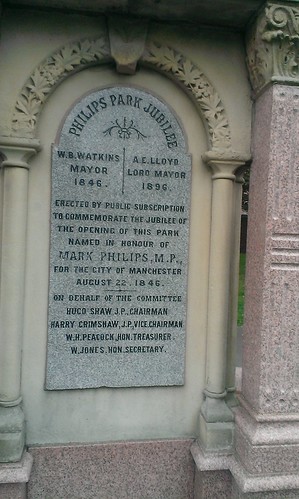
Philips Park, named for Mark Philips, the local Member of Parliament was open in 1846 after he committed himself to obtaining an open and free public space for the common man.
The River Medlock runs as brick-lined culvert through the park, so done because of the floods in 1872 that disinterred bodies and washed them downstream. The river could easily be mistaken for drainage, well, it is not.
There are serpentine paths all around the park with sections for children, cycling, rugby and other sports. It has memorial gardens and beyond the main park is the Philips Park Cemetery which opened in 1866.
People and things
As I walked through the park, I saw a boy of probably not yet 13 years of age sat on a bench smoking, he had ridden into the park on his bicycle and found a secluded spot to engage in this vice.
Soon, I walked into the cemetery where he definitely was not following his mother's advice by choosing to talk to strangers. Precociously, as he asked for how to get to the nearest tram station and I averred that I was new to this place, he wondered if I knew where I was, I had to use Google maps to point him in the right direction.
The grounding of cemeteries
In the cemetery, I observed many things; the quiet and stillness, a stillness in spirit, in mind and in body that is rest.
Yet, rest must not be an end, it must become part of the cycle of life and living, the opportunity we seize to get away from it all, the rat race and the hustle and bustle of chaotic living.
I recognise that in Africa we rarely visit cemeteries apart from when we put the dead to earth, I discovered that in England, cemeteries are so well kept, a job managed by the Friends of Philips Park Cemetery and they do provide quiet places for contemplation away from any disturbance. I eventually connected with this mind-set.
Beliefs for eternity
The cemetery had sections for the burial of Church of England, Roman Catholic, Jewish, non-Conformist (English Dissenters) - whatever that means and so on. It was like our beliefs usually handed down from our ancestry follow us through life whether we adhere to them or not and those beliefs decide where we are laid to rest. I would probably return to my Church of England roots than look for anything else.
One thing you could not miss in the cemetery with the power and the presence of love, many tombstones with the phrases, “In loving memory of”, "The dearly beloved", "The loving husband, wife, son, daughter of" with the day they died and at what age.
There was one tombstone that thanked the lady for being a wife of 53 years, in love and more, I was moved. The fact is in death, whether we mean it or not, love appears to conquer all.
Death is where resignation and acceptance meat at the ritual of ashes-to-ashes and dust-to-dust, when the dead are gone, they are gone, we bury or cremate them and keep the fond memories of them in our hearts and minds.
Other things
Leaving the burial ground, I returned to Philips Park to find out more about the park, and found a Peace Memorial that had a prayer written by Marianne Williamson but often attributed to Nelson Mandela, wrongly spelt with a double l.
The picture I took had a family who would have no idea what memorials are about clambering over it and it was clear that this activity by many other Philistines as these had damaged parts of the beautiful artwork, I was saddened and close to being angered.
This time, I walked back the way I came, quite refreshed and enlightened. I wonder where next my footsteps would take me. The other pictures.

Friday, 9 September 2011

Thought Picnic: The Chronicles of the Dead

Plans for journeys
As I got up this morning, I felt I needed to get out if the weather was fine enough and fine a place to meditate. Over the last few months, I have done serious mileage on my bicycle, the round-trip to church on Sundays is about 26 kilometres, maybe more, but it rarely bothers me, there are days that I have done close to 40 kilometres.
However, today, my ride to Zandvoort would have been 28 kilometres but in my quest to follow signposts for bicycle paths that lead to dead-ends, detours and strange places, I probably did close to 40 kilometres on my way out before I finally reached my destination.
A promise fulfilled
Before I left Amsterdam, I found I would be riding past the Saint Barbara Cemetery, I was last there on the 8th of February 2010 when I attended the burial service of my dear friend Dick van Galen Last, had an idea of where he was buried but never saw the burial or the burial plot itself because it would have been too emotional for me and I had to get to hospital for what turned out to be my last chemotherapy session.
So, I stopped by to pay my respects and I just could not find the location. I made for the cemetery office to ask about the location of the burial plot and they produced what one might call the register of the dead.
Cemetery management
Nothing was computerised, his name appeared in cursive handwriting in the book, with his age; he died 8 days short of his 58th birthday and the coordinates of where he was buried was noted.
The clerk who also doubles as a craftsman and many other things around the cemetery then checked the layout of cemetery on a map and after donning on some heavy-duty boots, lead me to the grave site.
As we walked up on of the avenues, he hand-pulled a ground moving digger, probably used to dig graves, just big enough to ride in but also small enough to be manoeuvred by a strong man too.
The first location we got to did not have the grave, I suspect certain graves have prominent headstones and then cards behind the headstone to indicate others sharing the allotment.
At his grave
Eventually, after about a 5-minute search, he found Dick’s grave, a nice marble headstone with his name and the account of dates as each person’s portion of the expanse of eternity gets carved into stone at graveyards – the date of birth and the date of death – the history of great men is not written in cemeteries, rather it is in the memories of those who return and in books far away.
I do not know how long I spent at Dick’s grave but as I muttered my thanks for his being my friend the words of Jesus came to my mouth – I am the resurrection – at which point I knew that death is simply part of the journey of the soul in the unlimited and unfathomable extents of eternity.
Thinking beyond ourselves
Time is an amazing thing, even stars we see in the night sky might well have long disappeared but if they are thousands or millions of light-years away, we will never know if they are still out there however their light travelling to us through the amazing universe signifies there was a source for the light we now see.
So do all those grave stones with the bones beneath the earth, the people laid there once walked the surface of the earth with passions and failings like you and I have.
As I left the cemetery, I thanked the clerk who was busy trimming the hedges, you then realise even the dead need caring for or else the cemetery will become a jungle and the thickets we’ll have to cut through to see our loved ones would have just reflected very badly on the living.

Monday, 24 August 2009

Known unto God

Unknown to man but known to God

The grave stone read “A soldier in the 1939-1944 war” at the top, some had the rank, others did not and at the bottom was written “Known unto God”.

Of the 1680 graves of men who perished in Operation Market Garden [1] over a period of 6 days between the 19th of September 1994 and the 25th of September 1944, some 245 carried the epithet of the Unknown Soldier – buried with honour for their service but unknown for all sorts of reasons.

On one tombstone, the inscription started with “Believed to be” it made you wonder when doubt should be removed and the truth be known, but should the truth be known or the situation be left for believers to believe as they will?

Believing might well have been difficult too because one tombstone marked the grave of the chaplain; on such an evil day, where would man have found comfort and succour in their last minutes on earth? With whom would they have left the “Kismet” [2] messages to dearly loved ones back at home?

The root of goodness

We were there - Arnhem Oosterbeek War Cemetery [3] - to visit the grave of someone we never knew but from whom came friends, families and good fortune. The people who lived through the wars of old never talked about how it affected them but we saw the scars as they stoically went about their business without grumble or discontentment.

The lady married to this gallant soldier already had a son by him and her daughter was born the day her father was declared missing, her grandson is my dear friend and for the first time, I finally found opportunity to pay my respects and see why she visited Arnhem every year from 1969 during the memorials up 2005 after which she was too indisposed to visit again.

As we approached the cemetery, it was so unexpected, my friend just burst into tears, I was taken aback, but cemeteries bring a quiet contemplation of serenity and mortality, memories of things past along with things not known the palpable sense of pilgrimage that accompanies knowing that someone from whom you came is rested in a perpetual memorial in a foreign land.

The dear lady died last year and her ashes are scattered where her husband is laid, the only love she knew and it is with poignancy that one recognises that she never remarried but brought up two children on her own.

We must not forget

However, one must not forget that the ravages of war has taken away young men, many not even in their 30s, the register of graves showed the name of the soldier, who the soldier was a son of and if the soldier was married, to whom he was married. Nothing was said of the offspring of the fallen.

In 1951, the British Government signed an undertaking with the government of the Netherlands and therein was established a number of Commonwealth graves as a memorial to our fallen men.

The grounds are well tended and clean, the memorials stand as beacons of great men who gave their lives for king, country and the freedom of mankind in a very dark hour of tyranny and humanity.

As the memorial to the fallen stands, one remembers Laurence Binyon’s For the Fallen [4], for therein we find the lines

They shall grow not old, as we that are left grow old

Age shall not weary them, nor the years contemn.

At the going down of the sun and in the morning

We will remember them.

And so we would, we who are left to mourn and pay respects will remember them.

Sources

[1] Operation Market Garden - Wikipedia, the free encyclopedia

[2] Kiss me Hardy or Kismet Hardy

[3] Commonwealth War Graves Commission – Arnhem Oosterbeek War Cemetery

[4] First World War.com - Prose & Poetry - Laurence Binyon:

Tuesday, 8 April 2008

The changing ceremonies of death

The modern funeral

Having not attended a funeral for 31 years, I never knew what to expect of a church service or the committal at the crematorium.

I soon found out that coffins do not get hoisted on the shoulders anymore; a special trolley/gurney was used to take the deceased to the altar.

Powderhouse Crematorium

After the church service we drove to the crematorium in a funeral cortège a few miles to the other end of town where my warped imagination could not help but notice the crematorium was on Powderhouse Lane, I would not have believed it if I had not seen it.

My fellow passengers in the car did not catch on to my thinking until later, it was just slightly less direct from being Ash Road, but the powder of the ash was what got me – one almost expected John Cleese to jump out from behind a tombstone but the solemnity of the occasion bored down that set of silly thoughts.

To earth or to ashes

I had never been to a crematorium and recently whilst chatting to a Dutch funeral director he opined that more people prefer to be buried than be cremated because they want a place for a memorial.

Whilst a crematorium and its grounds can offer places for remembrance and contemplation for loved ones, it looked like a poor imitation of the traditional cemetery – some innovation like remembrance walls and so on just looked so different.

The suddenness of ceremony

I also felt that a crematorium does not lend itself fully to the ceremony of ashes-to-ashes and dust-to-dust where everyone completely breaks down, the deepest emotions was probably at the eulogy where my pocket square absorbed secretions from my tear ducts.

I also learnt that wake-keeping ceremonies were more an Irish think than English, some even end with drinks and fights, I have never really understood the Nigerian version where the children stay up all night – it is stressful enough grieving for the dead.

We were part of a conveyor belt of commercial activity and so soon after the curtains closed we were ushered out to see the family flowers and commiserate with the family – like a doctor’s surgery, the NEXT sign must have lit up for those after and this was to go on till dusk.

We later retired to the village pub for drinks and some food, it was there after I had expressed my views about a crematorium on Powderhouse Lane that I was told the name of the funeral director is Mr. Cook.

Surely, someone was pulling my leg, but the truth is always just what it is – sometimes incredible.