Showing posts with label river. Show all posts

Sunday, 3 October 2021

Coronavirus streets in Leeds - XLVI

Waterways and memories

Out of my hotel, I veered left and round the back over the road and I was on the Leeds & Liverpool Canal and about to ply the Aire Valley Towpath that I last walked some 5 years ago. I might have taken more advantage of the sunny day, but I lazed in bed catching up on some much-needed sleep that I did not get out until well after 5:00 PM.

Memories distilled from the past into my mind, the recollection of things I gave a fleeting glance and of events that have left too much of a mark that they cannot be forgotten. From the centre of Leeds that canal runs on a higher plain under much human control and was used for the transport of goods and materials in industrial times. Now, leisurely or homely narrow canal boats use it, navigating 91 locks. 

Lower down to right, some 50 metres away as one bears west of Leeds is the River Aire, untamed and unruly, prone to flooding, unnavigable for commercial purposes and a work of nature in its awesome display. I would surmise the river provided power and the canal, transportation.

Paths lonely and free

The towpath was quiet with not that many walkers, a few joggers, some walking their dogs, and then the cyclists. It brought to mind the refrain of the song Lonely Road, by Christy Essien Igbokwe from her album, Ever Liked My Person? The general lyrics of the song I cannot recall, nor could I find an online transcription of it.

Lonely Road - Christy Essien-Igbokwe

One dog walker could not be bothered to look where she was going, she was ensconced in her phone, her dog basically becoming like a guide dog for the blind. Others I saw, we being strangers, might mutter a greeting to each other or at the very least diffuse the tension suggesting one is not hostile with a smile.

Apparently similar or similarly apparent

The canal is also part of the coast-to-coast canoe trail from Goole to Liverpool, called the Desmond Family Canoe Trail. About 6 kilometres into my walk at which point, I turned back on myself as the light was fading too, I saw six horses in a field across over the canal running about free in a field with trees.

Down at Kirkstall (Kirk is colloquial for church, I think) at The Ellers were noticeboards facing the canal with sayings and one I took for a time of reflection. “Don’t treat people as bad as they are, treat them as good as you are.” I guess I have some work to do regarding my attitude to some people.

Two men working on a canal boat acknowledged me on my way out then engaged me on my way back. He said, “You remind me of Chris Eubank.”, I said, “I hear that a lot.” Then he hoped I was not offended, I wasn’t, it is just that I was just in exercise apparel and again something found some similarity. His regional accent, I could understand, from another couple, I just chuckled rather than request an encore with an interrogative pardon.

Just over 12 kilometres later, I was back at the hotel, I expect to have a really relaxing and restful night too.

Thursday, 2 September 2021

RSS Mischief III - Swimming like crabs

Water all around

Apart from the front gate and a side gate there were no walls around my boarding secondary school, Remo Secondary School that we all knew as RSS. On the outskirts of Sagamu to the east, over a river bridge called Májọ̀pa that came with its tales of intrigue and paranormal dread that we at times exaggerated into fabulously unbelievable tales fed by imagination.

Then to the right was a hotel complex and a standpipe where we sometimes came for to fetch water if the taps around the school or the water source called Odò gàrrí (Garri pond) was too dirty for any use. The hotel was a disorderly house of ladies we eventually made friends with as aunties and not for any untoward activity.

To the gate

Further on to the roundabout, with two exits, the one to the right towards Ìkẹ́nnẹ́ and ahead over it to Ìpẹru, that part of the roundabout forming the northwest boundary of the school before a wall was built from the west round to the north and then to the east, leaving the south exposed to Odò gàrrí, farmlands, the rain forest that harboured a laughing jackal that for the best part of the first year at night howled the peace away. A path was later cleared for electricity pylons which opened parts of the unnavigable forest to exploration.

Soon after the roundabout was on the road to Ìpẹru was the main gate to Remo Secondary School on the right, facing onto the main staffroom. The wall was just a demarcation not a barrier, as no intrusion deterrents were placed on the tops of the wall, like broken glass or spikes, they were easily scalable to escape the confines or regimentation of hostelry and pathologically sadistic seniors.

Crabs swim better

Crossing the road after scaling the wall just before the roundabout from the school end, we plied a footpath through cocoyam farms then bearing left many pathways presented but one after about 1,500 metres of walking came to a river upstream of Májọ̀pa we called Ibù from which water was extracted for the waterworks and mains.

That part was deep, and no one ventured there because we were told someone drowned having been sucked up by one of the pipes, that was to the right. Ahead of us was a rickety wooden bridge and to the left shallow water where we went for a dip and pretended to swim, moving underwater like crabs.

We ran for dear life

This became a draw, for as many as 10 of us set out for this apparently illegal escape from authority to play. Though, without really witnessing it but following the stampede back to school that ensued. There was a fetish priestess in white who arrived from the other side through the bushes between the river and Sagamu probably to do some ritual to the river goddess.

When she arrived, whether it was a tall tale or not, one can not tell, but apparently, she got to the bank of the river and began to walk on water. We all jumped out of water hardly remembering to pick up our clothes as we broke sprinting world records literally unable to catch our breath and another fantastic yarn on our lips ready for any listening ear.

I cannot remember when the novelty of Ibù wore off, but it was not due to any official action of the school, I guess we found other distractions apart from where a river runs through it.

Blog - RSS Mischief I - Yikes! A snake

Blog - RSS Mischief II - The fundamentals of fluid mechanics

Monday, 15 March 2021

Coronavirus streets in Manchester - XXV

Taking a trek

After work today, I considered getting out for some exercise, the walking variety that I did much of over the second half of last year but have done little of this year. Getting into my garb and realising that it was not too chilly, I set out on the route I usually take.

The town centre was bustling, and I reached the outskirts, I walked by the towpath beside a church that has a Thursday soup kitchen. There on the ground crunched by footsteps that had passed along before me were many white plastic forks and spoons, though it was a bit disconcerting it was better to see that go to waste than food. If it were food, that would be scary, for I have seen rats the size of cats scurry about that path.

Scenes by the river

A girl and her mother had stopped by the river to feed the ducks as another two girls took to screaming so loud, it was almost upsetting. I said to them, I could scream too. Then a couple with their dog made so much way for me, I took the hint telling them, I guess I have a bit more work to do with my size.

As usual, everyone else was running though I could not understand how my pace had slowed to add 2 minutes to the time it took to complete a kilometre at the 4th and the 5th. The bane of going for long walks in the cold is a full bladder and that meant looking for a private place to ease myself. After which a man with two bulldogs taking him for a walk did the irresponsible thing of not cleaning up after one of them and he knew it because he looked back when got to the foul mess.

Care to be careful

On the home straight, I did pass by a soup kitchen and they do a lot for the hungry and the homeless, I just was no sure that the crowd with masks or any social distancing was safe or considerate. Minding my own business, I gave them a wide berth and hobbled home, under the strain of much exercise and over 17,000 steps in the kitty.


Tuesday, 6 October 2020

I'm not losing more

Always get decent gear

Come rain, come shine, I am up at the crack of dawn for my walks, as I found I am usually up early and what better time to get my steps in that doing it early. Today, I found that there is nothing as good as a decent raincoat with a hood. The one I have is an all-weather light coat with zippered air-vents on the sides.

By the middle of my walk, in the fifth kilometre, the rain was pouring down, you would have been soaking wet in a minute without good protection. Some had come out to run in the rain with shorts on. I simply kept my walking pace, my knees strapped with Velcro supports, to ease the discomfort that developed a couple of days ago.

Kneading my knees

I have been advised to try a hot and cold compress; I probably need a good sports massage instead. I can report that I have never felt fitter after over 2 months of walking. I am a bit concerned that I am not dropping any more weight having shed about 8 kilogrammes.

It rained the whole day on Saturday, the volume of water when observed on River Irwell was like a torrent, the embankment that people run on was completely flooded, the river had risen well over half a metre with the swell from the rain. By Monday, it had subsided, I can only wonder what I will see tomorrow.

Numbers, records, maintenance

By the time I get home, I would have done almost 12 kilometres and I will be ready to start work, the jacket, the track bottoms, my trainers and socks hopefully will dry out to consider a walk for lunch or sometime in the evening.

Not that it matters much apart from how measurement enforces competition against yourself, completing 7 kilometres under an hour, getting over 140,000 steps in a 7-day week, maybe we’ll get to 5,000,000 steps soon, considering we are at over 4,700,000 steps now. Why does it matter? Because the charts show improvement and rarely celebrate recidivism.

Monday, 25 August 2014

Walks through the cycle of life

 
Manchester walks
Continuing on the subject of my walking, I chose to walk towards the east of Manchester, the temple of Manchester City Football Club, Etihad Stadium and the SportCity area where the 2002 Commonwealth Games was hosted.
Having lived in Manchester for almost 6 months, I have only just begun to explore its environs. In fact, I have never been this far before and I only once walked in this direction when I was looking for an apartment, the adventurous self in me preferring not to return the way I went out.
Fuzzy mapping in the brain
My bearings are a mess though, because there times I have assumed roads or paths would lead to places I know, but almost never get there, a bit or perambulating and gallivanting, minutes almost counting the hour, I find that slither of salvation, a place I know and I am thankful I have not had to tell anyone that I am lost.
My walk took me down the Ashton Canal towpath where I saw a lady at the helm of canal boat wending its way upstream with her partner and a friend operating the water locks.
El Capitán
I saluted her with the greeting, el Capitán as we struck up a conversation about her boat, where they were going, how the water locks work and some other small talk. They had had the boat for two years and they were going up river to have it serviced. Meanwhile, they were in their third day of this journey from home wharf for dry dock, fascinating stuff.
I then helped in swinging the gates open and shut before I continued my walk.
Walking along
Soon I was at grand walkway to Etihad Stadium, I had one quick take before I returned to the steps from the canal scaling the double-steps up and running down the single steps, creating a bit of a pant and a workout before continuing on to Philips Park.
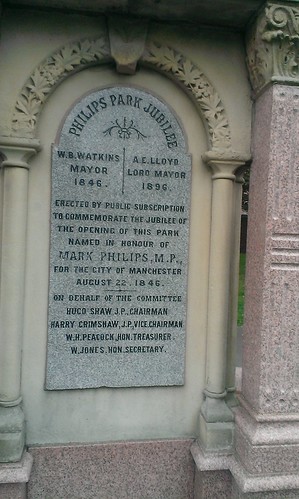
Philips Park, named for Mark Philips, the local Member of Parliament was open in 1846 after he committed himself to obtaining an open and free public space for the common man.
The River Medlock runs as brick-lined culvert through the park, so done because of the floods in 1872 that disinterred bodies and washed them downstream. The river could easily be mistaken for drainage, well, it is not.
There are serpentine paths all around the park with sections for children, cycling, rugby and other sports. It has memorial gardens and beyond the main park is the Philips Park Cemetery which opened in 1866.
People and things
As I walked through the park, I saw a boy of probably not yet 13 years of age sat on a bench smoking, he had ridden into the park on his bicycle and found a secluded spot to engage in this vice.
Soon, I walked into the cemetery where he definitely was not following his mother's advice by choosing to talk to strangers. Precociously, as he asked for how to get to the nearest tram station and I averred that I was new to this place, he wondered if I knew where I was, I had to use Google maps to point him in the right direction.
The grounding of cemeteries
In the cemetery, I observed many things; the quiet and stillness, a stillness in spirit, in mind and in body that is rest.
Yet, rest must not be an end, it must become part of the cycle of life and living, the opportunity we seize to get away from it all, the rat race and the hustle and bustle of chaotic living.
I recognise that in Africa we rarely visit cemeteries apart from when we put the dead to earth, I discovered that in England, cemeteries are so well kept, a job managed by the Friends of Philips Park Cemetery and they do provide quiet places for contemplation away from any disturbance. I eventually connected with this mind-set.
Beliefs for eternity
The cemetery had sections for the burial of Church of England, Roman Catholic, Jewish, non-Conformist (English Dissenters) - whatever that means and so on. It was like our beliefs usually handed down from our ancestry follow us through life whether we adhere to them or not and those beliefs decide where we are laid to rest. I would probably return to my Church of England roots than look for anything else.
One thing you could not miss in the cemetery with the power and the presence of love, many tombstones with the phrases, “In loving memory of”, "The dearly beloved", "The loving husband, wife, son, daughter of" with the day they died and at what age.
There was one tombstone that thanked the lady for being a wife of 53 years, in love and more, I was moved. The fact is in death, whether we mean it or not, love appears to conquer all.
Death is where resignation and acceptance meat at the ritual of ashes-to-ashes and dust-to-dust, when the dead are gone, they are gone, we bury or cremate them and keep the fond memories of them in our hearts and minds.
Other things
Leaving the burial ground, I returned to Philips Park to find out more about the park, and found a Peace Memorial that had a prayer written by Marianne Williamson but often attributed to Nelson Mandela, wrongly spelt with a double l.
The picture I took had a family who would have no idea what memorials are about clambering over it and it was clear that this activity by many other Philistines as these had damaged parts of the beautiful artwork, I was saddened and close to being angered.
This time, I walked back the way I came, quite refreshed and enlightened. I wonder where next my footsteps would take me. The other pictures.

Saturday, 14 December 2013

Decade Blogs - Tolu Oloruntoba - Royalties at the end of a river

Decade Blogs
In Royalties, for my decade of blogging, Tolu Oloruntoba looks at a source of constant conflict in Nigeria from the history linked to an explorer who perished far from home to those who for exploitation perish in their own lands.
We are left with questions about rights; the rights of ownership in conflict with the rights to exploit without which the resource is a meaningless deposit with much potential yet undiscovered or wasted, so is the capacity we have to express our thoughts, some written and others left unknown how do you determine the royalties between expression and silence?.
Tolu Oloruntoba uses the Twitter handle @ToluOloruntoba, I guess his royalty check is in the post. Thank you.
Who owns the oil river
and the carbonaceous secrets of the Delta?
Why, the guys upriver, of course,
in silenced Sahara marshes,
saving in these banks for others to take;
Adamawas eaten by the river rising, oily;
And poor old Mungo,
at the end of his Niger at last,
in disillusioned increments we cremate, in pistons,
with forgotten insurrections and dynasties,
hunters, hunted, fishers and fish
writing themselves into strata of future,
beneath our feet.
You didn’t know?
It ends in fire.
Postscript
1. Geography teaches us about the millennia of deposits it really takes to create crude oil, thousands of feet down. Who, then, in our case, should really get Nigerian oil royalties? The Niger Delta, Federal Government, or all the highlands and places bypassed and collected from? At any rate, crude oil, like most other fossil fuels, is a legacy of bygone eras. Those who left it to us are long gone. It’s a pity we have to be so human in our squabbles to share it. One also wonders what we are laying down now, and what will be left of us, millennia hence.
2. Mungo Park, the Scottish explorer who died seeking the source of the Niger, is buried at Jebba. One can imagine how the circle of life would have brought him, eventually, to the end of his tragically shortened journey.
3. I have followed Uncle Akin’s blog for at least five of his last ten years of blogging. Here’s to many more, if only (we’re selfish, I know) to enjoy his sensitivity, cracking wit and depth of conviction. It has been an honour to glean from his uniquely fertile mind, and be moved by his thoughts, sense of justice, and bravery in the face of truth, triumph or tragedy. We cannot pay him enough, in glowing words or royalties J, for the bolstering of our conscience, and deposits into our soul.

Saturday, 4 August 2007

No safer than a bridge of rotten planks

Lay me down before it lies down

Many would have hummed if not sung along whenever the whiff and strains of the Simon & Garfunkel classic Bridge over Troubled Water song comes to ones hearing.

The calming effect of relaying the importance of humans to other humans would really make you want to lay down in the comfort of comatose repose away from the troubles of this wicked world.

At last count, five had entered into permanent repose as strains of neglect found them on a troubled bridge over roaring waters as their confidence in being borne over a solid structure from one bank to another over the Mississippi River was dashed as the structure gave way to lay down onto land and water below.

Falling apart, falling down

Alas! This is no unique event but a litany of events that are beginning to catch the eye of those who really matter; American infrastructure built by generations long gone is coming apart.

It would appear that regimes of inspections over the proper repair of these infrastructure has lead to assessments of "structurally deficient" but seemingly posing no immediate danger to the public.

The American Society of Civil Engineers has been warning of these problems, they have become more of an activist agency for a change of perspectives, but the political masters have ignored these men of "bricks, mortar, concrete and steel" because there is no need to panic.

But, panic we must, because, for a major bridge and traffic artery to fall to pieces without the influence of unusual weather patterns or some seismological event on a cool calm day in a major metropolis or two as is the case of the twin cities of Minneapolis and St. Paul, there must be something seriously wrong.

Bridges, rails, roads and dams

We saw the breached levees following Hurricane Katrina, dams are falling and quite a few, a third of recent rail accidents have been due to track failure, a bursting steam pipe in the middle of Manhattan and we begin to see a trend, a pattern and something endemic.

If all this does not in some way fall under Homeland Security, I would wonder what does if people are afraid to go out or even stay in for the fear of something collapsing, all because it has not been proper maintained.

In the midst of this quagmire, the contract probably still exists to build the "bridge to nowhere" rather than larger contracts to service and repair the many thousands of bridges to somewhere in America where you can safely go to work and return home to your loved ones.

This is an emergency as major as any war America has ever fought, it should not take the demise of a landmark bridge like the Golden Gate or the Brooklyn before these structures are propped up and self-supporting under maximum strain by the sweat and blood that built the great nation of the United States of America - Get to it and fast.

References

Broken Bridges, Lost Levees and a Brutal Culture of Neglect

States with the most deficient bridges

Historical collapses