Considering I am a very light sleeper, I cherish every minute of sleep I get which rarely is longer than a 3 to 4-hour stretch before I am awoken and have to work myself to sleep again.
This morning at my seemingly lovely hotel which is part of a large hotel chain in Cologne, I was woken to an emergency by the fire alarm and after the catechism in German, we were given an English translation.
Evacuation! Evacuation!
“There is an emergency in the hotel, please leave your room and close the door behind you, do not use the lift and follow the directions to the front of the hotel.” Then, it said something about the staff and that I should look for “Helpless people”.
Bags and everything
That would be funny if I was not woken at that hour, but as I was in my pyjamas, it was easy to step into my trainers without even doing my laces and with my key card to hand I grabbed my cane and made down the three flights of stairs.
The number of evacuees that had left their rooms with their belongings were numerous, if we were fleeing a serious emergency, it would have been a looming catastrophe.
As we approached the front of the hotel, the “Helpless people”, which I eventually got to realise were supposed to be the “Helpful people”, the fire warden and staff assigned to handle emergencies beckoned to us to come into the hotel.
The frying pan was saved
He explained in German to the many guests and just told me in English there is no problem. Someone came to my aid and explained in detail that it was a kitchen incident of the chef leaving the pan on the stove for too long which triggered the fire alarm.
Thankfully, no one was hurt including the frying pan, but have I seen how not to do a fire drill or event a real evacuation? Then, please, like I always say in countries where English is not the official language, whilst you all speak English better I can ever speak your language, always get a native English speaker or a teacher of English to review your public announcements. Helpless people, indeed!
I see many Dutch
signs, or what I mean is signs in the Netherlands apparently written in English
that at times make my skin crawl and sometimes leaves me livid with rage.
Why, I ask myself
don’t they employ a native English speaker to do a once over before they make
the signs?
Obviously, the
Dutch pride themselves in being able to communicate in English and I am
learning a lot from a Swedish-Dutch friend who is studying to become an English
teacher. I never knew it was so much hard work all because it comes so
naturally to me and I am almost a purist – God forgive me.
This took the biscuit
The other day, we
went out to one of those man-made beaches on the shores of a man-made lake in
the middle of Rotterdam and as we were leaving there was a sign in Dutch with
an English translation probably to cater for the more international crowd.
The Dutch can so
easily fall into error when translating to English because they have the same
words for belief and faith, grace and mercy, to bring back or to take somewhere
– really too many to mention. I will not even go into announcements that sound
like the finality of life as we know it when we arrive at station terminuses.
Anyway, it was to
do with notifying about the pollution of the water and whether it was safe to
swimming in it. The English will just refer to the water and we will implicitly
know it is the lake but because the Dutch have to qualify and particularly
reference an object, I ended up reading a phrase that went thus: If anything is
wrong with the swimming water …
Swimming water? I’ll
say no more but that was enough for a good 10-minute conversation with my
teacher friend about correctness, rigour and the use of English even in a non-English-speaking country.
Keep and have your life
The one that gets
to me the most is when I pass by passport control at Schiphol airport and the
sign read. Please keep your passport
and boarding pass ready. Keep is passable English, have will have been more
correct.
Then Dutch signs
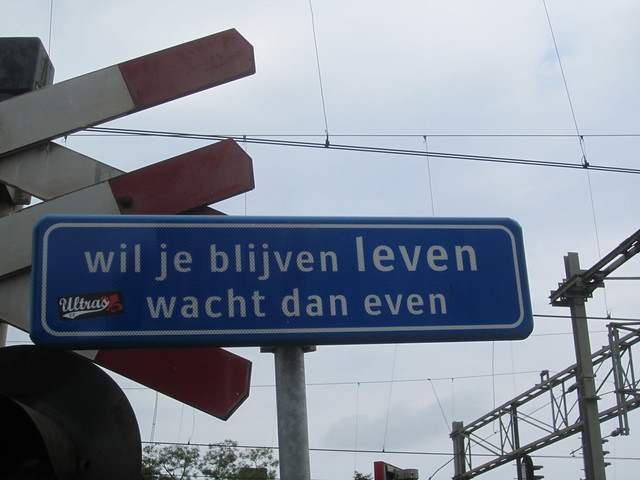
themselves can be quite interesting and it was Saturday on my way to a wedding
that I read the sign below at a railway crossing. It simply translates to –
Will you stay alive? Then just wait.
I suppose the
impatient risk being road kill or in this case rail track kill – after crossing,
the barriers came down and that was a good 5-minute wait before they came up
again allowing for three trains to pass that I really thought the crossing
needed a bridge.
I have not known
the Dutch to be that patient but on matters of life and death, I guess they’ll
wait to live than rush to die.
LinkedIn* is more or less the professional networking site that allows for people to keep tabs with people one has somewhat interacted with in professional life.
For a person who has been self-employed most of my working life and has worked in many organisations, LinkedIn offers a forum to keep tabs with people I have worked with and also allows one to keep abreast of the careers of those same people.
Most recently, I tapped this professional network for job opportunities after having been out of work for almost a year and that mostly due to serious illness. I was glad to find that many of my ex-colleagues responded with sympathy and help which eventually lead to a job.
Self-referencing resource
I have also found that the LinkedIn profile can serve as an adjunct to a curriculum vitae (CV) because it can contain information that would not necessarily appear on a CV for instance, it can be a self-referencing portal if an employer reviews the profile finds people you have worked with and probably knows those people or organisations and make qualified assumptions or deductions of the prospect.
A slightly more subjective but useful function in LinkedIn is the recommendation feature, it can be interesting and indicative of the views ex-colleagues have of a person, hence, it is important that the writer and recipient pay particular attention to the construction, content, context, intent and import of the recommendation.
The recipient is given the opportunity to edit and recommend to the writer changes that would reflect better in order not to have the opinions misconstrued by other readers.
Understand before acceptance
Where English is used but not the mother-tongue, it is even more pertinent that the matter be reviewed by an English speaker before publication. I have at least in a number of cases had to decline recommendations that were subject to unfavourable interpretation even though the intentions were noble and generous – such however should not be enough to allow a recommendation or it would be the equivalent of shooting oneself in the foot.
I was completely mortified when I read a recommendation posted on a LinkedIn profile, I was half persuaded to highlight that the intention and the meaning were at complete variance. However, on reflection, the writer might well have meant what he wrote and the recipient none the wiser about the nuances and pitfalls of the gentle English putdown has proudly published this damning assessment of abilities sandwiched in passable praise.
The short recommendation
“Person is a great consultant with a lot of knowledge from everything. Doesn't bother helping you with all sort of things. Really a great team worker and a nice colleague.”
Three short sentences that speak volumes that are either lost in translation from a Dutch context or are a good excuse to use language as a deficiency to castigate in the most unfair light.
Person is a great consultant with a lot of knowledge from of everything. Either way, the knowledge from or more correctly, the knowledge of everything could easily read as a Jack of all trades and a master of none. The more charitable turn of phrase would probably have been a very broad knowledge of technical concepts – giving it a more specific frame of context. Whilst Dutch allows for verbosity and generalisations that could be easily contextualised, English is not that forgiving.
Does he bother or does he mind?
Doesn't bother helping you with all sort of things. This is the damning part because it reads like he doesn’t mind helping you in every way but it says he is the most unhelpful person you can find regardless of the situation presented to him.
It might be that the writer thought bother was synonymous with mind; in some contexts ‘Are you bothered?’ or ‘Do you mind?’ could be interchangeable but definitely not here. With Google Translate to Dutch the meaning did not carry as well until I modified the sentence to read as “He doesn't bother helping you with all sort of things.”
Dutch requires that the object and subject are very explicit in a sentence, it is not that good with implicit references and so this passed the censorship of the recipient when it should not have gone any further.
Can he really be?
Really a great team worker and a nice colleague. This would leave one almost wondering what the writer was trying to say after the first two sentences and it might well allow one to consider the possibility of a Freudian slip. Malevolently, this was the sweetener to the bait, obfuscating the intentions in the second sentence.
You might call it pedantic but recommendations are read with a greater attention to the detail rather than the general idea of what the writer is trying to convey – this recommendation has in my opinion torn the professional reputation of an otherwise knowledgeable and great consultant who is a nice colleague to shreds.
To think this recommendation has been published for over 2 years might well mean the damage is already done.
As for my opinions of the recipient, I could not possibly comment any further. The advice is, never accept wholesale a recommendation you do not fully understand and comprehend regardless of the good intentions of the benevolent writer.
An anonymous and hence invisible person albeit from Colorado, USA left a comment on my blog pertaining to Farfour free to burn where presumably a child had offered herself as a martyr to annihilate the Jews.
I am no Arabic scholar and I have no knowledge of the language apart from the numbers which I learnt in a thick Yoruba accent from Keu (Madrassa) students in Nigeria.
Apparently, it appears most of the conversation reported might have been lost in translation and thereby we have ended up with a story a lot worse than what was portrayed.
It however then begs the question why the Minister of Information in the Palestinian government asked for the show to be discontinued, extracted a promise to present a different format and roundly condemned the content of the parts that were broadcast.
In fact, the commentator portends that Middle East Media Research Institute (MEMRI) an organisation based in Washington D.C. which is supposed to bridge the language gap between the West and the Middle-East had committed egregious atrocities in translation which could be deliberate with the view to excite negative review.
Being one who would always bring to the fore any comment that requires airing to bring balance to the topics I introduce, I publish here the full text of the comment left by Anonymous of Colorado – (I know where all comments come from).
If I have erred, I apologise, not meaning to cause offence to anyone, only to highlight issues of concern.
The comments
I would like to point out what can only be called an egregious mistranslation on the part of MEMRI with respect to the words of one of the children who were featured as a caller on the show this story reports on.
I call it that and not simply a mistake, because a MEMRI spokesperson appeared on CNN to confirm his organization standing by its translation "word for word" and "according to the syntax" even though it is easy for an organization that employs Arabic translators to actually see how wrong the translations that were produced at first are.
The transcript claims that "Sanabel", the little girl caller of the show, responds with "I will shoot" to the host's question "Sanabel, what will you do for the sake of the Al-Aqsa Mosque?"
As a matter of fact, and as can be seen in the video, it is the clown in the ridiculous Mickey Mouse like suit that says that and even makes the gesture of carrying a weapon.
The little girl Sanabel does however respond, but MEMRI omits her response. The little girl actually said in Arabic "bedi arsem soora", which means "I will draw a picture."
So this girl says she wants to draw a picture, and MEMRI transforms that to "I will shoot."
The second example is the most outrageous one, where MEMRI translates the little girl Sanabel's response to the question "we got that, what else?" as saying "We will annihilate the Jews." This is outrageously wrong and completely invented.
The girl can be clearly heard saying in Arabic "betokhoona el yahood", which means "the Jews shoot us."
The word "betokh-oo-na" can be broken down part by part and explained easily as follows:
betokh: the verb "shoots"
oo: the 3rd person plural subject pronoun meaning "they". It becomes "they shoot".
na: the 1st person plural object pronoun meaning "we". It becomes "they shoot us"
Having pointed that out, what the producers of this show are doing is morally outrageous. Instead of giving their children viewers the joy of watching child TV characters and enjoying that aspect of childhood, they are depriving them of that just as the Israeli occupation is depriving them from other aspects of normal childhood development. Both are equally wrong here.
In what is looking like a re-run of the Weapons of Mass Destruction fabrication of evidence against Iraq preceding the war, we are now hearing of weapons being found in Iraq presumably manufactured in Iran.
The US Secretary of Defense appeared on television yesterday without all the evidence to hand to state that they now believe Iran has been aiding the insurgents in attacks against American troops.
Many things do not add up about this developing premise to adopt a belligerent and aggressive invasion of Iranian sovereign territory, we can only hope that such madness would be tempered with the realities on the ground in Iraq.
Suspect evidence
Generally, the Iranians have brotherhood with the Shiites of Iraq who make up the majority of Iraqis and now form the majority government of Iraq. Americans have mostly had trouble with the Sunnites who were the minority ruling Iraq during the time of Saddam Hussein.
It would be a more serious problem if Iran was selling or smuggling weapons to the Sunnites who make up the greater part of the insurgency, however, within the security situation and turmoil in the Middle East, the illegal trade in weapons would thrive, it would not require the legal sanction of the Iranian government for weapons to cross the porous and precarious borders.
However, what is quite interesting is why weapons made and traced back to Iran allegedly have English markings rather than Persian or probably Arabic markings – this is the Islamic Republic of Iran and the official language is Persian when I last looked or is something amiss in this terrifying saga?
From WhatReallyHappened.com
Beyond which America seems to be forgetting they are in a war zone, weapons would come from far and wide, like good old granny would say – Get out of the kitchen, if you think it is getting too hot – your enemies would not just fall over like dominoes – wake up and smell the darn coffee.
This is short; I was out in Valkenburg, a city in the deep south of the Netherlands which lays claim to being the first city to have a railway station and a tourist office in the Netherlands.
There was a lot to see and I did take a lot of photographs to be unveiled in the not too distant future.
Some of the tourist attractions include the castle ruins and networks of caves that are supposed to serve as a nuclear shelter and so on.
What really grates me as we have seen on African Shirts is why people in tourism do not employ good translators to translate information properly into other languages.
This sign in particular makes interesting reading.
Wreck your castle
Here I am, in castle ruins reading about fortifications for the castle only to find the rulers attacked their own castle from the city side – well, why give the enemy the pleasure of destroying your castle when you can do it yourself.
Someone definitely has been tampering with the tourist fare of Valkenburg, have I been duped?
Besides, I was later assaulted with a variant of English that was so bad, it was entertaining.
[The Dutch part of the notice does talk about enemies attacking the castle]