My Pages

Showing posts with label civil law. Show all posts

Tuesday, 10 February 2015

Opinion: We laugh all the time - A case for gay marriage

I am for marriage
I have always had very liberal views on the issue of marriage that it has rarely bothered me what the gender pairing might be. Man to woman, man to man, woman to woman, if you've ever been in any of those shoes, love is a mysterious and powerful force.
The issue of gay marriage is more one of legal rights, in that if a person has chosen to live their lives with another, when certain critical life decisions need to be taken, the position and primacy of partner, lover, companion and spouse must not be trammelled.
Significance for the other
The situation where same-sex partners suddenly find themselves relegated by the family on the critical matters of life and death where there is no legal backing for the union is untenable.
Partners are people with whom one shares intimacy and companionship that neither family nor friend can aspire to. Hopes, fears, cares, anxieties and issues of life are exchanged in a bond no outsider to that partnership can begin to comprehend or unravel, it is unique between the people in that intimate relationship.
That family or relations might disapprove of the relationship does not invalidate it, lives are intertwined and hearts are melded, cleaved in a mystery indecipherable yet simple.
Religion is moot
It is such that marriage ceremonies are just what they are, ceremonies; the law recognises the civil contract of partnership and delegates a legal instrument to religious and civic institutions to contract marriages. A marriage might well be a religious activity to some, but it is fundamentally a civil contract that grants spousal rights to a chosen companion with whom a person has decided to share that responsibility with.
It is with that in mind that regardless of the age difference between Stephen Fry and Elliott Spencer, I celebrate the core element of the relationship which in the words of the younger makes compelling reading. He said, “I don’t care what people think, Stephen is the love of my life, the light of my life.” “We laugh all the time,” he continued “Humour is the binding thing in our life. I think that’s what brought us together.” [The Independent]
The pursuit of happiness
Now, if that is not the ultimate pursuit of happiness, I wonder what is. To have someone to laugh with, to cry with, to hold, to hug, to share the most intimate moments and know that when the biggest decisions are to be made, they are not sidelined, but significant, they should be front and centre, just as they have been chosen to be front and centre, bound in a union of love that sometimes dares not speak its name.
It took me a while to understand that in all this, sometimes marriages do not work and divorce is the only option for each party to find another hopeful opportunity for love. I had to unlearn my fundamentalist schooling to appreciate that marriages are never made in heaven but worked and played on earth. There is no fairy tale moment, just experiences, some good, some bad, some happy, some sad and if the fun outweighs the absence of laughter, you have a good thing going.
I am for everything that gives a tightly knit companionship of hearts legal standing, straight or gay marriage –who really cares? Let the significant other be significant in life and be very significant too in the eyes of the law.


Friday, 7 December 2012

CHELD - A Conversation on Domestic Violence

An Invitation

A Conversation on Domestic Violence

A CHELD & Law Society UNILAG Event

Wednesday, 12th of December, 2012
10:00 - 15:00
Julius Berger Hall
University of Lagos

Please attend


Witness and dumbfound
Domestic violence is something that appears to be a taboo topic in Nigeria and I have seen my share of it as a child. In the scheme of things my experience looks inconsequential.
My parents never hit at each other but there was enough tension in the house for us to know that the mental and emotional torture was just as palpable.
I was only 5 when my father intent on walking away from a tense situation got into his car and as my uncle held my mother back, he revved out of the garage and unbeknownst to him, he drove over my mother’s shin – almost 42 years on, the event plays back in my mind like a slow-motion horror film.
Raze the bloody altars
Elsewhere, I have seen worse, wives battered beyond recognition and nothing in the community, in society or in the law to actively come to their aid in support and in defence of their right to live in so-called matrimonial bliss.
The preponderance of culture in a majority of cases has had the battered wife return to that atrocious environment as we sacrifice our mothers, sisters, daughters, aunts, nieces and womenfolk on the many bloody altars of tradition, religion, custom, beliefs or just plain male chauvinistic arrogance.
Titi Arowolo
The extreme of which was the alleged literal butchering of Titi Arowolo by her husband, the details were graphic enough to not need corroborative pictures and the case languishes in court a good 18 months after the crime. [My Blog]
The incredulity of it all lies in the many facets of the story, the preparations for a wedding without preparing for marriage, the acquiescence, silence or indifference of their community when the conflict started which culminated in murder, the lackadaisical attitude of the law to issues of domestic violence and the crown it all, a pathologist said the lady was stabbed 76 times whilst the father-in-law professes his son had 17 knife wounds to his view of the daughter having sustained just 3 stab wounds.
We will not go into who is more qualified as a pathologist but we need to talk, we need to talk about Domestic Violence in our society and address the taboo issues head-on.
A Necessary Conversation
Dr Cheluchi Onyemeukwe runs the Centre for Health Ethics Law and Development (CHELD) which is established to employ law, policy, ethics promotion and research, and practical health development projects to improve public health in Nigeria and other African countries.
Writing to me in an email, her words, “I said I would do something after that Titi Arowolo case and this is my keeping my word to myself and God.”
In conjunction with the Law Society of the University of Lagos, CHELD is presenting A Conversation on Domestic Violence – Awareness, Education and Empowerment.
She says, “We discuss the signs of abuse, the myths around domestic violence, what to do in an abusive situation, the law on domestic violence such as the Lagos State law on domestic violence, the human rights aspects of domestic violence, the emotional underpinnings and impact of abuse.
We emphasise that domestic violence is not only physical abuse but also emotional abuse.
We talk about developing a strong sense of self and self-esteem.”
Then she says, “These Conversations are intended to do several things including but not limited to - keep the issue of domestic violence on the front burner and in the consciousness of different parts of society, provide information that is currently lacking, provide an avenue for people in abusive situations to seek help, and create avenues to break down cultural obstacles.
I started with doing counselling and providing material and other support to victims, but I think we need to do more, to do something before people find themselves in tragic situations.”
And she concludes, “We have also set up an Online Resource Centre for Domestic Violence, which will provide information on legal and organisational supports, helplines etc. It is at this Domestic Violence resource website. It is still under development.”
I endorse this
I am quite in support of this event and the many initiatives that will keep the issue of Domestic Violence in the public eye until every similitude of it is eradicated and those who practice it face the full might of the law with prompt justice for the victims.
There should be no excuse for Domestic Violence and it should never be excused by whatever belief system we may adhere to regardless of its provenance.
I implore you to attend this event if you can, share the information with as many as you can and visit the websites for more information on this issue.
Thank you.

Tuesday, 15 May 2012

Nigeria: Is Winners Chapel Losing Respect?


Our culture of cults
Pastor-bashing has almost become a pastime in Nigeria just as much as the churches they have founded have become the objects of much opprobrium. Worse still are attendees of such establishments who by their attitudes have subscribed to the cult of personality and have enslaved themselves to systems that operate no better than shamanist grottos.
We must not however allow the pall of injustice to hang over a demonstrably untenable situation without comment; there comes a time where religious adherents need to cast off the apparent dumbness of sheep that goes for community and fellowship returning to the excitement of using their God-given intellect to review the circumstances they are in.
The basics of the story [1] are: Parents leave twins at church crèche, obtain tags as proof, return to find one of the twins missing, church apparently doesn’t aid investigation, church allegedly interfering with the process, child not found one year on.
Facts of life anywhere
Rather than attempt to rehash elements of the story, I will address some very fundamental points we all need to be aware of.
A religious environment or meeting place despite the atmosphere of piety and solemnity or even feigned holiness in some cases is still a gathering point of people from all strata of society – some good and others not so good with all sorts of motives – there is a possibility that people will let down their guard in such settings when they are to be vigilant – like in society, crimes do happen in churches, mosques, synagogues, temples and grottos too.
Many religious establishments depend on volunteers to function effectively, people generous with their time and means are to be commended but each function and activity comes with a modicum of responsibility even though we work in the implicit trust that within an religious establishment people exercise the best of conduct as if they are licensed and regulated in the functions they perform.
Once volunteers have taken on responsibilities they are responsible for activities entrusted to their care, there greater the responsibility the better the standards of control and supervision must be – in the case of caring for children, it is paramount just as one would not expect sloppily prepared food and drinks to be served endangering the health of patrons, if I may, of the religious establishment.
Ordinary people make communities
A religious establishment will usually have hierarchies, rules and structures to deal with internal issues but when crimes are committed or criminal activity is suspected, it is not the place of that religious establishment to replace the state in the dispatch of police responsibilities for investigation, questioning of suspects and witnesses, securing the crime scene for forensic analysis and prosecuting to the fullest extent of the law those issues that have been identified to require that level of scrutiny.
Much as a religious establishment brings together many strands of society, it is not in and of itself beyond its primary function a police station, a court, a hospital, a school, a restaurant or a shop if it has not exclusively applied to operate as any of those establishments and so the abuse of any of those function must always devolve to civic authorities.
Persons who are found to be professionally skilled in all these areas might take on advisory role or even assume immediate responsibility until such a time that qualified persons not conflicted by affiliation can ensure that adequate and due civil process is followed.
Religious organisations are subject to civil authorities
The Catholic Church presents one of the poorest examples of the separation of Church and State when on having cases of child sexual abuse reported to the senior clergy they attempted to contain the matter rather than hand the cases over to the authorities – the embarrassment they were trying to avoid as well as the people they tried to protect has snowballed into an almost insurmountable crisis.
The case that inspired this blog pertains to Winners Chapel, a sprawling Pentecostal religious organisation that includes businesses and schools with the head of the organisation having gained notoriety for being the richest Nigerian pastor and the having delivered that legendary stinging slap in front of the congregation – this new development appears to compound what from a secular perspective is chronicling a catalogue of abuses.
Cajoled by religious behemoths
On the side of the parents, too many issues need addressing in general. That it took a whole year for the news of a missing child from the Children’s Department of a church to make the headlines is beyond the pale but my second paragraph already shows that people find it difficult, terrifying and sometimes impossible to challenge religious authority on civil matters.
The news story suggests that the church has been actively interfering with the investigation with regards to the police; such that the handlers of the children have not been interviewed to ascertain how a child under their care went missing, they seem to have polluted the narrative to suggest the child did not go missing in the care of the church volunteers, fed false information to the investigation teams and they have intimidated the parents so much that it has taken all this time for the parents to muster the courage to come out against the machinery of a behemoth organisation like Winners Chapel.
Humanity and justice are paramount
If any of the detail in news story bears any semblance of truth, nothing can justify the actions of the church in trying to cover up this case much as the parents are deserving of some sanction for not speaking up the more about this much earlier and forcefully.
In matters like this, victims after reporting matters to the religious leaders of their commune must immediately see that they case is handed over to the civil authorities whilst they engage counsel and advice outside of the structure of their religious settings to see the matter through to its conclusion.
I will continually say that the purpose of religion is for the service of the people, where that purpose is lost, whatever that religious situation is has become irrelevant and with the handling of the case of this missing child purpose and relevance are being lost for expediency.
I am disappointed in all parties involved in this case and most especially the church for not being a better force for justice, for fairness and for right – if people and children cannot feel safe there; the world is indeed a very dangerous place.
Actively seeking the missing child and to be seen to be doing everything to help the police, the parents and every concerned party is the great sense of justice that is required and it is the least one should expect of a religious establishment and most especially if that establishment is Winners Chapel.
Source
Related material

Wednesday, 22 September 2010

Preparing for a neighbourly dispute

Parking to the letter

I never get to write letters like this that often though sometimes one just has to be polite, firm and resolute about protecting one’s property from abuse.

My apartment comes with a car parking space and they cost a premium in Amsterdam, as the last year turned difficult I attempted divesting myself of that asset without success and so the hardship that followed.

Thankfully, things have begun to turnaround and it is still part of my property as it sometimes gets used by neighbours or other apartment block residents that have the courtesy of asking to use the parking space.

Though, I do remember a birthday celebrant coming over to ask to use the space years ago at least that was the reason she gave for wanting usage but whilst I am not complaining the offer of a piece of birthday cake would definitely not have been snuffed at – there’s gratitude for you.

Taking liberties

So, by happenstance I took my bicycle into the garage to get air in the tyres and saw a car in my parking space, it did not belong to my neighbours or my friends so I called the Residents’ Committee about the problem that I have now learnt is rife in the apartment block.

There have even been instances when the illegal activity have involved the miscreants moving non-vehicular property of the spots to park their cars, how annoying.

The Residents’ committee got back to me today and offered a few suggestions including getting a vehicle removal firm to shift the car, meanwhile, I have be taking pictures of the “criminal” activity for actionable process.

Stretching the meaning of theft

One analogy I was given was I do not expect when I am away from my home on holiday to see others occupy my property without my consent, that would be burglary. Without extensive extrapolation to occupy a parking spot without permission is an inconvenience if needed and an affront to polite society even it is empty, it might not be burglary but its value gives it a context of an element of theft.

I have given the miscreant till tomorrow morning to move that car before I am compelled to take drastic action.

The responsibility is not mine

It would be interesting to note that as I placed the letter under the windscreen wiper there was an envelope just on the dashboard without an address but a mobile phone number, probably from the abuser expecting me to call and then using that occasion to ask for permission to use my parking space.

Well, honestly, after three days of my noticing the car on the spot, there is no reason for me to seek out the culprit and then be bounced into doing the person a favour. It is incumbent on that person to seek me out and do that, so there we are.

Without Prejudice

I do not know if Dutch law allows for the usage of “Without prejudice” letters, but in English law I am informed that it grants the sender certain privileges of protection of expression that the receiver cannot take advantage of in law.

Many a time, when I was in the UK, it came in handy when dealing with difficult situations. English just happens to be my mother tongue even whilst living in the Netherlands, my shame but then, it has its effective uses.

The purpose is to ensure I am not unnecessarily inconvenienced if I do decide to have the vehicle removed and rightly so. The letter appears below.

Without prejudice

To whom it may concern,

I have noticed over the last few days that you have parked your car in my parking space without my permission.

Whilst the space is empty it does not make it a free parking space; it is a matter of common courtesy to request permission to put your vehicle in a place that you do not own.

I have for actionable purposes taken pictures of your vehicle on the space and reported the matter to the Residents’ Committee.

I would kindly suggest you remove your vehicle by dawn of the 23rd of September 2010 before I seek redress for this illegal activity.

I hope with this note you are duly notified without prejudice and with the utmost consideration on my part.

With the kindest regards,

Signed with contact number.

Friday, 30 April 2010

The case for State law over religious guidance

Civic responsibility above religious beliefs

In the light of the tussles between religious beliefs and civil obligations, I could not have wished for a better reference for legal opinion than one that was part of the rejection of an appeal based on a sacking the appellant believed was religious discrimination.

A marriage guidance counsellor with Relate [1] – a secular relationships guidance organisation – refused to offer counselling to same-sex couples due to his religious beliefs which were Christian in inclination leading to his being relieved of his duties.

The UK has seen a number of cases of civil servants refusing to perform their objective work functions on the grounds of it prejudicing their beliefs and hence withholding public services from people who do not seem to conform to their standards or moral values.

The gravitas of religious leaders contemned

In this case the former archbishop of Canterbury, Lard Carey even made representations to the Lord Justice on this matter and there has been a certain Christian persecution complex that has been gaining activist fervour with the subtext that Christians are no more allowed to express themselves with conviction – the converse of which is the appearance of prejudice and bigotry in Christian attitudes that are less than communal and inclusive.

Lord Justice Laws made some very far-reaching statements that could prove useful in dealing with religious laws in Nigeria whilst give all citizens equal access to a uniformly accepted set of laws dispensing justice and protecting rights without depending on any belief system apart from plainly being a member of that society.

The legal case is made for completely keeping religion out of State, civil matters and the law, the full text of this judgement should for all purposes be required reading for any student of law and I liberally quote from the statements made in the article as written in the Guardian [2].

Justice cannot be given a religious tint

He said, “Legislation to protect views held purely on religious grounds could not be justified, it is an irrational idea and it is also divisive, capricious and arbitrary.

The Archbishop called for a special panel of judges with a "proven sensitivity and understanding of religious issues" to hear the case. He went on to say, recent court decisions involving Christians had used "dangerous" reasoning and this could lead to civil unrest.

This is not to suggest that the archbishop was intent on invoking a mob to run riot against judges that weigh the facts of cases before them objectively without the influence and prejudice of religious faith, but that could deny non-adherent justice if civil issues are adjudicated by a panel of clergy-like lords.

Uniform laws for all

The Lord Justice then went on to say, “We do not live in a society where all the people share uniform religious beliefs. The precepts of any one religion – any belief system – cannot, by force of their religious origins, sound any louder in the general law than the precepts of any other. If they did, those out in the cold would be less than citizens and our constitution would be on the way to a theocracy, which is of necessity autocratic.

I do not think any stronger statement can be made for eliminating Sharia Law from being a part of the legal system in Nigeria on the basis that even in Northern Nigerian were the majority might be Muslim, all people do not share uniform religious beliefs.

"The law of a theocracy is dictated without option to the people, not made by their judges and governments. The individual conscience is free to accept such dictated law, but the state, if its people are to be free, has the burdensome duty of thinking for itself.

Taking religion out of civil society

This is where it gets untenable, if the people are to be free, the state has to think for itself and not be bound by religious laws over which there can be no reasoning or it can be subject to malevolent interpretation in the hands of those whose religious influence might not necessarily be commensurate with the required legal training to administer justice fairly and honestly.

Whilst Lord Carey was at liberty to say, “The description of religious faith in relation to sexual ethics as 'discriminatory' is crude and illuminates a lack of sensitivity to religious belief.” It can also be said that religious faith that cannot comprehend or tolerate difference in humanity is insensitive and inimical to societal cohesion.

In essence, religion must well be kept in the religious houses where the people congregate for worship and where the 'religious' people mix with other facets of society the character, personality and quality of the person by reason of their beliefs should not be obvious; adequate discretion must be exercised as to what you have faith in.

Source

[1] Relate | About Us


[2] Christian counsellor loses court fight over sacking | UK news | guardian.co.uk

Thursday, 29 April 2010

Nigeria: Senator's defiance makes Sharia Law untenable

Ambiguity of the situation

The debate and recriminations about the marriage of a Nigerian Senator to a presumed 13-year old Egyptian girl as a fourth wife has been going apace with great difficulty in bringing the discussion to some objective and clear-headed assessments of the facts, the laws, the sentiments and the consequences.

Reviewing the matter, I had decided that under civil law, the Nigerian Constitution in its explicit guidelines appeared strict but ambiguous, to a legal miscreant it had enough loopholes and to a wily defendant it was provable that no laws had been broken.

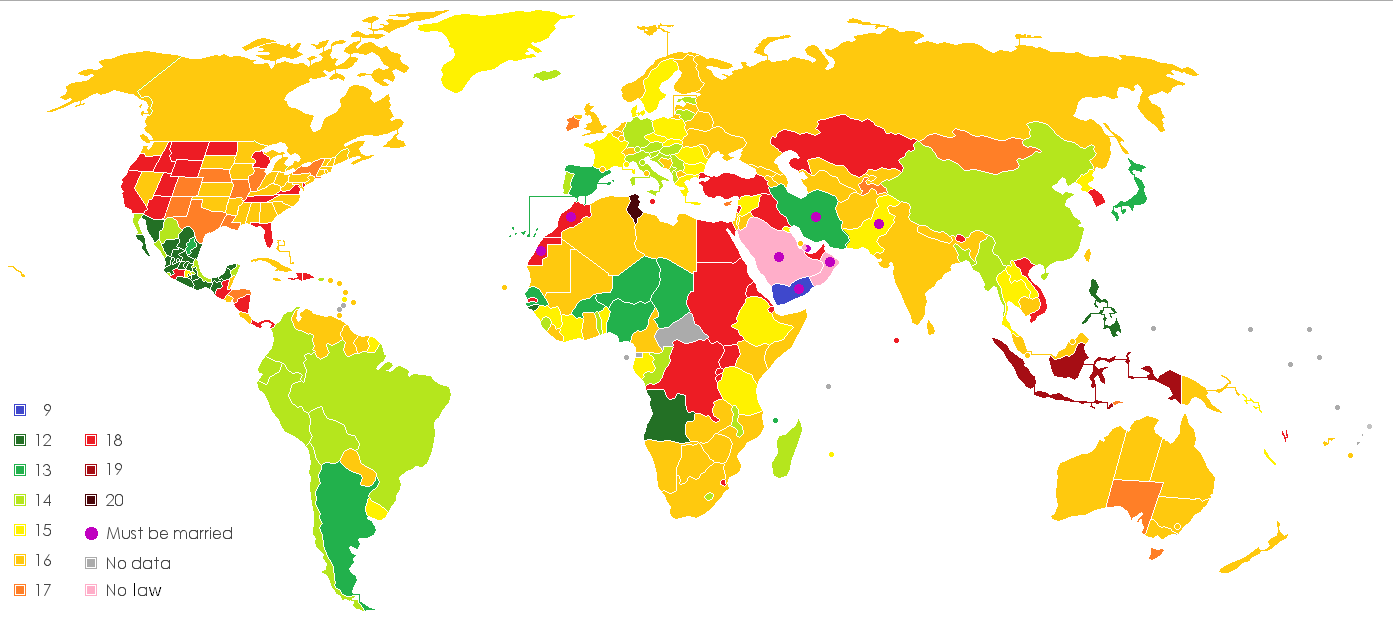
Notwithstanding the moral outrage, there was enough mileage of interpretation between the provisions of the Age of Consent (13 in Nigeria), the Marriage Act, the Child’s Rights Act and the Criminal Code – if anything, this issue would hopefully lead to the harmonisation of laws to grant adequate protections to children being co-opted under duress into adulthood without acknowledgement of their individual rights, once we have moved on from the witch-hunt and persecution.

The refuge of Islam

Now, Senator Ahmad Sani Yerima who is 49 has spoken up [1] on this matter and this calls for some serious contemplation before our society falls into a chaotic morass of lawlessness predicated on each man’s conscience and personal justification for acts that derive validation from beliefs we might find ourselves unable to question let alone defy.

Speaking from Egypt by phone to the BBC Hausa Service – They seem to have the scoop on anything that pertain to Nigerian leaders of Northern origin, the same service broadcast the allegedly hoax interview with President Umaru Yar’Adua in January when it was believe he had no capacity to do so.

The Senator believes he broke no laws but rather than seek refuge in civil laws he has said he would not respect any law that contradicted his religious beliefs – I suppose that is fair enough on face value but one should examine in detail what he had to say which I take liberty to post verbatim from the BBC News site.

Copying Prophet Mohammad

I don't care about the issue of age since I have not violated any rule as far as Islam is concerned, history tells us that Prophet Muhammad did marry a young girl as well. Therefore I have not contravened any law. Even if she is 13, as it is being falsely peddled around. If I state the age, they will still use it to smear Islam.

As a Muslim, as I always say, I consider God's law and that of his prophet above any other law, I will not respect any law that contradicts that and whoever wants to sanction me for that is free to do that.

This raises a number of questions and issues that lie at the matter of separation of State and Religion – in this case, the religious force is being dictated by the weight of Sharia Law.

An absence of accountability

At first, the Senator asserts that the age of the girl he married is not 13 but does not offer to tell the real age by citing privacy even though there is now a public interest and moral standing to be satisfied to clear up this issue if the girl is indeed above 13 and of sensibly marriageable age.

The preponderance of Islam is brought to bear on a civil issue for which we cannot find a recognised authority to adjudicate which by default almost makes this man unaccountable to anyone but God’s law and the prophet. One then wonders if Nigeria is a democracy, a theocracy or a non-descript quagmire of conflicts between laws derived from a seeming Judeo-Christian perspectives with its origins in British Law and indigenised Sharia Law.

With defiance he goes on to contend that even if the child is 13, he is answerable to no one and plugs equality with Prophet Mohammad by taking the example of the Prophet having married a young girl too.

Bringing Islam into disrepute

But the truth can be found in this statement, “If I state the age, they will still use it to smear Islam.” In other words, despite the precedents and force of Islamic law he can proffer, this singular act of marrying the young girl is at risk of bringing Islam into disrepute and dragging the holy names of the prophets and deities down with it.

For that alone, if there be any authorities within Islam with the power to pronounce judgement or the dreaded Fatwa on this matter, this is the time to save the face of Islam, Sharia and all that makes it a belief system from the embarrassment of a man whose main objective is to satisfy his propensity for young girls rather than be an example of pious Islamic living.

Should Islam suffer a battering because one man had to satisfy his lust for young flesh or shall other Islamic leaders turn a blind eye to this just as they are resisting the adoption of the Child’s Rights Act in Northern Nigeria because they also have a secret craving for the same?

Presaging the repeal of Sharia

It would be a shame if the Senator having extricated himself from the grasp of civil law there is no sanction based on commonsense and principle within the religion he strongly adheres to apart from one outside the realms of human capability and pronouncement.

If that be the case, then Islamic Law cannot and should be allowed to have precedence over civil laws if practitioners are not answerable to some humanly constituted legal authority and sanction for acts that would be termed morally reprehensible when examined under the plain like of sound reasoning without the taint of belief, creed, dogma or tenet.

For this alone, the repeal of Sharia law should gather pace immediately.

Source

[1] BBC News - Nigerian senator Sani denies marrying girl of 13


Relevant material Nigeria: Senator's teenage marriage is lawful though reprehensible


Nigerian Criminal Code Act Part III-IV The Relevant part is Chapter 19

Age of consent - Wikipedia, the free encyclopedia


Age_of_Consent.png (PNG Image, 1393x628 pixels)


Age of consent


Laws of the Federation of Nigeria 1990 - Marriage Act


Child's Rights Act of 2003

Friday, 18 May 2007

Stoners required for Sharia execution

Punishing crime against women

Crime and violence against women is still something men and society seem to be able to do with impunity in Africa, one report suggests it is seldom punished. There are civilising voices that are being raised to highlight these issues and bring focus to the need for radical and positive change.

Unfortunately, one such voice for change in the blogging community seems to have lost the desire to continue this thankless activity and I very well sympathise, social issues in Africa cannot gain prominence where the quest for basic survival is the primary pre-occupation.

Apathy reigns whilst hedonistic pursuits leave us in need for things to improve our society and raise our quality of life, one would miss the voice of Black Looks on these matters.

Sharia in the headlines

The law and religion collide again in Nigeria's north where a man has been sentenced to be stoned to death by Sharia Law.

His heinous crime is the forcible raping of two teenage girls, an act he committed with an accomplice who got off lightly with just a six-month sentence.

I would not argue the disproportionate difference in sentencing, as to how a rapist and an accomplice cannot both be accessories to the same crime and how not even a corporal punishment element appears in the sentencing of the supposedly lesser criminal.

The logic escapes me that the horridness of the crime of rape has been belittled in some way that would make it arguable for a participant in encouraging a rape might get off quite so lightly. Am I expressing surprise at Sharia judgements being so lenient?

There is a risk of imputing tribalism, in noting the ambiguous name of the main criminal which is indeterminately Southern Nigerian (Ade Debo) as compared with the more Northerly sounding and Muslim name of the accomplice (Shagari Abubakar), but I would contend that greater principles of due legal process, albeit Sharia Law prevailed in the execution of justice and judgement.

The punishment

In the West, rapists do get quite stiff sentences, even up to life imprisonment, in America, it would exact a capital punishment, especially if it leads to murder - I would argue that rape should and must be severely punished if proven.

The points of interest arise when you hear the proclamation of the judge; Aliyu Mohammed, "For your action, you will be stoned to death as ordained by Allah".

I would not dispute this statement, but how many times have we seen certain actions of men carried out in the name of God so as to be considered credible, unassailable and inviolable.

The we read that the men have 30 days to appeal the sentence where man in the assumed capacity of Allah can commute what Allah ordained to a lesser punishment - maybe I am being a bit pedantic here.

Are you a stoner at heart?

If the sentence does not get commuted, in the 21st Century, would there be a wolf pack of Nigerians available to pick up specially selected stones to throw at a fellow human-being till he were dead?

Would people be compelled by their Islamic leaders to do the Allah-ordained task of stoning or face the wrath of Allah?

Surely the execution of criminals should be the function of the state and this should be carried out in a humane and civilised manner, to set this activity in the marketplace of a mob of bloodthirsty people creating images too savage for Allan Quatermain's Africa is beyond the pale.

The bizarre nature of this whole thing would be if certain adherents of Sharia principles offer their services as professional "stoners", or rather, they are catalysts that help instigate and encourage the mob to pick up stones and finish off the criminal as he bellows out blood-curdling screams of pain to the hearing of inured children.

The role of civil law

We should punish crime appropriately, but at this juncture, civil law is probably the better tool to handle cases like this than traditional religious methods which would take the focus away from the crime and place it on the criminal as activists move to prevent this sentence from being carried out.

Somehow, Sharia Law does have its place in society, but it also has to adapt to modern values in such a way that social matters are handled with the adjudication of the Sharia court whilst felonies and serious criminal matters are forwarded to the civil law division.

The way Sharia Law grabs the headlines when these punishments are given persuades people to highlight the fossilised aspects of this code of conduct and creates resistance to the more civilising forces for social cohesion that Sharia Law might bring to communities.

The only progress I have seen in this matter is where the female victims of this sex crime have not been charged with some absurd offence of encouraging the rape; amazing perspective, but too valid in Africa to be ignored.