My Pages

Showing posts with label sharia. Show all posts

Monday, 19 April 2010

Nigeria: Senator's teenage marriage is lawful though reprehensible

{New information added 21/04/2010 18:00hrs} This conversation is ongoing on Facebook and I have received new information regarding the adoption of the Child's Rights Act of 2003 by more states in Nigeria - in this article Cross Rivers States was presumably the 23rd state to adopt the Act, other issues on Children's rights are discussed too Source Article.
What is legal can be immoral
I found myself engaged in a debate about morality and legality having seen a number of postings by friends regarding a Nigerian Senator who had married a 13-year old Egyptian girl. (Grandiose Parlor[1]) (AfricanLoft[2])
When I first read the topic, I was caught in great revulsion but I refused to allow my emotions becloud my judgment, despite the presumed research the news columnist appeared to have made regarding the marriage.
So easily, one can be taken by the sensational stuff and depart from objective scrutiny when one hears of what was paid as dowry that some have made appear as a wife purchase.
Between religion and homeliness
Indeed, because the man is Muslim, it is also easy to make Sharia the whipping boy, castigating religion whilst thinking the worst of the situation.
Categorically, it is morally reprehensible that a married man who already has three wives would take on a fourth that is only 13 – now, there is nothing wrong with a Muslim man marrying four wives – Islam allows for that “luxury”.
Having taken this 13 year old as a wife, I doubt she would be put to bed immediately, she would probably enter the family and adapt to the way of doing things within that polygamous family being groomed by the matriarch first wife – consummation may not take place for years - a need for cultural studies over preconceived personal prejudices would do us all a world of good.
That is not to put a gloss on the matter but to disabuse the tendency to think of every uncommon relationship through the myopic prism of sex – I find it amusing when the thought of homosexual relationships automatically creates revolting pictures in the minds of people who have no clue of what is going on between the persons involved.
The Age of Consent
Anyway, the first thing I did was to determine the age of consent [3] in Nigeria.
That being the age at which a person can be considered legally competent of consenting to sexual acts.
Apparently, Nigeria has one of the youngest ages of 13 [4], which means a 13 year old is considered legally able to engage in sexual activity [5] and adults need not suffer any legal consequence as a result of the sexual liaison.
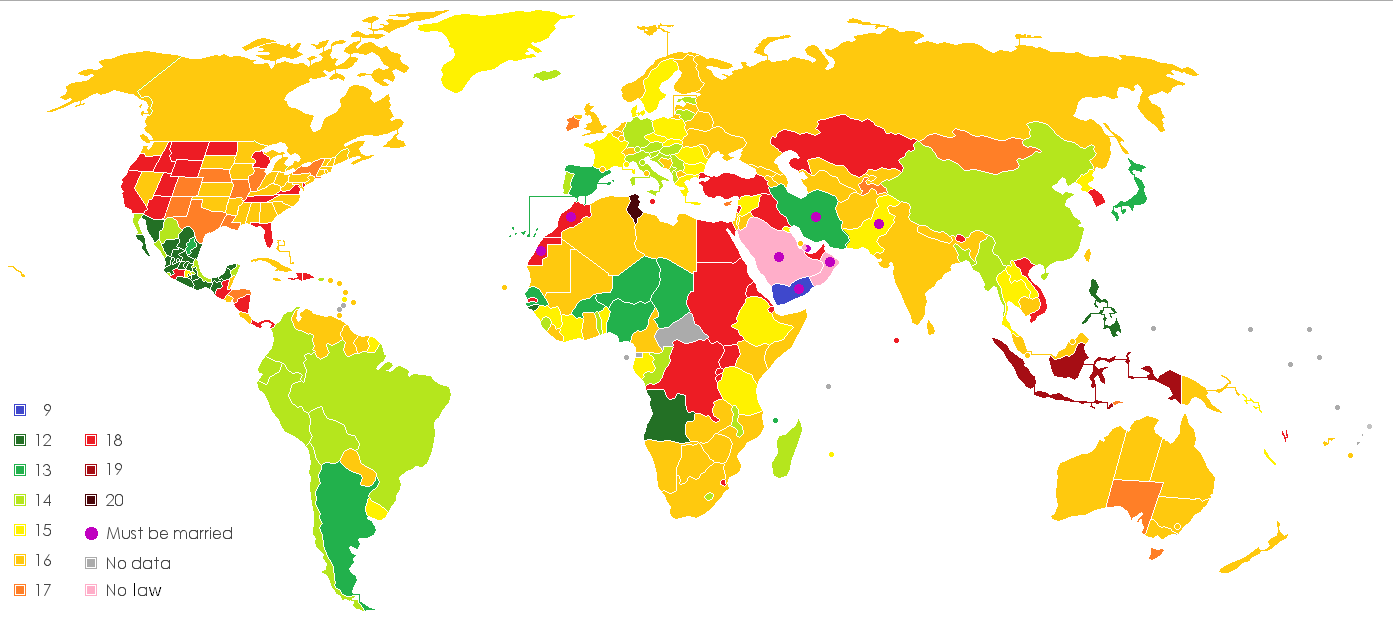
In the Northern African countries the ages range from 16 to 18, whilst the Arabian Peninsula allows for sex with 9 year olds, Saudi Arabian sets no minimum age at all – the mind boggles with apoplectic moral rage – but the law in those lands allow for it.
The ambiguity of the Marriage Act
Now, there is the conflict of laws that allow for sloppy judgment to lead to the witch-hunting of the senator – the Marriage Act [6] of the Constitution of the Federal Republic of Nigeria expects for marriages to be contracted between persons above 21 years old (Section 11), however, it also grants exceptions for marriages below that age if consent is granted by the father, the guardian or some legally constituted authority (Section 18 & 19).
In essence, the Senator most probably has broken no laws, whilst he might have excited our moral outrage, there is no reason to sanction him for marrying a girl – a lapse in judgment should not metamorphose into a criminal act just because we find that contract reprehensible.
There is definitely a case for changing the law to deal with the matter of making the “Age of consent” explicit and then merge that into the Marriage Act, if not, the loophole exists for children to be contracted into unhealthy relationships without the ability of self-determination or resistance. {Added 21/04/2010 - In addition the Child's Rights Act of 2003 needs to be adopted by more than the 4 to 6 states that have given it credence, because a child is defined as a person under 16 or 18 years of age, depending on the document reviewed.}
The law of in need of adjustment
The religious dimension to this matter however must not be left insignificant because a Nigerian mother lost the bid to annul the marriage [7] of her 18-year old son to a 55 year-old woman – whilst this interesting reversal of sexes might not excite passions – the matter of maturity and religious laws sided with the man against what would have been expected of a woman of a similar age.
In the end, the marriage of the Senator to the girl which would not have been allowed in Egypt is perfectly legal in Nigeria without resorting to the religious allowances of Sharia – however, if it gets reinforced by Sharia legal opinion, it is left to our legislature to argue to case for what should be legally acceptable and make the necessary changes to the law for that purpose.
Baying for the head of the senator is mob rule fuelled by mass hysteria – we should have avoid the inclination to formulate laws to accommodate our feeble sensibilities.
Sources

Wednesday, 21 January 2009

Nigeria: Women's democratic rights curtailed by Sharia

Separating the state from religion

When the more established democracies of the world decided to separate religion from the state even though the governed have strong religious inclinations they probably had very good reasons.

Nigeria happens to be a democracy but one where religious diktat not only encroaches on civil society but sometime gains ascendancy over transparent democratic processes.

A group of women had organised a protest for the 29th of January and this has been banned [1] by the Islamic authorities in the Northern city of Kano in Nigeria.

The bane of religious policing

The head of the Sharia police and this is completely different from the state managed and civil law enforcement apparatus opined that the planned protest was both an embarrassment and un-Islamic.

One would generally suggest that the reason why any group of people would join to protest for any cause would be because whatever channels for redress or grievance amelioration fails to serve its purpose fairly, judiciously, justly, satisfactory and expeditiously.

The issue on the mind of the protesters might well be a social and cultural issue which for reasons of modernity or enlightenment was about to find expression through the democratic right to protest. However, when custodians of Islamic norms – they being the Sharia police – interfered with this democratic process they risked bringing Islam into disrepute through their zealotry and their lack of understanding of the social consequences of their actions.

The plight of divorced women

The women protesting are divorced Muslim women who when divorced get thrown out of their homes, lose custody of their children and sometimes end up destitute according to the reports - the mental and psychological damage than can ensue from this kind of treatment cannot be quantified.

One could very well assume that these women are victims of domestic violence and might have been subject to extreme maritodespotism without any recourse for legal or social review of their circumstances with the aim of attaining a favourable outcome.

One would then think that where civil society has failed to address these deep issues of marital discord, religion would play an even better and compassionate role.

However, if religious leaders or those in the position to take presumably infallible religious texts and imperfectly interpret the texts without due regard for humanity and consideration those issues are then not dealt with and the victims are left twice without justice and done an injustice.

Religion failing humanity

Indeed, a demonstration by divorced women who cannot find justice and fairness in their communities would be an embarrassment; but where religious leaders have given up that opportunity for wise counsel for expediency; they allow for this injustice to continue rather than create avenues in which to properly accommodate the concerns of the protesters and advice their communities of adherents of humane ways of handling marriages that have irretrievably broken down and where one partner is of limited means.

In civil law, a divorced party should be able to claim alimony or palimony depending on the circumstances however when religion is allowed to become a legal framework for the policing of morality and social curtailment conflicts might then create tensions and unintended consequences.

In short, religion that does not address social matters of humanity with compassion and consideration with a view to fairness and justice is a bad religion or has bad clerics as religious leaders.

Kano is the more ridiculous now

For instance, the banning of this protest was to prevent Kano from being ridiculed in the eyes of the world – it is debatable if Kano has not now been more ridiculed by the banning of the protests.

Civil law and secular society in a democratic context has checks and balances, even though they may not be as effective as they should be or might be corrupted by all sorts of self-interest and/or selfishness, but the parties involved can be made accountable eventually, if there is a will for ensure it.

Legislating for morality through a parallel religious legal code and adherence of some religious lifestyle stricture can be problematic where the purveyors for religious management are not necessarily accountable to any authority except to some superior being.

Those leaders are NOT perfect

The danger also exists where religious leaders who have acquired religious knowledge and have attained a high status in society might be deluded into an infallibility complex and hence be unable command authority with humility, exercise responsibility with considerable and temper commandment with compassion.

The tendency to take the interpretation of religious texts to a point where they begin to personify the deity they profess to worship is rife and it lends itself to error, mistakes, misjudgements, cruelty, heresy and hypocrisy.

Democracies should be pre-eminent

For those and many other reasons a democracy should by its substance extend to any lawful and enfranchised citizen the right to peaceful protest and these rights should not be subject to the whim of some religious organ.

Where civil law enforcement does express concerns about a protest, they should be able to provide good reasons defensible in a court of law as to why a protest should not take place or provide adequate policing and security to allow for the protest and expression of democratic rights.

To goes without saying that religious law which for those in authority allows for the domination of the citizenry by an unaccountable and unrepresentative lot also deprives the citizenry of their rights to the pursuit of happiness in any way they see fit as responsible adults and considerate members of society.

All means to restore the honour of the women

There is no reason to curtail the rights of anyone in a democracy where the curtailment derives from rulebook other than the constitution of that country and this should not be restricted or subsumed to a quagmire of religious laws.

The whole idea of policing morals in the 21st century is not only ridiculous, it is preposterous and invites opprobrium from well constituted democracies.

In the end, what is at stake is justice for women and the compassionate review of the unacceptable treatment of divorced Muslim women, it is shame that neither civil nor religious law has been properly leveraged to restore the dignity, honour and integrity of these women.

Even in a society where there is no religion our sense of compassion and humanity should not fail to do this as a minimum – the protest should most definitely be allowed to hold for the sake of our democracy and despite the religious misgivings.

Sources

BBC NEWS | Africa | Sharia police block women's rally

Monday, 3 December 2007

President overrules Mohammed

President Mullah

This gets absurd and cannot approach farce faster than a shooting star zips past the world.

The President of Sudan as the military dictator who took power by overthrowing a democratically elected government in 1989, had two British Muslim peers of the realm in audience today.

Marshal Omar Hasan Ahmad al-Bashir, you should read that again, the President of Sudan is not a religious leader; he gained power through the barrel of the gun. Sudan has been in conflict for decades first between the Muslim North and Christian/Animist South and now the genocide perpetrated by the Arabs on the darker skinned of the West of Sudan in Darfur.

The only religious authority the President can call upon can be as trivial as the fact that he is a practising Muslim though he made alliances that have boosted his power and status by allying himself to Islamist causes and making the North of Sudan an Islamic state governed by Sharia Law.

Power to forgive

As I write, the peers of the realm seem to have secured the pardon of Gillian Gibbons as it appears once her sentence was given there was no right of appeal apart from a commutation or pardon by the President who appears to have supreme authority to overturn or revoke the force of religious law.

It is welcoming at least to see that political power wields that much influence over religious excess and if this means that the President can exercise compassion and has elements of humanity rather than pandering to expediency it is time to stop the genocide in Darfur immediate – call the Janjaweed back to the mosques in Khartoum.

Beyond this all, it means that there are men on earth who can receive tribute on behalf of Islam, receive apologies on behalf of Allah and Mohammed the Prophet and commute any sentence zealous Islamic clerics can pronounce in scapegoating others and exercising enough fear, terror, trembling and loathing to keep the locals in line.

As for Teddy Bear, one wonders if there would be a renaming ceremony as Sudan showcases everything that is just not so about the “religion of peace” and at one time in the courts of Suleiman the Magnificent, the religion of great enlightenment.