My Pages

Showing posts with label memorial. Show all posts

Saturday, 23 December 2023

John Coll: Calling on Herbert Dzinotyiweyi to fulfil his wishes

How we learnt of it

9 years ago, a very dear friend, John Alexander Coll passed on, unfortunately, many of us who knew him did not learn of his passing until almost a month after he had gone. The executor John chose to manage his estate and contacted me late on the 21st of January 2015 and expected a response from me by the 23rd of January 2015 for the funeral planned for the 30th of January 2015.

This presented a difficulty for many who would have liked to attend John’s funeral, we found a circle of friends and eventually were able to have someone in London represent those of us who would have had to travel from afar to honour this amazing man.

The executor of John’s estate

Sadly, 9 years on, John’s estate and issues have not been resolved as he had intended, his executor Herbert Dzinotyiweyi who used to handle the accounts for the company Connection Software that John founded through the years gave everyone the impression that the estate was a very complex and tax intensive issue, it probably was.

Herbert Dzinotyiweyi who for a while lived in the UK also has Zimbabwe roots and seems to have ensconced himself beyond the reach of scrutiny of his fiduciary obligations to the beneficiaries of John’s estate.

It was in early 2019 that I acquired details of John’s will and the probate that had 10 beneficiaries once the core of the estate had been liquidated, yielding almost £800,000 which if it were judiciously divided amongst those to whom John bequeathed a largesse would have been consequential and life-changing for each of them, most located in Zimbabwe where he once had interests and in South Africa.

Our engagement with Herbert Dzinotyiweyi

I was able to gather all the beneficiaries in conference a few times in 2019 into 2020, some of whom at the time that I contacted them were unaware that John Coll had made a generous bequest to their names.

We did Herbert Dzinotyiweyi to attend some of those conferences from the safety of Zimbabwe, at which no determination was gained or made until he removed himself from the conference groups as if he had no further obligations as executor. Suspicions arose that a professional forensic analysis of the moneys accrued from the estate after probate determined that money had gone, it had not gone to any of John Coll’s intended beneficiaries.

Just account for the estate

Whilst I do not intend to impugn Herbert Dzinotyiweyi’s name, some questions need answering; an explanation as to why John’s estate that made probate in June 2015 has still not been afforded the wishes of the testator, and there is a possible dereliction of responsibility as executor that might border on criminal enterprise, but this is not to accuse anyone.

A dead man cannot fight for his good intentions and wishes, which is why they trust someone or people to administer their estate when they are gone. The fact that John’s registered will was made and witnessed just 5 days before he passed on might have limited the scope of persons to elect as executors of his will. He cannot have thought that the person he selected would not expeditiously manage his estate and adhere fully to his generous desires, 9 years on.

Pattern or sheer coincidence?

I know this is not what John intended and I can only hope that action and justice for what John Coll desired is finalised by the time of the 10th anniversary of his passing and Herbert Dzinotyiweyi willingly accounts for his superintending of John Alexander Coll’s estate as executor.

The friends of John Coll who remember him fondly as an extraordinary person of consequence in innumerable ways will continue to agitate for the full realisation of his wishes. The matter is not closed by any stretch of the imagination. May John Coll continue to rest in peace.

NB: I am not a beneficiary of John’s will, I am a friend of John’s, we met in mid-1994. Obviously, I will review and edit this blog once all of John’s wishes are fulfilled as he intended.

Meanwhile, a quick search for Herbert Dzinotyiweyi would suggest he has run into some trouble. One cannot speculate on pattern or behaviour, but it is an interesting development to discover today. [ZimNow: Harare man in court over residential stand scam]

Blog - John Coll: Friend, Mentor, Gentleman (January 2015)

Monday, 23 May 2022

#TheAIDSMemorial #WhatIsRememberedLives Chris Clark


Chris Clark (1973 - 2009)

The AIDS Memorial

I follow the Instagram page of TheAIDSMemorial where the theme of #WhatIsRememberedLives memorialises the many who lost their lives to HIV/AIDS, some many in the late 1980s into the 1990s and even after.

I lost many friends to the plague, and I also made many friends who live as witnesses to the wonders of medicine that now keeps many of us alive. Some were really close friends and their loss shook me to the core, then, one was a lover, for whom the unexpected and sudden realisation of his demise is quite difficult even as I was fighting for my own life on the diagnosis of AIDS and cancer.

Many of us in losing friends or partners of a sexual minority rarely had support or comfort for our losses and grief. Some were ostracised or excluded from the obsequies of people they loved in life out of secrecy, shame, animosity, stigma, or denial. In The AIDS Memorial page, we find an opportunity to remember and ensure those significant relationships are never forgotten.

Of loves lost

That lover was Chris Clark, and this is the only picture I have of Chris Clark (May 30, 1973 - c. October 14, 2009). We met online in late 2003 when he lived in London and I in Amsterdam, there was such an attractive quality about him, his story, his experiences, and his ambitions that drew me to him, I guess I was smitten by that personality.

We tried hard to build a relationship, but I was unsure of what it would entail, I guess I was once afraid and I was lazy about the prospect of a long-distance relationship, I should have been bolder, but I learnt hard lessons in the process. He came to stay with me in Amsterdam when I realised that my cooking was too spicy for him.

Other places we met up for snatches of affection and more were in Berlin and at Playa del Ingles, it didn't bother me footing the expense, I was never able to use my head when it came to Chris, I was all heart and no sense.

In pain and in forgiving

His mum threw him out of their home at the age of 15 when he declared his homosexuality and somehow, it fell to a stranger who took him off the streets of London and then to the United States of America where he finished school and tried a career in film and photography.

Later, he moved to Amsterdam with a partner who sadly committed suicide by drowning in a canal. Much as he had hardships and challenges in his life, the parents who rejected him as he was growing up could not trust any of his apparently responsible older siblings to care for them as they were dying, they called on the humanity of Chris to give them the send-off they desired, and he acquitted himself well in that regard.

He lost his mother in February 2007, she died in his arms and his father in December of the same year, he bore the full cost for the funeral arrangements whilst the siblings quibbled about the estate. His father left everything to him as for everything they did to him, he was the only one that could be trusted to do right. Chris had a large and forgiving heart. I tried to offer emotional support in the absence of family, we last met up greeting in the new year of 2008 in Playa del Ingles.

When he died

He became HIV+ probably a few years before I did, but there were times when he did not have enough to eat in support of his essential medication. I sometimes think he allowed his condition to deteriorate over time. We grew estranged though we maintained sporadic communication into 2009 when my health slowly descended into full-blown AIDS I was hospitalised in late September 2009.

He constantly asked after me sending me text messages I did not promptly respond to, I felt Chris was too deep in my life in some of the things he did that I needed to protect myself, my heart, my emotions, and my mental health even as I was besotted with him. He invited me to Facebook which I did not respond to until after his passing.

I left the hospital on the 9th of October 2009 and as I was settling down just over a week later, I sent a message to his mobile phone and got a shocking response from his flatmate, Chris had died at home of renal failure just around the 14th of October, a few days after my discharge from hospital.

A memorial deserved

I had many fond memories of Chris, and I grieved his passing for many years. One Christmas, I did get the Christmas tree we argued about because I did not want one and he did. It was one way of memorialising him. In fact, I grieved alone sometimes leaving a message on his Facebook on birthdays and the supposed date of his death.

I thought I would never find love again until it took something so extraordinarily special that first reminded me of Chris and then informed me that I could move on from Chris, it took over 9 years for that to happen. He had that cheeky smile, a dry sense of humour, a way of pulling at your heartstrings and a wonderful personality.

I have wanted to write this for a long time, thank you Chris for sharing some time and love with me. Akin Akintayo

I wrote an AIDSMemorial page for Chris Clark in two parts, Part I and Part II, this blog fleshes out parts that I did not include for space constraints.

Thursday, 25 February 2021

James Anderson (1956 - 1994), The Opera Queen

A brief and enduring encounter

James Anderson was a friend of mine, we met one evening some 30 years ago at the old Brief Encounter pub on St. Martin’s Lane in London’s West End. I cannot say why he took a liking to me, but we got chatting, he got me a drink and then invited me back to his place.

Quite an intriguing guy, he lived in Bermondsey and his little apartment was crowded out with vinyl albums, 5,000, he told me, mostly to do with opera and operetta, he was a walking encyclopaedia of that genre of music and entertainment, long before I had any liking for it.

I left his place in the pouring rain to return to an apartment I shared with others only to find that I could not get in because I did not have the keys and I could not rouse anyone to open the door that late in the night. I went to find a phone box as this was before mobile phones became commonplace and called James about my predicament, still wet from the rain.

He kindly invited me back, gave me warm clothes, made me tea and we went to bed. That is how we began a friendship and I learnt that he was HIV+ with his health just about holding up. Over the next few years, I met up with James on all sorts of occasions. A humorous wit, a cheeky smile and almost always up to mischief.

Praying for the time

He also had a sense of urgency, he wanted to finish the second edition of his published book, The Complete Dictionary of Opera & Operetta and he did not know how much time he had left to get it done. He did get it all done and published.

In July 1993, we had a big 37th birthday party at his place in his honour, quite a few common friends were there, some I had also met before at the Brief Encounter. I did not realise that it was almost like a farewell party. James had been ill and developed AIDS, he seemed his jovial self but was probably putting up appearances. It was a rather jolly time.

A life cut short

Sadly, in early 1994 there was a two-page spread, a recognisable picture of a handsome and youthful man in a newspaper, I think the London Evening Standard, and there was a long tribute to the man we fondly knew as the Opera queen, James Anderson had died the night before due to complications of AIDS at the young age of 37.

I did not find out any details pertaining to his funeral, I just mourned privately, sad that such an amazing man had been taken from amongst us, like many others who I met and befriended after James. I cannot find anywhere James has been memorialised, not even on the UK AIDS Memorial Quilt.

Remembering the times

Of recent, I have been viewing memorials that have garnered some interest after the airing of the television series, It’s A Sin which documents a decade of lives of some young gay men affected by the AIDS crisis in London in the decade from 1981 to 1991. I have from time to time also searched online for James’ book, just to see if it was still in print.

However, this morning, reading a review of the book posted by a buyer in 2013, they complained the book was dated and some information was incorrect. This was a book researched long before the days of the Internet and I was almost ready to respond, that the only reason why the book had not been republished, updated and had current events and personalities were because, the author, died some 27 years ago.

All I have now of James Anderson is pictured in my mind, flashes of moments that defined our friendship, the danger that in my naivety I was unaware of and then accepted. He was the first person I knew who had the disease, it did not make him any less a wonderful person, he just passed on at a time when there was little to help his situation, as did many in the 1990s into the early 2000s.

Thursday, 4 August 2016

Berlin: Concentration camps and walled cities

Memorials of grave deeds
Some things just defy explanation or understanding and sadly they are at first part of our history and are constantly at the risk of repeating and recurring in the present with the same horrors of the past.
The remains of the Berlin Wall preserved in a memorial are sited just outside Nordbahnhof Station. The record of a deliberate decision of people in power to cage people under a ruthless authoritarian Communist rule. [Berlin Wall Memorial]
The architects of the wall destroyed life and property to plant this rotten edifice that ran through a cemetery and in the process the disinterment of over 1,000 graves to fit that purpose. The memorial now sits on what was once part of a cemetery.
Concentrated evil
When people sought to escape this regime, because the primordial cry of humanity is for freedom, they were shot. Someone took orders to shoot both young and old without mercy and it was done. At the memorial stands portraits of each person martyred in their quest for freedom.
Not even 16 years before this wall was conceived and erected in 1961, there was the liberation of the concentration camps, the first of which was sited near the seat of power to cater to political prisoners at Sachsenhausen in Oranienburg.
These were operated by the Nazis with an efficiency and organisation that today still baffles imagination and comprehension.
In this and many other Nazi concentration camps, they perfected the art and science of human extermination with an almost sense of omnipotence and power over life, livelihood, death and disposal.
History in present replay
Anyone who visits the memorial will fail with words with which to appreciate this enterprise. What however all in our touring group was when I noted to our tour guide how when the Communist government of the GDR were planning a memorial to the souls lost in the concentration camps in 1961, the people who said never again were building a new wall around Berlin.
Man’s capacity for evil is never trammelled, when power is absolute and that fear of the other is exploited, resulting in the persecution of the other and the considered different by the Nazis, then by the GDR, was repeated in the Brexit campaign, is showing a Genesis in the aftermath of the failed coup in Turkey and is a fearful prospect if Donald Trump becomes president of the United States of America.
Walls are not bridges and bridges are not walls, whichever is built would either celebrate or denigrate our common humanity. The populist rhetoric aims to accentuate our differences, and if we do not stand up to this narrative, before long, people will be victimised and how long before this poison colours our doorstep?


Sunday, 21 June 2015

Thought Picnic: Pouring libations to our naked past

Secrets of loyalty
Two weekends ago, I had one of my incognito escapades where the planning and execution were literally revealed to no one. When I did tell my friend what I had planned, he was surprised because my planned trip to Amsterdam and Antwerp was both sudden and expressed in a way that seemed I was going round the corner from my home.
My recent trip to South Africa had boosted my air miles reward scheme status to enjoy a number of priority access services through the airport. I had garnered no less than 21,000 miles from that journey accumulated over 6 flights.
It meant I had fast track access through security regardless of the ticket I had purchased. As I did the typical security strip-tease without the music, the customs official engaged me in conversation about where I was from, where I was going and so on.
Maybe a coincidence
As it transpired, I answered, “I am English and my parents are Nigerian.” He asked what part of Nigeria and that got drilled down to the South West and Ijebu. He then responded that he was from Ijebu Imodi-Imosan.
That was quite uncanny because the traditional chief of Imodi-Imosan is also an Agemo masquerade and an uncle of mine.
He, however, was planning to return to Nigeria, to Imodi-Imosan where he said he was under obligation to offer appeasements to the animist traditions of his grandmother who apparently belonged to an Agemo masquerade affiliated lineage in Imodi-Imosan.
It occurred to me that this quite unlikely event of lives clashing on the improbability that we are linked by whatever degree by the familiar and yet strange coincidence calls for some reflection.
Not forgetting our ordinariness
For, no matter what the enlightenment of travel, exposure and schooling does to us, we are primarily human with the persuasions of the ordinary that goes far back before we existed, in genes that we bear or in the traditions passed down to us to return to the grottos of our ancestry where we take root having branched out literally beyond sight and mind of the roots that give us standing and sway.
The memorials are now in tombstones and fleeting memories, sacrifices and words now to be written on Facebook pages of those dearly departed too. We find imprints in the sands of time, weathered beyond recognition of frequency, but blown back like a leaf to obey the laws of gravity once the breeze settles.
For all the sense of culture we can muster, devoid of superstition and ceremony, we are essentially one step ahead of primitive, bound to things and secrets that rule our minds and decisions to walk into the future whilst keeping a keen eye on the past.


Sunday, 5 April 2015

Bucharest: Bearing left

To the left for what’s left
On my last evening in Bucharest, I stepped out of the hotel and walked up the road to the left on Calea Victoriei.
Hardly 100 metres from the hotel was the Tourist Office, but it was closed. This in my view was information the hotel concierge could have given me to make my visit more eventful. I was quite irked to discover this.
After passing one of the many Orthodox Christian churches on this street I got to a square of significant historical importance.
There are many divides between Western European Christianity and Eastern European Christianity. Our churches are churches are built to different designs and our feasts are on different days. Their celebration of Easter is a week later than ours.
I will not go into church split along doctrinal, theological, linguistic, political, andgeographical lines that caused what is called the East-West Schism in the 11th Century. Romania in the summer time is three hours ahead too.
Respect and revolution
The Revolution Square named for the December 1989 revolution that toppled the Ceaușescu regime where thousands were slaughtered for rising against the dictatorship, the monument could well have been desecrated today.
I got chatting to another tourist from Denmark as I lamented the fact the skateboarders had taken over the place with no sense of history or occasion that warranted the memorial.
The revolution probably predates their births, it was then that one of their number came to compliment my dressing, and then asked to be photographed with me holding a skateboard. I obliged and returning to our conversation wondered if they could ever appreciate the need to view memorials with some respect.
Another mile down of walking and I past the old royal palace, now the National Museum of Art of Romania, a few more orthodox churches, and probably the finest piece of architecture in Budapest, I am told. The Romanian Athenaeum houses the "George Enescu" Philharmonic.


Monday, 25 August 2014

Walks through the cycle of life

 
Manchester walks
Continuing on the subject of my walking, I chose to walk towards the east of Manchester, the temple of Manchester City Football Club, Etihad Stadium and the SportCity area where the 2002 Commonwealth Games was hosted.
Having lived in Manchester for almost 6 months, I have only just begun to explore its environs. In fact, I have never been this far before and I only once walked in this direction when I was looking for an apartment, the adventurous self in me preferring not to return the way I went out.
Fuzzy mapping in the brain
My bearings are a mess though, because there times I have assumed roads or paths would lead to places I know, but almost never get there, a bit or perambulating and gallivanting, minutes almost counting the hour, I find that slither of salvation, a place I know and I am thankful I have not had to tell anyone that I am lost.
My walk took me down the Ashton Canal towpath where I saw a lady at the helm of canal boat wending its way upstream with her partner and a friend operating the water locks.
El Capitán
I saluted her with the greeting, el Capitán as we struck up a conversation about her boat, where they were going, how the water locks work and some other small talk. They had had the boat for two years and they were going up river to have it serviced. Meanwhile, they were in their third day of this journey from home wharf for dry dock, fascinating stuff.
I then helped in swinging the gates open and shut before I continued my walk.
Walking along
Soon I was at grand walkway to Etihad Stadium, I had one quick take before I returned to the steps from the canal scaling the double-steps up and running down the single steps, creating a bit of a pant and a workout before continuing on to Philips Park.
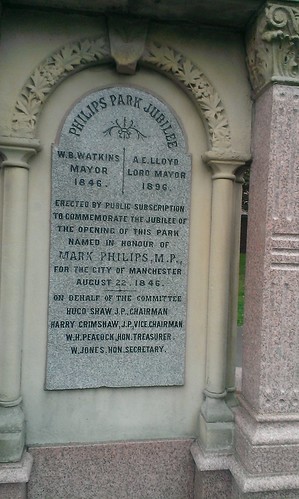
Philips Park, named for Mark Philips, the local Member of Parliament was open in 1846 after he committed himself to obtaining an open and free public space for the common man.
The River Medlock runs as brick-lined culvert through the park, so done because of the floods in 1872 that disinterred bodies and washed them downstream. The river could easily be mistaken for drainage, well, it is not.
There are serpentine paths all around the park with sections for children, cycling, rugby and other sports. It has memorial gardens and beyond the main park is the Philips Park Cemetery which opened in 1866.
People and things
As I walked through the park, I saw a boy of probably not yet 13 years of age sat on a bench smoking, he had ridden into the park on his bicycle and found a secluded spot to engage in this vice.
Soon, I walked into the cemetery where he definitely was not following his mother's advice by choosing to talk to strangers. Precociously, as he asked for how to get to the nearest tram station and I averred that I was new to this place, he wondered if I knew where I was, I had to use Google maps to point him in the right direction.
The grounding of cemeteries
In the cemetery, I observed many things; the quiet and stillness, a stillness in spirit, in mind and in body that is rest.
Yet, rest must not be an end, it must become part of the cycle of life and living, the opportunity we seize to get away from it all, the rat race and the hustle and bustle of chaotic living.
I recognise that in Africa we rarely visit cemeteries apart from when we put the dead to earth, I discovered that in England, cemeteries are so well kept, a job managed by the Friends of Philips Park Cemetery and they do provide quiet places for contemplation away from any disturbance. I eventually connected with this mind-set.
Beliefs for eternity
The cemetery had sections for the burial of Church of England, Roman Catholic, Jewish, non-Conformist (English Dissenters) - whatever that means and so on. It was like our beliefs usually handed down from our ancestry follow us through life whether we adhere to them or not and those beliefs decide where we are laid to rest. I would probably return to my Church of England roots than look for anything else.
One thing you could not miss in the cemetery with the power and the presence of love, many tombstones with the phrases, “In loving memory of”, "The dearly beloved", "The loving husband, wife, son, daughter of" with the day they died and at what age.
There was one tombstone that thanked the lady for being a wife of 53 years, in love and more, I was moved. The fact is in death, whether we mean it or not, love appears to conquer all.
Death is where resignation and acceptance meat at the ritual of ashes-to-ashes and dust-to-dust, when the dead are gone, they are gone, we bury or cremate them and keep the fond memories of them in our hearts and minds.
Other things
Leaving the burial ground, I returned to Philips Park to find out more about the park, and found a Peace Memorial that had a prayer written by Marianne Williamson but often attributed to Nelson Mandela, wrongly spelt with a double l.
The picture I took had a family who would have no idea what memorials are about clambering over it and it was clear that this activity by many other Philistines as these had damaged parts of the beautiful artwork, I was saddened and close to being angered.
This time, I walked back the way I came, quite refreshed and enlightened. I wonder where next my footsteps would take me. The other pictures.

Saturday, 12 July 2014

Thought Picnic: Only statues stand immortal after men have long gone

I stand before great men
As I visit cities around the world I am attracted to statues, monuments of stone or marble built to the memory of men whose passage in time is recorded for a viewing.
Before you, on a plinth higher than man is the edifice to man and it is usually a man though rarely a woman, the name, the year of birth and the year of death, between the years is a hyphen and that represents the long story of a life so honoured.
Yet my sight plays with my mind for seeing statues at night almost excites my imagination into thinking they would come alive and converse with me.
Men long gone
Then one reflects that statues are very much the yearning for immortality, great men personified in stone as a symbol, a memorial and a story, having walked the earth, they are long gone, dead and buried.
In the square in front of the fantastic neo-gothic Manchester Town Hall are five statues, I know only two of the men, Prince Albert the consort of Queen Victoria had a grand statue set under a canopy held up by four columns, his honour came by reason of marriage and great it was. Albert Square it is.
A few plinths away stood a greater man, William Ewart Gladstone without much ceremony, four times called to be Prime Minister of the United Kingdom during the reign of Queen Victoria, yet the greater honour of a grander memorial fell on him who married than on him who achieved.
But for the stones, there is no remembrance of the men except in history or in conversation where what they did or the lives they lived mattered.
We are transients
Man on whom power has fallen for stewardship yet fails to see this passage of time, a long period of passage that is an eternity and a future also which is an eternity, we men being markers on the chart that offers an opportunity to live, but never the gift of immortality.
In our folly, we grab money and grab power and act as if for us, time has stood still, as if the reckoning has stopped and history ended yesterday, but we are all transients, some for a moment, some for longer, like flowers we bloom, we wither, we die and blessed be the work of nature as we return to dust or ashes to be fondly remembered or completely forgotten.
If honour outlasts us, a statue rises in a likeness for a moment in time when we were most comely, and as I visit another city square, I sit again observing monuments to great men long dead. Lifeless statues with names, the year of birth and the year of death.
When I depart, my slow long walk or journey back home continues as I contemplate how well I shall be truly forgotten, not having made a dent in time.
The memorials in Albert Square, referenced from Wikipedia


Thursday, 26 June 2014

Berlin: Lest We Forget Those We Lost To Sexually Transmitted Infections

Stones of remembrance
Just further down the road at the big junction on the right after Wittenbergplatz but before Nollendorfplatz at An der Urania in Berlin stands a black marble stone with a red AIDS ribbon and one other on the ground, a square with inscriptions.
The quarter of space marked by a number of streets to the right also harbours many meeting places of people who have most been affected by HIV/AIDS as it scythed through the young with the vengeance of an unforgiving and unrelenting Grim Reaper.
However, this memorial did not just think of HIV/AIDS but it included Hepatitis and broadly Sexually Transmitted Diseases (STD).
Before you get holier than thou
Very easily, one can be sanctimonious and sententious as if completely unaffected and that might be the case for the abstainer, the celibate or the eunuch.
We however cannot deny that we are sexual beings and the desire to fulfil that need exists in the majority.
Some have experienced it through consent, some through violation, some as their innocence was snatched away by the unconscionably reprehensible, in violence or by subterfuge, none of which apart from the first are in the slightest, fun.
Death still looms
The greater point is to be aware of one's sexual health regardless of risks taken and to avail oneself of immediate treatment before other complications arise.
The rather innocuous infections can easily be vectors and vehicles enabling greater susceptibility to incurable diseases of which HIV is one and besides there is a rise in co-infections with the difficult to cure Hepatitis C.
Even in the West, people still die of these diseases as in some cases some diseases are becoming resistant to the heretofore effective drug therapies, like Gonorrhoea.
A memorial to all
What really touched me most was not that this was a memorial to the dearly and unfortunately departed, but that many living souls might have walked past a memorial to themselves.
Our secrets, fears, infidelities, embarrassment, shame, habits, ignorance, daring, promiscuity, innocence, naivety, stupidity, carelessness, carefreeness or just our plain humanity can put us in a place of pain.
We can mitigate those issues with accepting whom we are, being honest to ourselves and using the help to ensure we are no sooner victims than we should be.
To those we lost, you are never forgotten. Shalom!

Monday, 10 February 2014

Remembering Dick van Galen Last

A fine Dutch gentleman, and remembering him is a testament to the kind of man he was, as I have written before and will never tire of writing again, he is sorely missed.
Dick van Galen Last would have been 62 today, 4 years and 8 days after he passed on and 4 years and 2 days after we buried him.
I still remember that last day I saw him alive, he came to visit me just a week after I was discharged from hospital. I was too weak to go out for a meal, so we just talked over a pot of Earl Grey tea and some biscuits.
This was a little over two months before we had another chat on the phone where he informed me he had a health crisis, and we were sharing the same consultant. We even joked that we might meet up in the chemotherapy room one of these days.
Just three weeks on, he defended his PhD thesis; I could not attend as it was days after a chemotherapy session, I had no strength to do much, but vegetate at home. I heard that as he spoke, you could hear the strength drain out of him, but it was a spirited and commendable effort.
13 days after that amazing effort, Dick was gone and I learnt of his passing the day after. Tears in my eyes, literally sobbing all the way from my home to his, we, his friends had the opportunity to see him for the very last time, in his bed, formally dressed, with a cravat and as serene as if he was going to open his eyes at any moment.
I stood by him and whispered, “Goodbye, dear friend.”
I sometimes wonder if he was awarded his PhD posthumously, he did devote a good few years to that project travelling around the world doing research or looking for moments of tranquillity to complete the work. It was indeed determination in failing health that drove him to do what many might have put aside for another time.
When we gathered to see him off, there were hundreds filling that little chapel on that brisk and cold February morning, many paid tribute but I could not tarry for either the internment or the reception, I left after the service for what became my last session of chemotherapy.
My almost 13 year sojourn in the Netherlands began with Dick picking me up at the airport, lodging me for the first month and many other encounters of supper with his numerous multinational friends.
As interpreter, he would switch between English, Dutch, French, Spanish or German with the ease of a Babel Fish, he was such a person, thespian, cultured, refined, open-minded, loving, caring and much more.
To all of us who knew Dick, we all knew that when he died, a man indeed, of high integrity, a bon vivant whose joie de vivre remains as an example to all of us in the pursuit of happiness was gone.
Dear Dick, you may be gone, 4 years now, but you are never forgotten.


Monday, 9 December 2013

Thought Picnic: Learning to live well for the end

From conception to reception
When I went to Walsall, the place of my birth in July, it was for two reasons. For the memories and for the memorial.
I fulfilled the first but only thought of the second. I called my father when I was in Walsall just to have a conversation that drew from the well of memories left unstirred, and when he heard of where I was, he asked if I was writing my life story.
I am writing my life story, but I did not tell him that one of the reasons I returned was to find a place to rest when my days are done too.
Let’s live well
The last thing I would ever want is for there to be disputes about where this vessel would return to nature when its use is exhausted.
We are not there yet; we are alive and well, with many thoughts on living and one consideration on leaving. For how many secrets shall one carry to the grave and to what extent shall one rue what could have been if we could alter the course of events today.
For when you open the book to read my story, I hope that the open book I have made of my life in the things I have written would become a shared experience of living well even under the threat of death. Just let’s live well.


Monday, 14 October 2013

Sorry, I never told you ...


A page somewhere has become the memorial stone, where each year I have returned to lay a bouquet of thoughts in words too difficult to say.
Four years have gone in the annals of time like it was only yesterday, your smile, your embrace, your company, your fun was snatched away in an instant.
You had that piece of my heart no one ever reached or touched, where my head was never where it should be when we spoke and yet we never did the many things we should have done together because we were both foolish.
Now, I am wiser, but you are gone, four years gone, too far-gone, a memory still too strong to be forgone, I have no words but ones in this song. Sorry, I never told you, all I wanted to say.
Thank you for you taught me real love, if only you were here for us to share.
One Sweet Day
Sorry I never told you
All I wanted to say
And now it's too late to hold you
'Cause you've flown away
So far away

Never had I imagined
Living without your smile
Feeling and knowing you hear me
It keeps me alive
Alive

And I know you're shining down on me from heaven
Like so many friends we've lost along the way
And I know eventually we'll be together
One sweet day

Darling I never showed you
Assumed you'd always be there
I took your presence for granted
But I always cared
And I miss the love we shared

And I know you're shining down on me from heaven
Like so many friends we've lost along the way
And I know eventually we'll be together
One sweet day

Although the sun will never shine the same again
I'll always look to a brighter day
Lord I know when I lay me down to sleep
You will always listen as I pray

And I know you're shining down on me from heaven
Like so many friends we've lost along the way
And I know eventually we'll be together
One sweet day

Sorry I never told you
All I wanted to say
Mariah Carey, Walter Afanasieff, Nathan Morris,
Michael McCary, Shawn Stockman and Wanya Morris


Sunday, 1 January 2012

Incredible India: India Gate

Halting and hobbling
After visiting the Bahá’í Lotus Temple, I had planned to visit India Gate, an imposing structure very much like the Arc de Triomphe in Paris and this meant getting off at the northern terminus of the Violet Line that intersects with the Yellow Line at Central Secretariat metro station.
Unlike on my way to the Lotus Temple no one offered their seat to me, I was suffering quite a bit after my walks and much as I had not needed my cane for the last few months in the Netherlands, I did have it with me in India and found that I needed it more than I realised I would.
This month has been sedentary at best, in the Netherlands I would have been on my bicycle, the riding helped a lot as physiotherapy, not much so here even with the just usable gym downstairs.
Wide and ceremonial
From the signposting within the metro I came out at Gate 3 and then realised India Gate was not going to be a brisk walk for I got on a tuk-tuk having negotiated tourist prices with the driver.
Left and then left turn, I could see India Gate looking deceptively close but probably a good 2 kilometres away. The lawns on both sides of this really wide road had been cordoned off with seats being installed in readiness for some parade which I suspect is the Indian Republic Day on the 26th of January.
I suppose they had to start this early for all sorts of reasons that I will refrain from generalisation and supposition.
No snaps, no thank you
Just before the major road in front of the gate, I got off and for the first time I saw a pedestrian crossing with traffic lights and push-button call signal. Though I also noticed I was the only one who thought it sensible to cross there – Indians basically jay-walk with a sense of bravado that borders on the suicidal.
As I got to the gate, I ran the gauntlet of photographers, in all maybe 20 approached me and I was not their typical tourists, those that were not in my face, I ignored completely and those who dared to be bolder got a sharp and stern rebuke that they almost scurried away like frightened squirrels.
What I found most fascinating was the Taj Mahal pose which had been brought to India Gate as a novelty. The one where photographically you appeared to be touching the tip of the Taj Mahal just did not look as exciting if it was the flat-topped India Gate – I was having none of it and I was not being a killjoy, just unimpressed.
To the fallen
India Gate built in 1931 during the colonial times to honour and memorialise the war dead is now the national monument and the Indian Army’s tomb to the Unknown Soldier.
The walls of the gate are engraved with names of the fallen and a flame burns under the canopy. The expansive grounds around the gate are public areas where people gather for picnics, games and other activities.
Everything on sale there was going for prices I was not willing to pay to the many that were there to exploit for opportunity and occasion. After circumnavigating the gate, I decided to have a late lunch at Connaught Place – I got on the metro in the wrong direction then changed, had a meal and returned to crash out until I was woken up at midnight by the fireworks and celebrations ushering in the New Year.

Monday, 24 August 2009

Known unto God

Unknown to man but known to God

The grave stone read “A soldier in the 1939-1944 war” at the top, some had the rank, others did not and at the bottom was written “Known unto God”.

Of the 1680 graves of men who perished in Operation Market Garden [1] over a period of 6 days between the 19th of September 1994 and the 25th of September 1944, some 245 carried the epithet of the Unknown Soldier – buried with honour for their service but unknown for all sorts of reasons.

On one tombstone, the inscription started with “Believed to be” it made you wonder when doubt should be removed and the truth be known, but should the truth be known or the situation be left for believers to believe as they will?

Believing might well have been difficult too because one tombstone marked the grave of the chaplain; on such an evil day, where would man have found comfort and succour in their last minutes on earth? With whom would they have left the “Kismet” [2] messages to dearly loved ones back at home?

The root of goodness

We were there - Arnhem Oosterbeek War Cemetery [3] - to visit the grave of someone we never knew but from whom came friends, families and good fortune. The people who lived through the wars of old never talked about how it affected them but we saw the scars as they stoically went about their business without grumble or discontentment.

The lady married to this gallant soldier already had a son by him and her daughter was born the day her father was declared missing, her grandson is my dear friend and for the first time, I finally found opportunity to pay my respects and see why she visited Arnhem every year from 1969 during the memorials up 2005 after which she was too indisposed to visit again.

As we approached the cemetery, it was so unexpected, my friend just burst into tears, I was taken aback, but cemeteries bring a quiet contemplation of serenity and mortality, memories of things past along with things not known the palpable sense of pilgrimage that accompanies knowing that someone from whom you came is rested in a perpetual memorial in a foreign land.

The dear lady died last year and her ashes are scattered where her husband is laid, the only love she knew and it is with poignancy that one recognises that she never remarried but brought up two children on her own.

We must not forget

However, one must not forget that the ravages of war has taken away young men, many not even in their 30s, the register of graves showed the name of the soldier, who the soldier was a son of and if the soldier was married, to whom he was married. Nothing was said of the offspring of the fallen.

In 1951, the British Government signed an undertaking with the government of the Netherlands and therein was established a number of Commonwealth graves as a memorial to our fallen men.

The grounds are well tended and clean, the memorials stand as beacons of great men who gave their lives for king, country and the freedom of mankind in a very dark hour of tyranny and humanity.

As the memorial to the fallen stands, one remembers Laurence Binyon’s For the Fallen [4], for therein we find the lines

They shall grow not old, as we that are left grow old

Age shall not weary them, nor the years contemn.

At the going down of the sun and in the morning

We will remember them.

And so we would, we who are left to mourn and pay respects will remember them.

Sources

[1] Operation Market Garden - Wikipedia, the free encyclopedia

[2] Kiss me Hardy or Kismet Hardy

[3] Commonwealth War Graves Commission – Arnhem Oosterbeek War Cemetery

[4] First World War.com - Prose & Poetry - Laurence Binyon: